

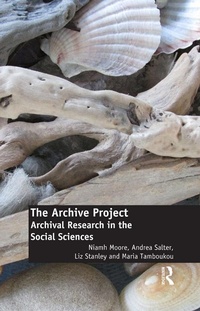
The Archive Project
Archival Research in the Social Sciences
Published on 28. July 2016
210 pages
978-1-317-04462-8 (ISBN)
Description

Recent scholarship on archival research has raised questions concerning the character and impact of 'the archive' on how the traces of the past are researched, the use and analysis of different kinds of archived data, methodological approaches to the practicalities involved, and what kind of theory is drawn on and contributed to by such research. The Archive Project: Archival Research in the Social Sciences builds on these questions, exploring key methodological ideas and debates and engaging in detail with a wide range of archival projects and practices, in order to put to use important theoretical ideas that shed light on the methods involved.
Offering an overview of the current 'state of the field' and written by four authors with extensive experience in conducting research in and creating archives around the world, it demonstrates the different ways in which archival methodology, practice and theory can be employed. It also shows how the ideas and approaches detailed in the book can be put into practice by other researchers, working on different kinds of archives and collections. The volume engages with crucial questions, including: What is 'an archive' and how does it come into existence? Why do archival research and how is it done? How can sense be made of the scale and scope of collections and archives? What are the best ways to analyse the traces of the past that remain? What are helpful criteria for evaluating the knowledge claims produced by archival research? What is the importance of community archives? How has the digital turn changed the way in which archival research is carried out? What role is played by the questions that researchers bring into an archive? How do we deal with unexpected encounters in the archive?
A rigorous and accessible examination of the methods and choices that shape research 'on the ground' and the ways in which theory, practice and methodology inform one another, this book will appeal to scholars across the social sciences and humanities with interests in archival and documentary research.
Offering an overview of the current 'state of the field' and written by four authors with extensive experience in conducting research in and creating archives around the world, it demonstrates the different ways in which archival methodology, practice and theory can be employed. It also shows how the ideas and approaches detailed in the book can be put into practice by other researchers, working on different kinds of archives and collections. The volume engages with crucial questions, including: What is 'an archive' and how does it come into existence? Why do archival research and how is it done? How can sense be made of the scale and scope of collections and archives? What are the best ways to analyse the traces of the past that remain? What are helpful criteria for evaluating the knowledge claims produced by archival research? What is the importance of community archives? How has the digital turn changed the way in which archival research is carried out? What role is played by the questions that researchers bring into an archive? How do we deal with unexpected encounters in the archive?
A rigorous and accessible examination of the methods and choices that shape research 'on the ground' and the ways in which theory, practice and methodology inform one another, this book will appeal to scholars across the social sciences and humanities with interests in archival and documentary research.
Reviews / Votes
'Social science researchers have been turning to archival work but there has been little in the way of discussion about what they are doing and why. This excellent book fills that gap. It combines intellectual engagement with accessibility, and practical discussion of working in archives, by four authors who convey their grasp of and enthusiasm for the endeavour. Whether you are experienced at archival research or new to it, you will gain a lot from reading The Archive Project.'Rosalind Edwards, University of Southampton, UK
More details
Language
English
Place of publication
London
United Kingdom
Publishing group
Taylor & Francis Ltd
Target group
College/higher education
Illustrations
1 Tables, black and white; 1 Illustrations, black and white
File size
22,17 MB
ISBN-13
978-1-317-04462-8 (9781317044628)
Copyright in bibliographic data and cover images is held by Nielsen Book Services Limited or by the publishers or by their respective licensors: all rights reserved.
Schweitzer Classification
Other editions
Additional editions

Niamh Moore | Andrea Salter | Liz Stanley
The Archive Project
Archival Research in the Social Sciences
Book
07/2020
1st Edition
Routledge
€45.79
The article will not be published
Niamh Moore | Andrea Salter | Liz Stanley
The Archive Project
Archival Research in the Social Sciences
Book
06/2020
1st Edition
Routledge
€73.60
Shipment within 15-20 days
Niamh Moore | Andrea Salter | Liz Stanley
The Archive Project
Archival Research in the Social Sciences
Book
08/2016
1st Edition
Routledge
€231.50
Shipment within 10-20 days
Persons
Niamh Moore is a Chancellor's Fellow in Sociology at the University of Edinburgh, UK, with a background in interdisciplinary feminist studies. Her research includes work on ecofeminist activism (The Changing Nature of Ecofeminism: Telling Stories from Clayoquot Sound, UBC Press, 2015), the archiving and reuse of data, and community-based participatory research, including with community-food growing projects.
Andrea Salter is Research Facilitator for the Arts, Humanities and Social Sciences at the University of Cambridge, UK, and has held postdoctoral positions at UCL and the Universities of Cambridge and Edinburgh. With a background in sociology and human geography, she continues to research 'documents of life'. Publications include articles and also The World's Great Question: Olive Schreiner's South African Letters (Cape Town: VRS, 2014, with Liz Stanley).
Liz Stanley is Professor of Sociology and ESRC Professorial Research Fellow at the University of Edinburgh, UK. Her work focuses around conjunctions of theory, methodology and the past. Books include Breaking Out Again (with Sue Wise), The Auto/Biographical I, Mourning Becomes, Documents of Life Revisited, and The World's Great Question (with Andrea Salter). See http://www.sociology.ed.ac.uk/people/staff/stanley_liz
Maria Tamboukou is Professor of Feminist Studies at the University of East London, UK. Her research activity is in the areas of critical feminisms, auto/biographical narratives and studies in neo-materialism. Writing feminist genealogies is the central focus of her work. Recent publications include the monograph Sewing, Writing and Fighting: Radical Practices in Work, Politics and Culture.
Andrea Salter is Research Facilitator for the Arts, Humanities and Social Sciences at the University of Cambridge, UK, and has held postdoctoral positions at UCL and the Universities of Cambridge and Edinburgh. With a background in sociology and human geography, she continues to research 'documents of life'. Publications include articles and also The World's Great Question: Olive Schreiner's South African Letters (Cape Town: VRS, 2014, with Liz Stanley).
Liz Stanley is Professor of Sociology and ESRC Professorial Research Fellow at the University of Edinburgh, UK. Her work focuses around conjunctions of theory, methodology and the past. Books include Breaking Out Again (with Sue Wise), The Auto/Biographical I, Mourning Becomes, Documents of Life Revisited, and The World's Great Question (with Andrea Salter). See http://www.sociology.ed.ac.uk/people/staff/stanley_liz
Maria Tamboukou is Professor of Feminist Studies at the University of East London, UK. Her research activity is in the areas of critical feminisms, auto/biographical narratives and studies in neo-materialism. Writing feminist genealogies is the central focus of her work. Recent publications include the monograph Sewing, Writing and Fighting: Radical Practices in Work, Politics and Culture.
Content
About the Authors
Prologue
1. In Other Archives and Beyond
Interlude
2. Archival Methodology Inside the Black Box: Noise in the Archive! (Liz Stanley)
Interlude
3. Archival Rhythms: Narrativity in the Archive (Maria Tamboukou)
Interlude
4. Reading Time Backwards? Archival Research and Temporal Order, (Andrea Salter)
Interlude
5. Weaving Archival Imaginaries: Researching Community Archives, (Niamh Moore)
Interlude
6. The Beginning in the Ending: Reassembling Archival Practices
Epilogue
References
Index
Prologue
1. In Other Archives and Beyond
Interlude
2. Archival Methodology Inside the Black Box: Noise in the Archive! (Liz Stanley)
Interlude
3. Archival Rhythms: Narrativity in the Archive (Maria Tamboukou)
Interlude
4. Reading Time Backwards? Archival Research and Temporal Order, (Andrea Salter)
Interlude
5. Weaving Archival Imaginaries: Researching Community Archives, (Niamh Moore)
Interlude
6. The Beginning in the Ending: Reassembling Archival Practices
Epilogue
References
Index
