

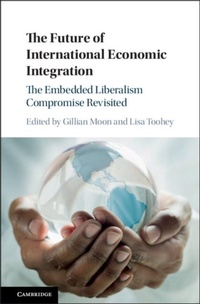
The Future of International Economic Integration
The Embedded Liberalism Compromise Revisited
Published on 17. September 2018
270 pages
978-1-108-24702-3 (ISBN)
Description

As part of the 1947 General Agreement on Tariffs and Trade (GATT), a compromise on domestic socio-economic issues was struck and subsequently given the name 'embedded liberalism'. The Future of International Economic Integration explores the multiple dimensions of the embedded liberalism compromise, to understand its contemporary influence on both the scope and application of international trade law, and on the content and character of parallel domestic socio-economic policy space. Top international economic law scholars have contributed chapters that look at the four principal dimensions of the topic. It sets out the history and character of the embedded liberalism compromise, explores the relationship between the compromise and WTO law, explores areas of contemporary tension that invoke the principles of the compromise such as human rights, cultural diversity, and environmental protection, and investigates what future impact the compromise might have on new trade and investment agreements.
Reviews / Votes
'This excellent volume does much more than excavate the underlying principles of the post-World War II international trade regime. It also demonstrates precisely how these principles went askew in the most recent wave of globalisation. Most importantly, it addresses how deep reflection on the principles can offer insights into ways of strengthening the fragile 'system' of global economic governance today.' John Gerard Ruggie, Berthold Beitz Professor in Human Rights and International Affairs, John F. Kennedy School of Government, Massachusetts 'This is an excellent set of essays on the continuing vitality of some of the architectural assumptions in the design of modern international economic law. The essays cover numerous issues including trade, investment, food security, cultural sensibilities, human rights, and the workplace.' Steve Charnovitz, George Washington University Law School, Washington DC 'There is a pressing need for sustained and thoughtful discussion about how the international economic system can best serve the interests of a wide range of social and human rights issues and maintain the necessary balance between economic openness and domestic socio-economic stability. This book provides an insightful contribution to that debate in curating the work of some of international economic law's innovative and leading academics, and offers a much needed perspective and way forward for international economic law in testing times.' Gabrielle Marceau, University of Geneva, President of SIEL and Senior Counsellor, WTO Legal Affairs Division 'History is full of ironies; we live in a time when the rule of law and embedded liberalism is under threat from policymakers in two of the countries that designed the longstanding mix of domestic and international trade policies that has kept economic peace and stimulated economic growth. This important edited volume by Professors Gillian Moon and Lisa Toohey rethinks the embedded liberalism concept and reminds us why it deserves both our understanding and support today.' Susan Aaronson, George Washington University, Washington DC, and Senior Fellow, Centre for International Governance InnovationMore details
Language
English
Place of publication
Cambridge
United Kingdom
Target group
Professional and scholarly
Illustrations
Worked examples or Exercises; 1 Tables, black and white
File size
0,00 MB
ISBN-13
978-1-108-24702-3 (9781108247023)
Copyright in bibliographic data and cover images is held by Nielsen Book Services Limited or by the publishers or by their respective licensors: all rights reserved.
Schweitzer Classification
Other editions
Additional editions
Gillian Moon | Lisa Toohey
The Future of International Economic Integration
The Embedded Liberalism Compromise Revisited
Book
09/2018
Cambridge University Press
€162.19
No shipping information available
Persons
Gillian Moon is Senior Visiting Fellow in the School of Law at the University of New South Wales and at the Australian Human Rights Institute. She specialises in intersections between human rights law, international economic law and development, and the impact of international trade law and foreign investment rules on human rights, equality and development. She has published in leading journals, including Human Rights Law Quarterly, Nordic Journal of International Law, Journal of International Economic Law and Journal of World Trade. Lisa Toohey is Professor of Law at the University of Newcastle, New South Wales. Her research on trade law has been published in a variety of leading journals, including International and Comparative Law Quarterly, The Chinese Journal of Comparative Law and the Leiden Journal of International Law. She is a Senior Fellow of the Institute of International Economic Law at Georgetown University and an Adjunct Professor of the University of New South Wales, Sydney.
Content
Contributor biographies; Foreword Andrew Lang; Preface; List of acronyms; Part I. The Concept of the Embedded Liberalism Compromise: 1. Introduction to the embedded liberalism compromise Gillian Moon and Lisa Toohey; 2. The embedded liberalism compromise in the making of the GATT and Uruguay Round Agreements Meredith Kolsky Lewis; 3. The embedded liberalism compromise as touchstone in times of political turmoil Lisa Toohey; 4. Universal human rights in the embedded liberalism compromise Gillian Moon; 5. Recalibrating the embedded liberalism compromise: 'legitimate expectations' and international economic law Chios Carmody; Part II. The Dynamic of the Embedded Liberalism Compromise: 6. From agriculture to food security: embedded liberalism and stories of regulatory failure Fiona Smith; 7. Embedded liberalism and national treatment: the case of Taiwan's Mijiu taxation Hsu-Hua Chou and Weihuan Zhou; 8. Embedded liberalism and international investment agreements: the future of the right to regulate, with reflections on WTO law Catharine Titi; 9. Regulatory coherence in future free trade agreements and the idea of the embedded liberalism compromise Andrew D. Mitchell and Elizabeth Sheargold; Part III. Engineering the Embedded Liberalism Compromise: Addressing the Future in Times of Turmoil: 10. Embedded liberalism as a framework for description, critique and advocacy: the case of human rights measures under the GATT Rachel Harris; 11. Embedded liberalism and global business: domestic stability versus corporate autonomy? Justine Nolan and Gillian Moon; 12. The embedded liberalism compromise and cultural policy measures. Maintaining cultural diversity alongside WTO law Franziska Sucker; 13. The WTO's purpose, regulatory autonomy and the future of the embedded liberalism compromise Emily Reid.
