

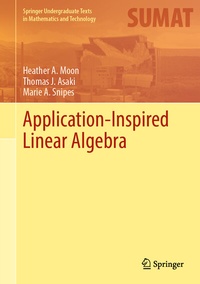
Application-Inspired Linear Algebra
Description

This textbook invites students to discover abstract ideas in linear algebra within the context of applications. Diffusion welding and radiography, the two central applications, are introduced early on and used throughout to frame the practical uses of important linear algebra concepts. Students will learn these methods through explorations, which involve making conjectures and answering open-ended questions. By approaching the subject in this way, new avenues for learning the material emerge: For example, vector spaces are introduced early as the appropriate setting for the applied problems covered; and an alternative, determinant-free method for computing eigenvalues is also illustrated. In addition to the two main applications, the authors also describe possible pathways to other applications, which fall into three main areas: Data and image analysis (including machine learning); dynamical modeling; and optimization and optimal design. Several appendices are included as well, oneof which offers an insightful walkthrough of proof techniques. Instructors will also find an outline for how to use the book in a course. Additional resources can be accessed on the authors' website, including code, data sets, and other helpful material. Application-Inspired Linear Algebra will motivate and immerse undergraduate students taking a first course in linear algebra, and will provide instructors with an indispensable, application-first approach.
More details
Other editions
Additional editions
Persons
Heather A. Moon received her PhD in Mathematics at Washington State University. She spent 8 years as an Assistant/Associate Professor of Mathematics at liberal arts colleges, where she mentored numerous undergraduate research projects in data and image analysis. Currently, she is pursuing her scientific interests, in the doctoral program in Physics at Washington State University, where she is excited to use her expertise in mathematics and data and image analysis to study the world around us.
Thomas J. Asaki
received his Ph.D. in Physics at Washington State University. He spent 13 years as a postdoc and technical staff member at Los Alamos National Laboratory exploring inverse problems, image and data analysis methods, nondestructive acoustic testing and related optimization problems. He is currently an Associate Professor in the Department of Mathematics and Statistics at Washington State University where, since 2008, he has enjoyed continuing research and helping students discover richness in applied mathematics.
Marie Snipes received her Ph.D. in Mathematics from the University of Michigan. Prior to her doctoral studies, she spent four years in the US Air Force as a data analyst. She is currently an Associate Professor of Mathematics at Kenyon College, where she regularly teaches inquiry-based courses and mentors undergraduate research projects. Her research interests include geometric function theory, analysis in metric spaces, and applications of these areas to data problems.
The authors are co-creators of the IMAGEMath Project (www.imagemath.org), bringing image and data applications (of calculus of variations, PDE's, and linear algebra) into the undergraduate curriculum.
