

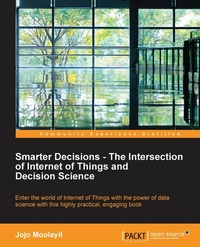
Smarter Decisions - The Intersection of Internet of Things and Decision Science
Description

Key Features
[*]Explore real-world use cases from the Internet of Things (IoT) domain using decision science with this easy-to-follow, practical book
[*]Learn to make smarter decisions on top of your IoT solutions so that your IoT is smart in a real sense
[*]This highly practical, example-rich guide fills the gap between your knowledge of data science and IoT
Book DescriptionWith an increasing number of devices getting connected to the Internet, massive amounts of data are being generated that can be used for analysis. This book helps you to understand Internet of Things in depth and decision science, and solve business use cases. With IoT, the frequency and impact of the problem is huge. Addressing a problem with such a huge impact requires a very structured approach. The entire journey of addressing the problem by defining it, designing the solution, and executing it using decision science is articulated in this book through engaging and easy-to-understand business use cases. You will get a detailed understanding of IoT, decision science, and the art of solving a business problem in IoT through decision science. By the end of this book, you'll have an understanding of the complex aspects of decision making in IoT and will be able to take that knowledge with you onto whatever project calls for it What you will learn
[*]Explore decision science with respect to IoT
[*]Get to know the end to end analytics stack - Descriptive + Inquisitive + Predictive + Prescriptive
[*]Solve problems in IoT connected assets and connected operations
[*]Design and solve real-life IoT business use cases using cutting edge machine learning techniques
[*]Synthesize and assimilate results to form the perfect story for a business
[*]Master the art of problem solving when IoT meets decision science using a variety of statistical and machine learning techniques along with hands on tasks in R
Who this book is forIf you have a basic programming experience with R and want to solve business use cases in IoT using decision science then this book is for you. Even if your're a non-technical manager anchoring IoT projects, you can skip the code and still benefit from the book.
All prices
More details
Other editions
Additional editions
Person
Jojo Moolayil is an arti?cial intelligence, deep learning, machine learning, and decision science professional with over six years of industrial experience. He is the author of Learn Keras for Deep Neural Networks, published by Apress, and Smarter Decisions - The Intersection of IoT and Decision Science, published by Packt Publishing. He has worked with several industry leaders on high-impact, critical data science and machine learning projects across multiple verticals. He is currently associated with Amazon Web Services as a research scientist in Canada. Apart from writing books on AI, decision science, and the internet of things, Jojo has been a technical reviewer for various books in the same ?elds published by Apress and Packt Publishing.
Content
IoT and Decision Science
Studying the IoT problem universe and Designing a Use case
Experimenting Predictive Analytics
Machine Learning for Predictive Analytics
Fast track Decision Science
Prescriptive Science & Decision Making
Disruptions in IoT
A promising future
Digging deeper into the logical stack of IoT
Now that we have a clear understanding of what is IoT and the similar terms around it, lets understand the ecosystem better. For convenience, IoE will be referred as IoT while exploring the four logical components of the stack in brief.
IoTs logical stack
When we deconstruct the IoT ecosystem into logical units, we have People, Processes, Data, and Things. Lets explore each of these components in brief.
People
People or we interact with devices and other people on a daily basis. The communication could be either People to People, People to Device, or Device to People. Considering People as a separate dimension in the IoT ecosystem is an essential move as the complexity in understanding this is really challenging. When any form of communication occurs where People play a role on either end of the interaction, it embeds a unique pattern that is intrinsic to the People dimension. Lets understand this better with an example. Most of us use social networking sites such as Facebook, Twitter, LinkedIn, and so on, where we are connected to multiple people/friends. Here, the communication paths are mainly People to People. Considering the previous example, we had people to device and device to people communication paths (communication between the smartphone and microwave). Considering People as a dimension, everyone would differ in the way they interact with the system. I might find the new interface of Facebook very difficult to use but a friend may find it extremely easy. The real problem here is everyone is skilled, but the skillsets differ from person to person. The characteristics of the interaction identified by a person may be a representative for a very small community.
We have a population of six billion plus, and over 1/6th of them have already been connected. With such a huge population consisting of a plethora of communities representing people of different geographical areas, culture, thinking, and behavior, defining one generic set of rules or characteristics to define people interaction is very challenging. Instead, if we understand the People dimension in a more constructive way, we can tap the opportunity to capture the behavior more accurately and help them benefit from the ecosystem in the best way.
With the advent of IoT, we have sensors capturing information and characteristics at more granular levels than ever before. Here, if we can accurately define People as a complete dimension, personalized experience will be a complete game changer. The smart watch industry is investing humongous efforts to get its offering more personalized; if it succeeds, it will be a pivotal player in the coming revolution.
Processes
The most lucid definition for Processes would be everything required to deliver the right information to the right person/system at the right time. A wide variety of things fall in the Processes dimension that includes technology, protocols, business logic, communication infrastructure, and so on. Broadly, they can be classified into two components-Technology and Business Processes. Lets explore these two components in brief in order to understand the Processes dimension in more detail.
Technology
The technology required in the Processes dimension of IoT comprises of the software, protocol, and infrastructure. We will explore Technology by understanding its three broad divisions for Processes.
Software
Software consists mainly of the operating system. Devices in IoT require a special kind of an operating device. Smart devices such as the smart refrigerator, smart microwave, and many others require an operating system running on them that can then enable it to be an active component in the network. Tasks executed can vary from sending, processing, and receiving data or executing instructions and sending signals to respective controllers within the device for action. Now, the question is, why do these devices require a special operating system? Why cant the existing rich flavors of Unix/Linux, Windows, Mac, or even Android be used? The answer is the same as the reason that we used Android for smartphones and not the existing OS back then. The devices that connect to the network in IoT are small or sometimes tiny. Ideally, these devices would be equipped with less powerful computing capabilities, lower memory, and lower battery life. It is almost impossible to run a fully-fledged operating system on them. We need a specially designed OS that can take care of the limited memory, processing power and battery life of the device and yet provide maximum functionality to tag the device as a smart device. Google recently launched an operating system for IoT devices called Brillo. Brillo is an Android-based embedded operating system specifically designed for low power and memory-constrained IoT devices. It provides the core platform services required for IoT devices along with a developer kit freely available for developers/hardware vendors to get the OS running and build additional services on their devices. Some similar examples would be Apple's Watch OS for Apple Watch, Android Wear from Google for smartwatches, and others. Soon, we can expect a vast community of devices running Brillo and a plethora of apps that can be installed additionally for even better functionality (something very similar to the Google Play store).
Protocol
Once the devices are software-enabled, we need to get a protocol in place that can help them communicate with other heterogeneous devices in the network. To understand this better, recollect the first example where we could defrost the refrigerator using our smartphone. The smartphone needs to talk to the refrigerator that also needs to understand what exactly is being communicated. With a huge variety of heterogonous devices, this communication path just gets more and more complicated. Hence, we need to have a simplified protocol in place where complicated process can be abstracted and the devices can communicate with each other effectively. Google recently launched an open source protocol called Weave. Weave is basically an IoT protocol that is a communications platform for IoT devices that enables device setup, phone-to-device-to-cloud communication, and user interaction from mobile devices and the web. It has ushered productivity in the developers efforts by easing up device interoperability regardless of the brand or manufacturer.
Infrastructure
Infrastructure can simply be defined as the integration of the operating system, communication protocol, and all other necessary components to harmonize the environment for an IoT use case. All major cloud infrastructure providers are now focusing on providing an IoT-specialized environment. Google launched IoT Cloud Solutions, Amazon launched AWS IoT, Microsoft launched Azure IoT Suite, and so on. All of these solutions integrate the disparate systems together to make the ecosystem scalable and agile. Digging deeper into these suites will be beyond the scope of this book.
Business processes
The second part of the Processes dimension is Business Processes. It basically covers the set of rules and processes to govern the communication and operation of the devices connected in the IoT ecosystem. There isn't a concrete definition till now that can be used here and the discussion of the topic will be beyond the scope of this book. However, we will take a look at this closely while solving an IoT use case in Chapter 3, The What And Why - Using Exploratory Decision Science for IoT and Chapter 4, Experimenting Predictive Analytics for IoT.
Things
Things form the crux of the IoT ecosystem. They include any form of sensors, actuators, or other type of devices that can be integrated into machines and devices to help them connect to the Internet and communicate with other devices and machines. These things will be always active during their lifetime and will sense events, capture important information, and communicate them with other devices.
A typical example would be the refrigerator, TV, or microwave that we considered in the previous use case. The sensors installed in these devices capture data and send information/signals to other devices that can then be used to take action.
Data
Data is by all means the most value-adding dimension in the IoT ecosystem. Today, the devices that are connected to the Internet are capturing tons and tons of data that can represent the most granular-level details for the devices they are connected to. The magnitude of this data is colossal. Storing and processing such vast and varied amounts of data questions the fact whether the data is really valuable. In a true sense, most of the data is transient in nature and loses its value within minutes of generation. With ever-improving technology and computing capabilities, the amount of...

