

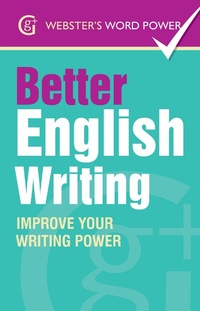
Webster's Word Power Better English Writing
Improve Your Writing Power
Published on 31. August 2014
384 pages
978-1-84205-787-2 (ISBN)
Description

Effective, written work that people want to read, and remember, stands out. This book will help you write emails, a CV, a thesis, report, essay or novel. This book shows you to how to attack the piece of writing, from planning to effective communication so people will remember your work and want to come back to it.
More details
Other editions
Additional editions
Book
04/2014
Geddes & Grosset
€9.00
Shipment within 3-4 weeks
Content
- Cover Page
- Title Page
- CONTENTS
- BETTER WRITING FOR EVERY DAY
- INTRODUCTION
- PLAIN ENGLISH
- What is plain English and why is it important?
- How to apply plain English to your writing
- Think ahead - plan and structure your writing
- Talk directly to your reader - use 'you' and 'we'
- Use simple, straightforward words
- Words and phrases to avoid
- Keep sentences and paragraphs short and concise
- Use lists to help you manage information
- Be active, not passive
- When passive can be useful
- Avoid nominalisation
- Tell it like it is!
- Examples of plain English and not-so-plain English
- Before
- After
- Before
- After
- Before
- After
- REVISING AND EDITING YOUR WRITING
- Why it's essential to revise and edit your writing
- Leave it and go back to it
- Revise the big picture
- Edit the detail
- AutoCorrect, spellcheckers, grammar checkers and Google Translate - use with caution
- WRITING FOR LEARNING
- INTRODUCTION
- RESEARCH SKILLS
- What information are you looking for?
- Where can you find that information?
- Organising your information
- Acknowledging sources/copyright
- References
- Main text
- Bibliography
- Beware of cut and paste and plagiarism
- ESSAYS
- The process of writing an essay
- Planning your essay
- Structuring your essay
- Writing the introduction
- Developing the argument
- Writing the conclusion
- THESES/DISSERTATIONS
- The process of writing a thesis
- Planning your thesis
- Structuring your thesis
- Sections within the structure
- Title page
- Abstract
- Acknowledgements
- Contents page (can also include lists of tables, illustrations and figures)
- Introduction
- The literature review
- Materials and methods
- Results/Findings
- Discussion
- Conclusions
- References
- Appendices
- WRITING FOR WORK OR BUSINESS
- INTRODUCTION
- APPLYING FOR A JOB
- How to write an effective CV
- Personal details
- Education and qualifications
- Work experience
- Further information
- Interests
- Referees
- Example of a CV
- How to write an effective covering letter
- Role of the covering letter
- Do your research before you write
- Format
- Date
- Address
- Greeting
- Headings
- Main body of the letter
- Ending
- Enclosures
- Example of a covering letter for a job application
- How to write a reference
- Greeting
- Main body of the letter
- Conclusion
- Example of a reference
- Presentations
- EMAILS AND TEXTING IN THE WORKPLACE
- General approach
- Style and tone
- Text-speak?
- Good practice
- EMAILS AND LETTERS
- General approach
- Style and tone
- House style
- Good practice
- Writing emails to customers
- Example of an email to a customer
- Writing letters to customers
- Example of a letter to a customer
- REPORTS
- The process of writing a report
- Planning your report
- Structuring your report
- Sections within the structure
- Title page
- Contents page
- Executive summary
- Introduction
- Findings
- Summary and conclusions
- Recommendations
- Appendix
- Staying relevant, objective and factual
- PRESENTATIONS
- Planning a presentation
- Purpose
- Audience
- Venue
- Remit
- Structuring a presentation
- Introduction
- Main points
- Conclusion
- Delivering an effective presentation
- Remember that practice makes perfect
- Use body language
- Use your voice
- Breathe!
- Be enthusiastic and energetic
- Be prepared!
- What type of visual aid?
- Flipchart
- Handout
- OHP
- PowerPoint
- Video
- Whiteboard
- Example of a PowerPoint presentation
- MARKETING AND PROMOTIONAL WRITING
- General approach
- Audience
- Style and tone
- Call to action
- Writing brochures/leaflets
- Example of a leaflet
- Writing for websites
- Presenting information
- Writing content
- Plain English
- BBC
- The Guardian
- WWF's Earth Hour
- Social media
- WRITING ANNOUNCEMENTS
- General approach
- Get your facts correct
- Presentation style
- Beginning: tell the news straight away
- Middle: develop the news
- End: looking forward and being positive
- Style and tone
- Example of an announcement
- How to announce good news
- Example of how to announce good news
- How to announce bad news
- Example of how to announce bad news
- Writing for the Media
- INTRODUCTION
- WHAT'S UNIQUE ABOUT WRITING FOR THE MEDIA?
- The five Ws and an H
- Example of 'five Ws and an H'
- Media style
- Example of two openings
- Interviewing techniques
- Do your research
- Plan and structure
- Establish a rapport
- Ask open-ended questions
- House style
- Example of house style
- Preferred dictionary
- Addresses, ages, dates and numbers
- Collective nouns
- Hyphens and en rules
- Abbreviations, titles, capital letters and royalty
- Fonts and layouts
- Style of language
- Spin
- DIFFERENT MEDIA, DIFFERENT STYLES
- Newspapers
- Tabloids and broadsheets
- Examples of tabloid and broadsheet headlines
- Tabloid headline
- Broadsheet headline
- Examples of tabloid and broadsheet report approach
- Tabloid news report approach
- Broadsheet news report approach
- Structure and style
- Magazines
- News features
- Profiles
- Lifestyle features
- Consumer features
- Question and answer
- Specialist features
- Structure and style
- Example of a feature profile
- Ezines
- Research
- Write your article
- Resource box
- Developing your own ezine
- Example of an ezine
- Newsletters
- Blogs
- Why do you want to blog?
- How to set up a blog
- Writing a blog
- Examples of blogs
- Reviews
- What is the target audience/market?
- Include basic information
- Don't give away too much
- Example of a review
- ACKNOWLEDGING SOURCES/COPYRIGHT
- Writing Creatively
- INTRODUCTION
- FICTION
- Short stories
- Impactful opening
- Introduction of main character(s)
- Introduction of setting
- Problem/conflict introduced and developed
- Problem/conflict develops to a climax
- Effect of this climax on the character
- Resolution
- Novels
- WRITING YOUR OWN FICTION COMPOSITION
- Setting
- Plot
- Exposition
- Conflict
- Rising action
- Climax
- Falling action
- Resolution
- Narrator/voice
- Dialogue
- Characters
- Elizabeth
- Darcy
- Jane
- Bingley
- Wickham
- Mrs Bennet
- Mr Bennet
- Mr Collins
- Lady Catherine de Bourgh
- Themes
- Pride
- Prejudice
- Love and marriage
- Reputation
- Class and social standing
- A good beginning and a good end
- The writing process - fiction
- First lines
- Setting the scene
- Prompts
- NON-FICTION
- Biographies
- Examples from two different biographies
- Travel
- Travel articles
- Examples of a travel article
- Example of literary travel writing
- Travel guides
- Example of a travel guide
- Cookery
- Theme
- Structure
- Two examples of recipe structure
- Photographs
- Writing recipes
- Example of recipe writing
- Introductions and other content
- Technical writing
- End-user documents
- Examples of end-user documents
- Traditional technical writing
- Example of traditional technical writing
- Technological marketing material
- 'How to' writing
- Examples of 'how to' writing
- Reference works
- Dictionary
- Example of how to use a dictionary
- Other types of dictionaries
- Thesaurus
- Example of a thesaurus
- Encyclopedia
- Atlas
- Directory
- Reference for writers
- Writers' and Artists' Yearbook
- Rhyming dictionary
- Grammar books
- Emotional thesaurus
- Names books
- Inspirational books
- Quotations books
- WRITING YOUR OWN NON-FICTION COMPOSITION
- Research
- What information are you looking for?
- Where can you find that information?
- Accuracy
- Organising your information
- Acknowledging sources/copyright
- References
- Beware cut and paste and plagiarism!
- Style and tone
- Planning your composition
- Structuring your composition
- Biography
- Recipe collection
- Operating instructions for a communication camera
- Staying relevant, objective and factual
- The writing process - non-fiction
- KEEP READING AND WRITING
- KEEP READING
- Newspapers
- Magazines and ezines
- Fiction
- Non-fiction
- Textbooks and 'how to' materials
- Blogs
- Newsletters
- KEEP WRITING
- Diary
- Blog
- Letters and cards
- Essays and compositions
- Newspapers
- Magazines and ezines
- Good luck and keep writing!
- REFERENCES
- Better writing for every day
- Writing for learning
- Writing for work or business
- Writing for the media
- Writing creatively
- Copyright
- OTHER TITLES IN THIS SERIES
- Back Cover
