

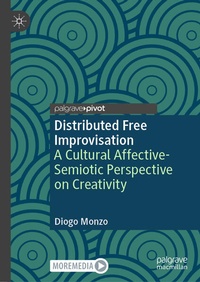
Distributed Free Improvisation
Description

This book presents a new model to visualize and understand the creative process in free improvisation: the Interactive Dimensions of the Creative Flow (IDCF). Drawing on theoretical work on distributed creativity and the author's background as a professional pianist, this short monograph establishes provocative dialogues between the field of music and the cultural psychology of semiotic dynamics to investigate human interactions involved in the act of creating.
New empirical data and literature research on improvisation are used to discuss the historical and sociocultural factors behind collective and collaborative processes. In this context, the Distributed Free Improvisation Model offers a new theoretical and methodological innovation to the study of musical improvisation, which is presented as the result of a musical practice that develops in a community, in sociocultural contexts, through multiple interactions from which the senses and meanings of what is produced emerge. An inspiring read for students, professionals, and researchers in the field of cultural psychology, music improvisation, and creativity studies, this book opens new pathways to the study of creative processes and affective semiosis.
Reviews / Votes
"This book is filled with music-while it gives the World a new theoretical model for artistic creativity. It is a long-awaited inter-disciplinary synthesis of music, semiotics, and cultural psychology." (Jaan Valsiner, Founding Editor, "Culture & Psychology")
"This book is a major contribution to the field of creativity and musical investigation. An innovative meeting of different fields of knowledge that has much to teach musicians and psychologists." (Mônica Souza Neves-Pereira, University of Brasília - UnB, Brasil)
"This book opens a potentially exciting and transformative approach to investigating and analyzing this fundamental ability to navigate external stimuli in the flow of activity, and will interest researchers, practitioners, and a diverse general public." (Clifford Hill Korman, Federal University of the State of Rio de Janeiro - UNIRIO, Brasil)
More details
Other editions
Additional editions
Person
Diogo Monzo is doing a post-doctorate internship at the Institute of Psychology of the University of Brasília, Brazil. He is a recording artist with a career in popular music and musical improvisation.
Content
Chapter 1. Conceptualizing the Proposal.- Chapter 2. The Accordion Bellows Metaphor.- Chapter 3. The Cultural Semiotic Subject.- Chapter 4. Affective-Semiotic Self-Regulation.- Chapter 5.The Tension of Idiosyncrasies.- Chapter 6. The Experimentation Process.- Chapter 7. The Emergence of the New.- Chapter8. Feedback.- 9.Conclusion.
