

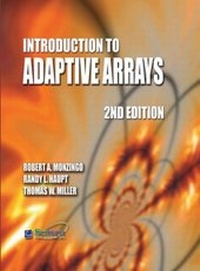
Introduction to Adaptive Arrays
2nd Edition
Published on 14. May 2014
544 pages
978-1-61353-113-6 (ISBN)
Description

This second edition is an extensive modernization of the bestselling introduction to the subject of adaptive array sensor systems. With the number of applications of adaptive array sensor systems growing each year, this look at the principles and fundamental techniques that are critical to these systems is more important than ever before.
Introduction to Adaptive Arrays, 2nd Edition is organized as a tutorial, taking the reader by the hand and leading them through the maze of jargon that often surrounds this highly technical subject. It is easy to read and easy to follow, as fundamental concepts are introduced with examples before more current developments and techniques are introduced.
Problems at the end of each chapter serve both instructors and professional readers by illustrating and extending the material presented in the text. Both students and practicing engineers will easily gain familiarity with the modern contribution that adaptive arrays have to offer practical signal reception systems.
Introduction to Adaptive Arrays, 2nd Edition is organized as a tutorial, taking the reader by the hand and leading them through the maze of jargon that often surrounds this highly technical subject. It is easy to read and easy to follow, as fundamental concepts are introduced with examples before more current developments and techniques are introduced.
Problems at the end of each chapter serve both instructors and professional readers by illustrating and extending the material presented in the text. Both students and practicing engineers will easily gain familiarity with the modern contribution that adaptive arrays have to offer practical signal reception systems.
More details
Series
Edition
2nd edition
Language
English
Place of publication
NY
United States
Target group
College/higher education
Professional and scholarly
ISBN-13
978-1-61353-113-6 (9781613531136)
Copyright in bibliographic data and cover images is held by Nielsen Book Services Limited or by the publishers or by their respective licensors: all rights reserved.
Schweitzer Classification
Other editions
Additional editions
Robert A. Monzingo | Randy L. Haupt | Thomas W. Miller
Introduction to Adaptive Arrays
Book
06/2011
2nd Edition
SciTech Publishing Inc
€171.50
Shipment within 3-4 weeks
Persons
Robert Monzingo received the B.S.E.E. degree from Stanford University, the M.S.E.E. degree from the University of Arizona, and the Sc.D. degree from Washington University, St. Louis. He has been active in the areas of automatic control, radar, and communications for many years and is presently associated with the Aerospace Corporation in El Segundo, CA as a Senior Engineering Specialist where he is engaged in work on adaptive arrays, GPS systems, and satellite communication systems.
Randy Haupt is a Fellow of the IEEE and Applied Computational Electromagnetics Society (ACES) and is a Senior Scientist at the Penn State Applied Research Lab. From 1999-2003 he was Professor and Department Head of ECE at Utah State University. He also was a Professor of EE at the Air Force Academy and the University of Nevada-Reno. He is a retired Lt. Col. from the US Air Force. He has many journal articles, conference publications, and book chapters to his credit and is the author of Antenna Arrays: A Computational Approach by Wiley (2010).
Thomas Miller currently works for Raytheon Corporation where he has been cited for leadership in advanced early warning surveillance radar and adaptive signal processing. He is the author and coauthor of multiple journal articles as well as contributor to several books.
Randy Haupt is a Fellow of the IEEE and Applied Computational Electromagnetics Society (ACES) and is a Senior Scientist at the Penn State Applied Research Lab. From 1999-2003 he was Professor and Department Head of ECE at Utah State University. He also was a Professor of EE at the Air Force Academy and the University of Nevada-Reno. He is a retired Lt. Col. from the US Air Force. He has many journal articles, conference publications, and book chapters to his credit and is the author of Antenna Arrays: A Computational Approach by Wiley (2010).
Thomas Miller currently works for Raytheon Corporation where he has been cited for leadership in advanced early warning surveillance radar and adaptive signal processing. He is the author and coauthor of multiple journal articles as well as contributor to several books.
Content
Part I: Adaptive Array Fundamental Principles: System Uses, System Elements, Basic Concepts, and Optimum Array Processing
Chapter 1: Introduction
Chapter 2: Adaptive Array Concept
Chapter 3: Optimum Array Processing
Part II: Adaptive Algorithms
Chapter 4: Gradient-Based Algorithms
Chapter 5: Direct Inversion of the Sample Covariance Matrix
Chapter 6: Recursive Methods for Adaptive Array Processing
Chapter 7: Cascade Preprocessors
Chapter 8: Random Search Algorithms
Chapter 9: Adaptive Algorithm Performance Summary
Part III: Advanced Topics
Chapter 10: Compensation of Adaptive Arrays
Chapter 11: Direction of Arrival Estimation and Related Topics
Chapter 12: Recent Developments in Adaptive Arrays
Appendices
Chapter 1: Introduction
Chapter 2: Adaptive Array Concept
Chapter 3: Optimum Array Processing
Part II: Adaptive Algorithms
Chapter 4: Gradient-Based Algorithms
Chapter 5: Direct Inversion of the Sample Covariance Matrix
Chapter 6: Recursive Methods for Adaptive Array Processing
Chapter 7: Cascade Preprocessors
Chapter 8: Random Search Algorithms
Chapter 9: Adaptive Algorithm Performance Summary
Part III: Advanced Topics
Chapter 10: Compensation of Adaptive Arrays
Chapter 11: Direction of Arrival Estimation and Related Topics
Chapter 12: Recent Developments in Adaptive Arrays
Appendices
