

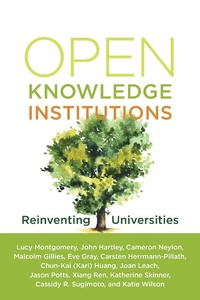
Open Knowledge Institutions
Reinventing Universities
Published on 3. August 2021
176 pages
978-0-262-36516-1 (ISBN)
Description

The future of the university as an open knowledge institution that institutionalizes diversity and contributes to a common resource of knowledge: a manifesto.
In this book, a diverse group of authors-including open access pioneers, science communicators, scholars, researchers, and university administrators-offer a bold proposition: universities should become open knowledge institutions, acting with principles of openness at their center and working across boundaries and with broad communities to generate shared knowledge resources for the benefit of humanity. Calling on universities to adopt transparent protocols for the creation, use, and governance of these resources, the authors draw on cutting-edge theoretical work, offer real-world case studies, and outline ways to assess universities' attempts to achieve openness.
Digital technologies have already brought about dramatic changes in knowledge format and accessibility. The book describes further shifts that open knowledge institutions must make as they move away from closed processes for verifying expert knowledge and toward careful, mediated approaches to sharing it with wider publics. It examines these changes in terms of diversity, coordination, and communication; discusses policy principles that lay out paths for universities to become fully fledged open knowledge institutions; and suggests ways that openness can be introduced into existing rankings and metrics. Case studies-including Wikipedia, the Library Publishing Coalition, Creative Commons, and Open and Library Access-illustrate key processes.
In this book, a diverse group of authors-including open access pioneers, science communicators, scholars, researchers, and university administrators-offer a bold proposition: universities should become open knowledge institutions, acting with principles of openness at their center and working across boundaries and with broad communities to generate shared knowledge resources for the benefit of humanity. Calling on universities to adopt transparent protocols for the creation, use, and governance of these resources, the authors draw on cutting-edge theoretical work, offer real-world case studies, and outline ways to assess universities' attempts to achieve openness.
Digital technologies have already brought about dramatic changes in knowledge format and accessibility. The book describes further shifts that open knowledge institutions must make as they move away from closed processes for verifying expert knowledge and toward careful, mediated approaches to sharing it with wider publics. It examines these changes in terms of diversity, coordination, and communication; discusses policy principles that lay out paths for universities to become fully fledged open knowledge institutions; and suggests ways that openness can be introduced into existing rankings and metrics. Case studies-including Wikipedia, the Library Publishing Coalition, Creative Commons, and Open and Library Access-illustrate key processes.
More details
Other editions
Additional editions
Book
08/2021
MIT Press
€32.20
Article exhausted; check different version
Persons
Lucy Montgomery is Professor of Knowledge Innovation at Curtin University in Australia, where she leads the Innovation in Knowledge Communication research program at the Centre for Culture and Technology. John Hartley is John Curtin Distinguished Professor Emeritus at Curtin University and Visiting Professor at the London School of Economics and Political Science. Cameron Neylon is Professor of Research Communications, in the Centre for Culture and Technology at Curtin University, and Director of Knowledge Unlatched Research. Malcolm Gillies is Emeritus Professor at the Australian National University, and Visiting Professor at King's College London. Eve Gray is Senior Research Associate in the IP Unit at the University of Cape Town, South Africa. Carsten Herrmann-Pillath is Professor and Permanent Fellow at the Max Weber Centre for Advanced Social and Cultural Studies at University of Erfurt, Germany. Chun-Kai (Karl) Huang is a Senior Research Fellow (Data Scientist) in the Centre for Culture and Technology at Curtin University. Joan Leach is Professor and Director of the Australian National Centre for the Public Awareness of Science at the Australian National University. Jason Potts is Professor of Institutional Economics at RMIT University in Melbourne, Australia. Xiang Ren is an Academic Course Advisor and Senior Lecturer in the Australia-China Institute for Arts and Culture at Western Sydney University. Katherine Skinner is Director of the Educopia Institute in Atlanta.Cassidy R. Sugimoto is Professor of Informatics at the School of Informatics, Computing, and Engineering at Indiana University, Bloomington. Katie Wilson is Research Fellow in the Centre for Culture and Technology at Curtin University with the Curtin Open Knowledge Initiative project.
