

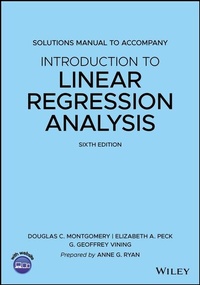
Introduction to Linear Regression Analysis, 6e Solutions Manual
Description

Introduction to Linear Regression Analysis, 6th Edition is the most comprehensive, fulsome, and current examination of the foundations of linear regression analysis. Fully updated in this new sixth edition, the distinguished authors have included new material on generalized regression techniques and new examples to help the reader understand retain the concepts taught in the book.
The new edition focuses on four key areas of improvement over the fifth edition:
* New exercises and data sets
* New material on generalized regression techniques
* The inclusion of JMP software in key areas
* Carefully condensing the text where possible
Introduction to Linear Regression Analysis skillfully blends theory and application in both the conventional and less common uses of regression analysis in today's cutting-edge scientific research. The text equips readers to understand the basic principles needed to apply regression model-building techniques in various fields of study, including engineering, management, and the health sciences.
More details
Other editions
Additional editions
Persons
DOUGLAS C. MONTGOMERY, PHD, is Regents Professor of Industrial Engineering and Statistics at Arizona State University. Dr. Montgomery is the co-author of several Wiley books including Introduction to Linear Regression Analysis, 5th Edition.
ELIZABETH A. PECK, PHD, is Logistics Modeling Specialist at the Coca-Cola Company in Atlanta, Georgia.
G. GEOFFREY VINING, PHD, is Professor in the Department of Statistics at Virginia Polytechnic and State University. Dr. Peck is co-author of Introduction to Linear Regression Analysis, 5th Edition.
Content
Preface vii
2 Simple Linear Regression 1
3 Multiple Linear Regression 13
4 Model Adequacy Checking 29
5 Transformations and Weighting to Correct Model Inadequacies 59
6 Diagnostics for Leverage and Influence 74
7 Polynomial Regression Models 79
8 Indicator Variables 86
9 Multicollinearity 95
10 Variable Selection and Model Building 100
11 Validation of Regression Models 105
12 Introduction to Nonlinear Regression 108
13 Generalized Linear Models 113
14 Regression Analysis of Time Series Data 121
15 Other Topics in the Use of Regression Analysis 125
Chapter 3
Multiple Linear Regression
- 3.1
- .
- Regression is significant. Source d.f. SS MS F p-value Regression 3 257.094 85.698 29.44 0.000 Error 24 69.87 2.911 Total 27 326.964
- All three are significant. Coefficient test statistic p-value ß2 5.18 0.000 ß7 2.20 0.038 ß8 -3.77 0.001
- R2 = 78.6% and
- F0 = (257.094 - 243.03)/2.911 = 4.84 which is significant at a = 0.05. The test statistic here is the square of the t-statistic in part c.
- 3.2 Correlation coefficient between yi and is .887. So (.887)2 = .786 which is R2.
- 3.3
- A 95% confidence interval on the slope parameter ß7 is
- A 95% confidence interval on the mean number of games won by a team when x2 = 2300, x7 = 56.0 and x8 = 2100 is
- 3.4
- with F = 15.13 and p = 0.000 which is significant.
- R2 = 54.8% and which are much lower.
- For ß7, a 95% confidence interval is 0.484 ± 2.064(.1192) = (-.198, .294) and for the mean number of games won by a team when x7 = 56.0 and x8 = 2100, a 95% confidence interval is 6.926 ± 2.064(.533) = (5.829, 8.024). Both lengths are greater than when x2 was included in the model.
- It can affect many things including the estimates and standard errors of the coefficients and the value of R2.
- 3.5
- Regression is significant. Source d.f. SS MS F p-value Regression 2 972.9 486.45 53.31 0.000 Error 29 264.65 9.13 Total 31 1237.54
- R2 = 78.6% and . For the simple linear regression with x1, R2 = 77.2%.
- A 95% confidence interval for the slope parameter ß1 is -.053 ± 2.045(.006145) = (-.0656, -.0405).
- x1 is significant while x6 is not. Coefficient test statistic p-value ß1 -8.66 0.000 ß6 1.43 0.163
- A 95% confidence interval on the mean gasoline mileage when x1 = 275 in3 and x6 = 2 is 20.187 ± 2.045(.643) = (18.872, 21.503).
- A 95% prediction interval for a new observation on gasoline mileage when x1 = 275 in3 and x6 = 2 is 20.187 ± 2.045(3.089) = (13.887, 26.488)
- 3.6 The lengths from problem 2.4 are 2.223 and 12.716, respectively. For problem 3.5, they are 2.631 and 12.634. The lengths are pretty much the same which indicates that adding x6 does not help much.
- 3.7
- F = 9.04 with p = 0.000 which is significant.
- None of the t-tests are significant. There is a multicollinearity problem.
- which indicates their is no contribution of lot size and living space given that all the other regressors are in the model.
- Yes, there is a multicollinearity problem.
- 3.8
- F = 27.95 with p = 0.000 which is significant. R2 = 70.0% and .
- Both are significant. Coefficient test statistic p-value ß6 6.74 0.000 ß7 2.25 0.034
- For ß6, a 95% confidence interval is .0185 ± 2.064(.0027) = (.013, .024) and for ß7, a 95% confidence interval is 2.185 ± 2.064(.9727) = (.177, 4.193).
- t = 6.62 with p = 0.000 which is significant. R2 = 63.6% and . These are basically the same as in part b.
- A 95% confidence interval on the slope parameter ß6 is .019 ± 2.064(.0029) = (.013, .025). The length of this confidence interval is almost exactly the same as the one from the model including x7.
- As always, MSRes is lower when x6 and x7 are in the model.
- 3.9
- F = 24.66 with p = 0.000 which is significant.
- R2 = 66.4% and
- x1 is significant while x4 is not. Coefficient test statistic p-value ß1 -5.12 0.000 ß7 -.02 0.986
- It doesn't appear to be.
- 3.10
- F = 16.51 with p = 0.000 which is significant.
- x4 and x5 appear to contribute to the model. Coefficient test statistic p-value ß1 1.35 0.187 ß2 1.77 0.086 ß3 0.82 0.418 ß4 3.84 0.001 ß5 -2.52 0.017
- For the model in part a, R2 = 72.1% and . For the model with only aroma and flavor, R2 = 65.9% and . These are basically the same.
- For the model in part a, the confidence interval is 1.1683 ± 2.0369(.3045) = (.548, 1.789). For the model with only aroma and flavor, the confidence interval is 1.1702 ± 2.0301(.2905) = (.581, 1.759). These two intervals are almost the same.
- 3.11
- F = 29.86 with p = 0.000 which is significant.
- x2 and x5 appear to contribute to the model. Coefficient test statistic p-value ß1 1.86 0.093 ß2 4.90 0.001 ß3 0.31 0.763 ß4 -0.00 1.00 ß5 -11.03 0.000
- For the model in part a, R2 = 93.7% and . For the model with only temperature and particle size, R2 = 91.5% and . These are basically the same.
- For the model in part a, a 95% confidence interval is .282 ± 2.228(.05761) = (.154, .410). For the model with only aroma and flavor, a 95% confidence interval is .282 ± 2.16(.05883) = (.155, .409). These two intervals are almost the same.
- 3.12
- F = 87.6 with p = 0.000 which is significant.
- Both contribute to the model. Coefficient test statistic p-value ß1 8.82 0.000 ß2 10.91 0.000
- For the model in part a, R2 = 84.2% and . For the model with only time, R2...
