

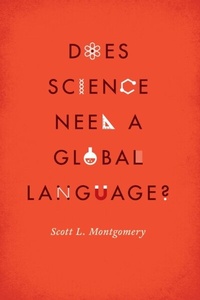
Does Science Need a Global Language?
English and the Future of Research
1st Edition
Published on 31. May 2024
241 pages
978-0-226-01004-5 (ISBN)
Description

In early 2012, the global scientific community erupted with news that the elusive Higgs boson had likely been found, providing potent validation for the Standard Model of how the universe works. Scientists from more than one hundred countries contributed to this discovery-proving, beyond any doubt, that a new era in science had arrived, an era of multinationalism and cooperative reach. Globalization, the Internet, and digital technology all play a role in making this new era possible, but something more fundamental is also at work. In all scientific endeavors lies the ancient drive for sharing ideas and knowledge, and now this can be accomplished in a single tongue- English. But is this a good thing?
In Does Science Need a Global Language?, Scott L. Montgomery seeks to answer this question by investigating the phenomenon of global English in science, how and why it came about, the forms in which it appears, what advantages and disadvantages it brings, and what its future might be. He also examines the consequences of a global tongue, considering especially emerging and developing nations, where research is still at a relatively early stage and English is not yet firmly established.
Throughout the book, he includes important insights from a broad range of perspectives in linguistics, history, education, geopolitics, and more. Each chapter includes striking and revealing anecdotes from the front-line experiences of today's scientists, some of whom have struggled with the reality of global scientific English. He explores topics such as student mobility, publication trends, world Englishes, language endangerment, and second language learning, among many others. What he uncovers will challenge readers to rethink their assumptions about the direction of contemporary science, as well as its future.
In Does Science Need a Global Language?, Scott L. Montgomery seeks to answer this question by investigating the phenomenon of global English in science, how and why it came about, the forms in which it appears, what advantages and disadvantages it brings, and what its future might be. He also examines the consequences of a global tongue, considering especially emerging and developing nations, where research is still at a relatively early stage and English is not yet firmly established.
Throughout the book, he includes important insights from a broad range of perspectives in linguistics, history, education, geopolitics, and more. Each chapter includes striking and revealing anecdotes from the front-line experiences of today's scientists, some of whom have struggled with the reality of global scientific English. He explores topics such as student mobility, publication trends, world Englishes, language endangerment, and second language learning, among many others. What he uncovers will challenge readers to rethink their assumptions about the direction of contemporary science, as well as its future.
All prices
More details
Other editions
Additional editions
Book
05/2013
University of Chicago Press
€24.76
Article not available at the moment
Person
Scott L. Montgomery is a consulting geologist and university lecturer. He is the author of
The Chicago Guide to Communicating Science,
The Powers That Be: Global Energy for the Twenty-First Century and Beyond, and several books on the history of science and scientific language, including
Science in Translation: Movements of Knowledge through Cultures and Time.
Content
- Intro
- Copyright
- Title Page
- Dedication
- Contents
- Foreword
- Preface
- 1. A New Era
- 2. Global English: Realities, Geopolitics, Issues
- 3. English and Science: The Current Landscape
- 4. Impacts: A Discussion of Limitations and Issues for a Global Language
- 5. Past and Future: What Do Former Lingua Francas of Science Tell Us?
- 6. Does Science Need a Global Language?
- Notes
- Index

