

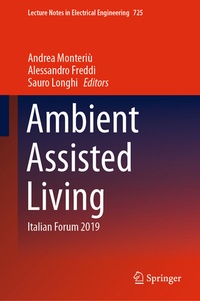
Ambient Assisted Living
Description

This book documents the state of the art in the field of ambient assisted living (AAL), highlighting technologies and services which aim to improve health and quality of life, while promoting active aging. The coverage is wide ranging, with topical sections devoted to human monitoring, smart living services, biomedical and robotic solutions, including different case studies and real-world examples where assistive technologies are successfully applied. The book comprises a selection of the best, refereed papers presented at the 10th Italian Forum on Ambient Assisted Living (ForItAAL), held in Ancona, Italy, in June 2019, which represents the annual event that involves the Ambient Assisted Living Italian Association and brought together researchers, technology teams, policy makers, and stake-holders. Readers will find that the expert contributions offer clear insights into the ways in which the most recent exciting advances may be expected to assist in addressing the needs of the elderly and those with chronic conditions.
More details
Other editions
Additional editions
Content
- Intro
- Organization Committee
- Preface
- Contents
- Human Monitoring
- Measuring Environmental Data and Physiological Parameters at Home to Assess the Caregiver Burden in Assistants of People with Dementia
- 1 Introduction
- 2 Methodology
- 2.1 Monitored Parameters
- 2.2 Questionnaires Data
- 2.3 Data Analysis
- 3 Results
- 4 Conclusions
- References
- A Vision-Based Approach for the at Home Assessment of Postural Stability in Parkinson's Disease
- 1 Introduction
- 2 Framework Description
- 2.1 System Description
- 2.2 Participants
- 2.3 Experimental Procedure and Data Acquisition
- 2.4 Characterization of Postural Stability
- 2.5 Statistical Analysis
- 2.6 Automatic Assessment of Postural Instability by Machine Learning
- 3 Experimental Results
- 3.1 Measurement Accuracy of the Parameters
- 3.2 Discriminant Power of Parameters
- 3.3 Postural Instability Assessment
- 4 Conclusions
- References
- ``In Bed'' BCG Signal Analysis
- 1 Introduction
- 2 The Ballistocardiographic Signal (BCG)
- 3 Cardiac and Respiratory Rate Evaluation
- 4 ``In Bed'' Analysis
- 5 Conclusion
- References
- Analysis of Skeletal Muscles Contractility Using Smart SEMG-Based Socks
- 1 Introduction
- 2 Materials
- 2.1 HPe-Based Electrodes Preparation and Implementation
- 2.2 Data Acquisition and Transmission System
- 3 Preliminary Results
- 4 Conclusions
- References
- Characterization of a PPG Wearable Sensor to Be Embedded into an Innovative Ring-Shaped Device for Healthcare Monitoring
- 1 Introduction
- 1.1 Wearable Sensors for Physiological Signals Monitoring
- 1.2 The Aim
- 2 Materials and Methods
- 2.1 System Description
- 2.2 Experimental Set-Ups
- 2.3 Data Analysis
- 3 Results
- 4 Discussion
- 5 Conclusion
- References
- Multi Sensorial Stimulation Lab: A New Approach for Severe Dementia
- 1 Literature Review
- 1.1 Healthcare Open Innovation Ecosystems
- 1.2 Current Dementia Therapy
- 1.3 The Snoezelen Method
- 2 The Proposed Framework
- 2.1 Players Interaction Model
- 2.2 The Technological Framework
- 3 The Framework Validation Methodology
- 3.1 Patients Selection Criteria
- 3.2 Clinical and Biological Parameters
- 4 Conclusions
- References
- Smart Living Services
- Technological Infrastructure Supports New Paradigm of Care for Healthy Aging: The Living Lab Ausilia
- 1 Introduction
- 1.1 ICT Infrastructure
- 1.2 MQTT Broker
- 1.3 Identification and Tracking
- 2 Augmented Virtuality for Occupational Therapy
- 2.1 AUSILIA Pathway
- 2.2 Software Interfaces for Occupation Therapy
- 3 Ausilia Clinical Assessment and Scales
- 4 The Customized Design of AUSILIA
- 5 Economic Sustainability of Ausilia
- 5.1 Business Model Canvas
- 6 Conclusions and Future Applications
- References
- Cognitive Buildings for Increasing Elderly Fire Safety in Public Buildings: Design and First Evaluation of a Low-Impact Dynamic Wayfinding System
- 1 Introduction
- 2 Literature Overview
- 2.1 Paradigms for Built Environment-Integrated Solutions
- 2.2 Safety-Affecting Factors for Elderly in Buildings
- 2.3 Solutions to Support the Elderly in Evacuation
- 3 Phases, Materials and Methods
- 3.1 Behavioral-Based Requirements for Co-WayS Definition
- 3.2 Co-WayS Technological Requirements
- 3.3 Evacuation Drills
- 4 Results
- 4.1 Co-WayS Definition and Implementation in the Case Study
- 4.2 Drill Evacuation Results
- 5 Conclusions
- References
- Probabilistic Logic Reasoning in Multi-agent Based Smart Home Environment
- 1 Introduction
- 2 Related Research
- 3 Background
- 3.1 ProbLog
- 3.2 Agent Interaction Protocols
- 4 The Multi-Agent System Architecture
- 4.1 Device Agents
- 4.2 Service Agents
- 4.3 Reasoner Agents
- 4.4 Negotiator Agents
- 5 Preliminary Evaluation
- 5.1 Experimental Setup
- 5.2 Tests and Results
- 5.3 Threats to the Validity of the Experiments
- 6 Conclusions and Future Works
- References
- How Would Do that? An Agile Elicitation Technique to Explore Users' Spontaneous Gestural Commands
- 1 Introduction
- 2 Touch-Less Based Gestural Commands
- 2.1 Devising User-Based Gestural Commands
- 3 The Case Study
- 3.1 Implementation and Equipment
- 3.2 Setting
- 3.3 Experimental Procedure
- 3.4 Participants
- 3.5 Analysis
- 4 Results
- 4.1 Hand Shapes
- 4.2 Hand Chosen
- 5 Movements
- 5.1 Agreement of the Gesture
- 5.2 Perceived Influence of Previous Experience
- 6 Discussion
- 7 Conclusion
- References
- VOICE Actuated Control Systems (VACS) for Accessible and Assistive Smart Homes. A Preliminary Investigation on Accessibility and User Experience with Disabled Users
- 1 Introduction
- 1.1 VACSs and Individuals with Disabilities
- 2 The Study
- 2.1 Participants
- 2.2 Setting and Equipment
- 2.3 Tasks
- 2.4 Procedure
- 2.5 Results
- 3 Discussion
- References
- Smart Cities: A New Relationship Between People and Technologies
- 1 Introduction
- 2 Users and Smart Cities
- 2.1 Smart Cities Definitions Including Services
- 3 New Aspects of Users' Services
- 3.1 A New Idea for Personalization of Services
- 3.2 A New Perspective for Collective Intelligence
- 4 Future Work
- 5 Conclusions
- References
- Biomedical and Robotic Solutions
- Humanoid Robotics for Patients with Sarcopenia: A Preliminary Study on Interaction Features
- 1 Introduction
- 2 Humanoid Robotics
- 3 Humanoid Robotics Application
- 4 Humanoid Robotics for Sarcopenia Prevention
- 5 Brief Overview of Selected Humanoid Robots
- 6 Conclusion
- References
- Preliminary Study of Brain-Inspired Model for Multimodal Human Behavior Detection in Social Context
- 1 Introduction
- 2 Related Works
- 3 Neuroscientific Background
- 3.1 Thalamus
- 3.2 Brain Cortex
- 4 Brain-Inspired Perceptual System
- 4.1 Social Cues
- 4.2 Data Acquisition and Pre-processing
- 4.3 Features Extraction
- 4.4 Behavioral Pattern Generation
- 5 Discussion and Conclusion
- References
- An Obstacle Avoidance Strategy Using an Indoor Localization System
- 1 Introduction
- 2 Related Work
- 3 The Proposed Solution
- 4 Hardware Architecture of the System
- 5 Obstacle Avoidance Algorithm
- 6 Results
- References
- Human-in-the-Loop Approach to Safe Navigation of a Smart Wheelchair via Brain Computer Interface
- 1 Introduction
- 2 Proposed Approach
- 2.1 Robot Navigation
- 2.2 EEG-Based Feedback
- 2.3 Navigation: EEG Feedback Integration via ROS Nodes
- 3 Experimental Setup
- 3.1 Smart Wheelchair
- 3.2 BCI
- 4 Preliminary Results
- 4.1 BCI Training
- 4.2 Simulation Testing
- 5 Conclusion
- References
- Classification of Cardiac Tones of Mechanical and Native Mitral Valves
- 1 Introduction
- 2 Features and the Algorithms Used for Valve Classification
- 3 Experimental Phase Description and Results Discussion
- 4 Conclusions
- References
- TestGraphia, Document Analysis-Based Diagnosis of Dysgraphia
- 1 Introduction
- 2 Evaluation Method
- 3 Writing Parameters
- 3.1 Writing Size
- 3.2 Non-Aligned Left Margin
- 3.3 Skewed Writing
- 3.4 Insufficient Space Between Words
- 3.5 Sharp Angles
- 3.6 Broken Links Between Letters
- 3.7 Collisions Between Letters
- 3.8 Irregular Size of Letters
- 3.9 Inconsistent Height Between Letters with and Without Extension
- 3.10 Atypical Letters
- 3.11 Ambiguous Letters
- 3.12 Traced Letters
- 3.13 Unstable Track
- 4 System Description
- 5 Results
- 6 Validation
- 7 Conclusion
- Appendix I-Algorithms
- Writing Size Algorithm
- Non-Aligned Left Margin Algorithm
- Skewed Writing Algorithm
- Insufficient Space Between Letters Algorithm
- Irregular Size of Letters Algorithms
- Inconsistent Height Between Letters With and Without Extension Algorithm
- References
- Assistive Technologies: Case Studies
- Integrated ICT System for the Implementation of Rehabilitation Therapy for Alzheimer's Patients and for the Improvement of Quality and Efficiency in Managing Their Health: The Rehab-Dem Project
- 1 Introduction
- 2 Project Rationale
- 3 Tools and Technology
- 4 Study and Research
- 5 Scientific and Technical Preliminary Results
- 6 Conclusions
- References
- Preliminary Analysis of the OPENCARE System Architecture in Residential Facilities
- 1 Introduction
- 2 The Participatory Design Approach
- 2.1 The User Interface
- 3 The OPENCARE Air Data Sensors
- 4 Measurements of the Air Quality
- 5 Future Steps and Conclusion
- References
- Analysis of Human Behavior in Five Healthcare Centers for the Development of New Technologies, in Support of the Improvement of Life Quality
- 1 Introduction
- 2 The Project
- 3 Objectives
- 4 Methods
- 4.1 Observations in Different Indoor Environments
- 4.2 Observations in Healthcare Centers
- 4.3 Interviews with Health Professionals
- 4.4 Questionnaires to Different Age Groups
- 5 Research Instruments
- 5.1 The Naturalistic Observation
- 5.2 The Structured Interview
- 5.3 The Questionnaire
- 6 Data Collection
- 6.1 The Healthcare Facilities Participating in the Project
- 7 Data Analysis
- 8 Discussion
- 9 Conclusions
- References
- MAESTRO, an Integrated Quality Assurance Framework for Seniors
- 1 Introduction
- 1.1 Introduction to MAESTRO's Project
- 1.2 Introduction to MAESTRO's Platform
- 2 Repository and Taxonomy of Products
- 2.1 Repository
- 2.2 Taxonomy
- 2.3 Management of Products
- 2.4 Memoride Example: Product Added on the Platform
- 3 Product and User Profiles
- 3.1 Product Profile
- 3.2 End-User Profile
- 3.3 Memoride Example: Product and End-User Profiles
- 4 Conclusion
- References
- ICF-Based Classification to Bridge the Gap Between End-Users and AAL Solutions
- 1 Introduction
- 2 The MAESTRO Project
- 3 The ICF-Based Recommendation System
- 3.1 Why the ICF Taxonomy
- 3.2 Body Functions and Structures
- 3.3 Activity and Participation
- 4 MAESTRO as a Mean to Classify AAL Projects
- 4.1 Overview of Classification Results
- 4.2 A Closer View to Following the ICF Dimensions
- 4.3 Considerations on the Classification Capabilities of MAESTRO
- 5 Conclusions and Final Remarks
- References
- Active Paintings. Design Project for a Portable Exhibition for People with Dementia or Cognitive Impairment
- 1 Introduction
- 2 Dementia Treatment and Art Therapy
- 3 The Project
- 4 The Paintings
- 5 The Activities
- 5.1 Pissarro
- 5.2 Renoir
- 5.3 Van Gogh
- 5.4 Mirò
- 5.5 Kandinskij
- 5.6 Pollock
- 6 The Paths
- References
