

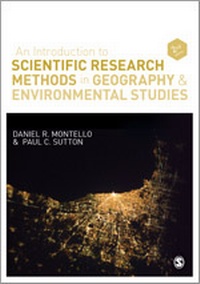
An Introduction to Scientific Research Methods in Geography and Environmental Studies
2nd Edition
Published on 10. December 2012
328 pages
978-1-4462-7191-9 (ISBN)
Description

"Covers a broad range of subjects that undergraduates in the discipline should be familiar and comfortable with upon graduation. From chapters on the scientific method and fundamental research concepts, to experimental design, sampling and statistical analysis, the text offers an excellent introduction to the key concepts of geographical research. The content is applicable for students at the beginning of their studies right through to planning and conducting dissertations. The book has also been of particular support in designing my level 1 and 2 tutorials which cover similar ground to several of the chapters."
- Joseph Mallalieu, School of Geography, Leeds University
"Montello and Sutton is one of the best texts I've used in seminars on research methodology. The text offers a clear balance of quantitative vs. qualitative and physical vs. human which I've found particularly valuable. The chapters on research ethics, scientific communication, information technologies and data visualization are excellent."
- Kenneth E. Foote, Department of Geography, University of Colorado at Boulder
This is a broad and integrative introduction to the conduct and interpretation of scientific research, covering both geography and environmental studies. Written for undergraduate and postgraduate students, it:
Explains both the conceptual and the technical aspects of research, as well as all phases of the research process
Combines approaches in physical geography and environmental science, human geography and human-environment relations, and geographic and environmental information techniques (such as GIS, cartography, and remote sensing)
Combines natural and social scientific approaches common to subjects in geography and environmental studies
Includes case studies of actual research projects to demonstrate the breadth of approaches taken
It will be core reading for students studying scientific research methods in geography, environmental studies and related disciplines such as planning and earth science.
- Joseph Mallalieu, School of Geography, Leeds University
"Montello and Sutton is one of the best texts I've used in seminars on research methodology. The text offers a clear balance of quantitative vs. qualitative and physical vs. human which I've found particularly valuable. The chapters on research ethics, scientific communication, information technologies and data visualization are excellent."
- Kenneth E. Foote, Department of Geography, University of Colorado at Boulder
This is a broad and integrative introduction to the conduct and interpretation of scientific research, covering both geography and environmental studies. Written for undergraduate and postgraduate students, it:
Explains both the conceptual and the technical aspects of research, as well as all phases of the research process
Combines approaches in physical geography and environmental science, human geography and human-environment relations, and geographic and environmental information techniques (such as GIS, cartography, and remote sensing)
Combines natural and social scientific approaches common to subjects in geography and environmental studies
Includes case studies of actual research projects to demonstrate the breadth of approaches taken
It will be core reading for students studying scientific research methods in geography, environmental studies and related disciplines such as planning and earth science.
Reviews / Votes
Montello and Sutton is one of the best texts I've used in seminars on research methodology. The text offers a clear balance of quantitative vs. qualitative and physical vs. human which I've found particularly valuable. The chapters on research ethics, scientific communication, information technologies and data visualization are excellent. Unlike many recent surveys and anthologies of geographic methodologies, Montello and Sutton provide a comprehensive and integrated overview which will continue to be of value across the entire disciplineKenneth E. Foote
Department of Geography, University of Colorado at Boulder This second edition of An Introduction to Scientific Research Methods in Geography and Environmental Studies now ranks itself in the category of "books with experience", that is, it can be situated among these few noted books that have probably been used in many classes through the years. While advanced undergraduates in geography and natural sciences would obviously benefit from this reading at the condition of being combined with other related titles, other students in the broader field of environmental studies might also learn from the authors' interdisciplinary approach. -- Yves Laberge
All prices
More details
Edition
Second Edition
Language
English
Place of publication
London
United Kingdom
Target group
College/higher education
US School Grade: From Preschool to Second Grade, Reading Age: From 8 to 12 years, Interest Age: From 8 to 12 years
ISBN-13
978-1-4462-7191-9 (9781446271919)
Copyright in bibliographic data and cover images is held by Nielsen Book Services Limited or by the publishers or by their respective licensors: all rights reserved.
Schweitzer Classification
Other editions
Additional editions
Daniel R. Montello | Paul Sutton
An Introduction to Scientific Research Methods in Geography and Environmental Studies
Book
12/2012
2nd Edition
SAGE Publications Ltd
€243.64
Shipment within 15-20 days
Daniel R. Montello | Paul Sutton
An Introduction to Scientific Research Methods in Geography and Environmental Studies
Book
12/2012
2nd Edition
SAGE Publications Ltd
€98.20
Shipment within 15-20 days
Persons
Daniel Montello is Professor of Geography at the University of California, CA. I grew up in the Hollywood Hills of Los Angeles, California (Laurel Canyon) during the 1960's. The movie 'Soylent Green' and the chest pain I experienced with deep breaths during smog alerts had a significant impact on me and my nascent perception of the Human-Environment-Sustainability problematic. I later moved to Santa Barbara during my High School years and was deeply influenced by the works of Rachel Carson, Paul Ehrlich, and Garrett Hardin. Needless to say my early childhood experiences primed me to be significantly influenced by apocalyptic movies and neo-malthusian jeremiads.
I spent my undergraduate daze at Union College in Schenectady New York. I began as a naive pre-med but I ended up with a Chemistry degree and a desire to work in the area of environmental cleanup. I soon learned that EPA Superfund sites spend more of the clean up funds on lawyers in three piece suits than on chemists in Hazmat suits. This only seeded my latent cynicism as I volunteered for Zero Population Growth while I taught High School Chemistry, Physics, and Math at the Anacapa School in Santa Barbara. I later did some time as a process engineer at the Santa Barbara Research Center where I participated in the design, fabrication, and testing of infrared sensors for scientific and military equipment including satellite sensors.
I discovered Geography through friends that were graduate students in Geography at UCSB in the early 1990s. I milked my time as a graduate student in the Geography Department at UCSB for as long as I could obtaining an M.A. in Geography in 1995, an M.A. in Statistics in 1997, and a PhD in Geography in 1999. My dissertation was titled: "Census from Heaven: Estimation of human population parameters using nighttime satellite imagery and GIS". I am deeply indebted to many faculty at UCSB for their guidance and their service to the discipline.
I took a position in the Geography Department at the University of Denver in the Fall of 1999 and have been here since then. I have many interests spanning much of geography but ranging into ecology, economics, and philosophy. Most of my research focuses on applied issues associated with the Human-Environment-Sustainability problematic. I do a great deal of work with nighttime satellite imagery derived from the Defense Meteorological Satellite Program's Operational Linescan System (DMSP OLS). Data products derived from DMSP OLS imagery are being used to map and estimate human population distribution, energy consumption, economic activity, urban extent, CO2 emissions, Ecological Footprints, and more. The tools needed to engage in this research are remote sensing , geographic information analysis, and statistics. I also am interested in the development of the discipline of ecological economics. I use my expertise in GIS and spatial data analysis in collaborations with economists and ecologists to make spatially explicit valuations of ecosystem services. Nonetheless my interests are quite broad and I have had students write theses and dissertations in areas ranging from crime mapping to explaining 'high-stakes' testing scores in the public schools to mapping invasive species.
My fascination with apocalyptic movies has not faded though and I teach a first year seminar titled: Utopia, Dystopia, and the End of the World. I do my small part to insure that 'Soylent Green' remains in the lexicon of the culturally literate. I also teach geographic statistics, population geography, and ecological economics. I try to serve the discipline of Geography primarily by teaching and mentoring students in a way that prepares them to be informed and active citizens, provides them with unique and relevant skills that helps them pursue meaningful careers, and provokes and stimulates their curiosity and intellect in ways that insures that they appreciate that a geographic perspective is essential to a rich intellectual life.
I spent my undergraduate daze at Union College in Schenectady New York. I began as a naive pre-med but I ended up with a Chemistry degree and a desire to work in the area of environmental cleanup. I soon learned that EPA Superfund sites spend more of the clean up funds on lawyers in three piece suits than on chemists in Hazmat suits. This only seeded my latent cynicism as I volunteered for Zero Population Growth while I taught High School Chemistry, Physics, and Math at the Anacapa School in Santa Barbara. I later did some time as a process engineer at the Santa Barbara Research Center where I participated in the design, fabrication, and testing of infrared sensors for scientific and military equipment including satellite sensors.
I discovered Geography through friends that were graduate students in Geography at UCSB in the early 1990s. I milked my time as a graduate student in the Geography Department at UCSB for as long as I could obtaining an M.A. in Geography in 1995, an M.A. in Statistics in 1997, and a PhD in Geography in 1999. My dissertation was titled: "Census from Heaven: Estimation of human population parameters using nighttime satellite imagery and GIS". I am deeply indebted to many faculty at UCSB for their guidance and their service to the discipline.
I took a position in the Geography Department at the University of Denver in the Fall of 1999 and have been here since then. I have many interests spanning much of geography but ranging into ecology, economics, and philosophy. Most of my research focuses on applied issues associated with the Human-Environment-Sustainability problematic. I do a great deal of work with nighttime satellite imagery derived from the Defense Meteorological Satellite Program's Operational Linescan System (DMSP OLS). Data products derived from DMSP OLS imagery are being used to map and estimate human population distribution, energy consumption, economic activity, urban extent, CO2 emissions, Ecological Footprints, and more. The tools needed to engage in this research are remote sensing , geographic information analysis, and statistics. I also am interested in the development of the discipline of ecological economics. I use my expertise in GIS and spatial data analysis in collaborations with economists and ecologists to make spatially explicit valuations of ecosystem services. Nonetheless my interests are quite broad and I have had students write theses and dissertations in areas ranging from crime mapping to explaining 'high-stakes' testing scores in the public schools to mapping invasive species.
My fascination with apocalyptic movies has not faded though and I teach a first year seminar titled: Utopia, Dystopia, and the End of the World. I do my small part to insure that 'Soylent Green' remains in the lexicon of the culturally literate. I also teach geographic statistics, population geography, and ecological economics. I try to serve the discipline of Geography primarily by teaching and mentoring students in a way that prepares them to be informed and active citizens, provides them with unique and relevant skills that helps them pursue meaningful careers, and provokes and stimulates their curiosity and intellect in ways that insures that they appreciate that a geographic perspective is essential to a rich intellectual life.
Content
Introduction: A Scientific Approach to Geography and Environmental Studies
Fundamental Research Concepts
Scientific Communication
Data Collection in Geography and Environmental Studies: Overview
Physical Measurements
Behavioural Oservations and Archives
Explicit Reports: Surveys, Interviews and Tests
Experimental and Non-Experimental Research Designs
Sampling
Statistical Data Analysis
Data Display: Tables, Graphs, Maps, Visualizations
Reliability and Validity
Information Technologies in Research
Ethics in Scientific Research
Fundamental Research Concepts
Scientific Communication
Data Collection in Geography and Environmental Studies: Overview
Physical Measurements
Behavioural Oservations and Archives
Explicit Reports: Surveys, Interviews and Tests
Experimental and Non-Experimental Research Designs
Sampling
Statistical Data Analysis
Data Display: Tables, Graphs, Maps, Visualizations
Reliability and Validity
Information Technologies in Research
Ethics in Scientific Research
