

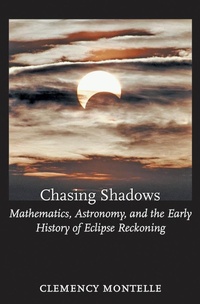
Chasing Shadows
Mathematics, Astronomy, and the Early History of Eclipse Reckoning
Published on 10. July 2011
424 pages
978-0-8018-9910-2 (ISBN)
Description

Lunar and solar eclipses have always fascinated human beings. Digging deep into history, Clemency Montelle examines the ways in which theoretical understanding of eclipses originated and how ancient and medieval cultures shared, developed, and preserved their knowledge of these awe-inspiring events.
Eclipses were the celestial phenomena most challenging to understand in the ancient world. Montelle draws on original research-much of it derived from reading primary source material written in Akkadian and Sanskrit, as well as ancient Greek, Latin, and Arabic-to explore how observers in Babylon, the Islamic Near East, Greece, and India developed new astronomical and mathematical techniques to predict and describe the features of eclipses. She identifies the profound scientific discoveries of these four cultures and discusses how the societies exchanged information about eclipses. In constructing this history, Montelle establishes a clear pattern of the transmission of scientific ideas from one culture to another in the ancient and medieval world.
Chasing Shadows is an invitingly written and highly informative exploration of the early history of astronomy.
Eclipses were the celestial phenomena most challenging to understand in the ancient world. Montelle draws on original research-much of it derived from reading primary source material written in Akkadian and Sanskrit, as well as ancient Greek, Latin, and Arabic-to explore how observers in Babylon, the Islamic Near East, Greece, and India developed new astronomical and mathematical techniques to predict and describe the features of eclipses. She identifies the profound scientific discoveries of these four cultures and discusses how the societies exchanged information about eclipses. In constructing this history, Montelle establishes a clear pattern of the transmission of scientific ideas from one culture to another in the ancient and medieval world.
Chasing Shadows is an invitingly written and highly informative exploration of the early history of astronomy.
More details
Series
Language
English
Place of publication
Baltimore
United States
Target group
Professional and scholarly
Illustrations
51 s/w Zeichnungen, 6 s/w Photographien bzw. Rasterbilder
51 Line drawings, black and white; 6 Halftones, black and white
File size
8,86 MB
ISBN-13
978-0-8018-9910-2 (9780801899102)
DOI
10.1353/book.469
Copyright in bibliographic data and cover images is held by Nielsen Book Services Limited or by the publishers or by their respective licensors: all rights reserved.
Schweitzer Classification
Other editions
Additional editions
Book
07/2011
Johns Hopkins University Press
€102.47
Article exhausted; check different version
Person
Clemency Montelle is a lecturer in the Department of Mathematics and Statistics at the University of Canterbury.
Content
Preface
1. Heavenly Hide and Seek: An Introduction to Eclipse Reckoning in Early Times
1.1. Development and Cross-Cultural Transmission
1.2. Eclipses and Their Human Significance
1.3. Observation and Theory
1.4. Aims of This Study
2. The Rudiments of Alignment: Basic Eclipse Theory
2.1. The Moon and the Sun
2.2. Eclipses
2.3. Prediction and Patterns of Eclipses
2.4. The Celestial Sphere
2.5. Mathematical Conventions
3. An Accountancy of Appearances: Mesopotamian Eclipse Reckoning
3.1. Overview
3.2. The Earliest Accounting for Eclipses: Enuma Anu Enlil
3.3. Assyrian Eclipse Reckoning: The Letters and Reports
3.4. Babylonian Eclipse Reckoning
4. Beyond the Appearances: Greek Eclipse Reckoning
4.1. Overview
4.2. Early Greek Geometrical Celestial Conceptions
4.3. Sizes, Distances, and Measurement: Aristarchus and Archimedes
4.4. Early Greek Mathematical Astronomy
4.5. The Peak of Greek Mathematical Astronomy
4.6. Omens in Greek and Hellenistic Sources
5. Recipient and Remoceler: Indian Eclipse Reckoning
5.1. Overview
5.2. General Features of Eclipse Reckoning in India
5.3. Eclipses as Omens
5.4. Eclipse Observation Records in Inscriptions
5.5. Eclipse Reckoning in Indian Texts with Greco-Babylonian Influence: The Pancasiddhantika of Varahamihira
5.6. Eclipse Reckoning from the Fifth to the Tenth Century
5.7. Paramesvara and the Astronomical School in Kerala
6. A Science of Configuration: Arabic Eclipse Reckoning
6.1. Overview
6.2. General Features of Eclipse Reckoning in the Islamic Near East
6.3. Major Contributions to Islamic Eclipse Reckoning
7. Concluding Remarks
Appendixes
A. Abbreviations and Conventions
B. A Comparison of NMAT and MAT Eclipse Predictions
C. The Eclipse Tables in the Wajiz of al-Khazini
Notes
Glossary
Bibliography
Index
1. Heavenly Hide and Seek: An Introduction to Eclipse Reckoning in Early Times
1.1. Development and Cross-Cultural Transmission
1.2. Eclipses and Their Human Significance
1.3. Observation and Theory
1.4. Aims of This Study
2. The Rudiments of Alignment: Basic Eclipse Theory
2.1. The Moon and the Sun
2.2. Eclipses
2.3. Prediction and Patterns of Eclipses
2.4. The Celestial Sphere
2.5. Mathematical Conventions
3. An Accountancy of Appearances: Mesopotamian Eclipse Reckoning
3.1. Overview
3.2. The Earliest Accounting for Eclipses: Enuma Anu Enlil
3.3. Assyrian Eclipse Reckoning: The Letters and Reports
3.4. Babylonian Eclipse Reckoning
4. Beyond the Appearances: Greek Eclipse Reckoning
4.1. Overview
4.2. Early Greek Geometrical Celestial Conceptions
4.3. Sizes, Distances, and Measurement: Aristarchus and Archimedes
4.4. Early Greek Mathematical Astronomy
4.5. The Peak of Greek Mathematical Astronomy
4.6. Omens in Greek and Hellenistic Sources
5. Recipient and Remoceler: Indian Eclipse Reckoning
5.1. Overview
5.2. General Features of Eclipse Reckoning in India
5.3. Eclipses as Omens
5.4. Eclipse Observation Records in Inscriptions
5.5. Eclipse Reckoning in Indian Texts with Greco-Babylonian Influence: The Pancasiddhantika of Varahamihira
5.6. Eclipse Reckoning from the Fifth to the Tenth Century
5.7. Paramesvara and the Astronomical School in Kerala
6. A Science of Configuration: Arabic Eclipse Reckoning
6.1. Overview
6.2. General Features of Eclipse Reckoning in the Islamic Near East
6.3. Major Contributions to Islamic Eclipse Reckoning
7. Concluding Remarks
Appendixes
A. Abbreviations and Conventions
B. A Comparison of NMAT and MAT Eclipse Predictions
C. The Eclipse Tables in the Wajiz of al-Khazini
Notes
Glossary
Bibliography
Index
