

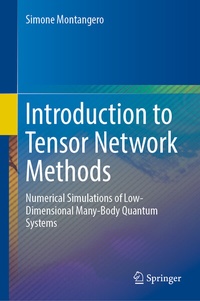
Introduction to Tensor Network Methods
Description

This volume of lecture notes briefly introduces the basic concepts needed in any computational physics course: software and hardware, programming skills, linear algebra, and differential calculus. It then presents more advanced numerical methods to tackle the quantum many-body problem: it reviews the numerical renormalization group and then focuses on tensor network methods, from basic concepts to gauge invariant ones. Finally, in the last part, the author presents some applications of tensor network methods to equilibrium and out-of-equilibrium correlated quantum matter.
The book can be used for a graduate computational physics course. After successfully completing such a course, a student should be able to write a tensor network program and can begin to explore the physics of many-body quantum systems. The book can also serve as a reference for researchers working or starting out in the field.
More details
Other editions
Additional editions
Person
Content
Introduction.- Part I: Software and Hardware.- Lesson 1: Computer for Physicists.- Lesson 2: Software for Physicists.- Part II: Crash Programming Course.- Lesson 3: Fortran.- Lesson 4: Python.- Lesson 5: Gnuplot.- Part III: Single-Body Problem.- Lesson 6: Matrix Diagonalization.- Lesson 7: Integrals.- Lesson 8: Differential Equations.- Part IV: Many-Body Problem.- Lesson 9: Monte Carlo.- Lesson 10: Renormalization Group.- Lesson 11: Tensor Networks.- Part V: Symmetries.- Lesson 12: Group Theory.- Lesson 13: Quantum Phase Transitions.- Lesson 14: Global Symmetries.- Lesson 15: Gauge Theories.
