

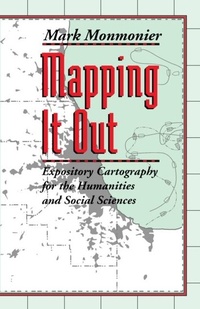
Mapping It Out
Expository Cartography for the Humanities and Social Sciences
1st Edition
Published on 31. May 2024
318 pages
978-0-226-21785-7 (ISBN)
Description

Writers know only too well how long it can take-and how awkward it can be-to describe spatial relationships with words alone. And while a map might not always be worth a thousand words, a good one can help writers communicate an argument or explanation clearly, succinctly, and effectively.
In his acclaimed How to Lie with Maps, Mark Monmonier showed how maps can distort facts. In Mapping it Out: Expository Cartography for the Humanities and Social Sciences, he shows authors and scholars how they can use expository cartography-the visual, two-dimensional organization of information-to heighten the impact of their books and articles.
This concise, practical book is an introduction to the fundamental principles of graphic logic and design, from the basics of scale to the complex mapping of movement or change. Monmonier helps writers and researchers decide when maps are most useful and what formats work best in a wide range of subject areas, from literary criticism to sociology. He demonstrates, for example, various techniques for representing changes and patterns; different typefaces and how they can either clarify or confuse information; and the effectiveness of less traditional map forms, such as visibility base maps, frame-rectangle symbols, and complementary scatterplot designs for conveying complex spatial relationships.
There is also a wealth of practical information on map compilation, cartobibliographies, copyright and permissions, facsimile reproduction, and the evaluation of source materials. Appendixes discuss the benefits and limitations of electronic graphics and pen-and-ink drafting, and how to work with a cartographic illustrator.
Clearly written, and filled with real-world examples, Mapping it Out demystifies mapmaking for anyone writing in the humanities and social sciences.
"A useful guide to a subject most people probably take too much for granted. It shows how map makers translate abstract data into eye-catching cartograms, as they are called. It combats cartographic illiteracy. It fights cartophobia. It may even teach you to find your way."-Christopher Lehmann-Haupt, The New York Times
In his acclaimed How to Lie with Maps, Mark Monmonier showed how maps can distort facts. In Mapping it Out: Expository Cartography for the Humanities and Social Sciences, he shows authors and scholars how they can use expository cartography-the visual, two-dimensional organization of information-to heighten the impact of their books and articles.
This concise, practical book is an introduction to the fundamental principles of graphic logic and design, from the basics of scale to the complex mapping of movement or change. Monmonier helps writers and researchers decide when maps are most useful and what formats work best in a wide range of subject areas, from literary criticism to sociology. He demonstrates, for example, various techniques for representing changes and patterns; different typefaces and how they can either clarify or confuse information; and the effectiveness of less traditional map forms, such as visibility base maps, frame-rectangle symbols, and complementary scatterplot designs for conveying complex spatial relationships.
There is also a wealth of practical information on map compilation, cartobibliographies, copyright and permissions, facsimile reproduction, and the evaluation of source materials. Appendixes discuss the benefits and limitations of electronic graphics and pen-and-ink drafting, and how to work with a cartographic illustrator.
Clearly written, and filled with real-world examples, Mapping it Out demystifies mapmaking for anyone writing in the humanities and social sciences.
"A useful guide to a subject most people probably take too much for granted. It shows how map makers translate abstract data into eye-catching cartograms, as they are called. It combats cartographic illiteracy. It fights cartophobia. It may even teach you to find your way."-Christopher Lehmann-Haupt, The New York Times
All prices
More details
Other editions
Additional editions
Book
06/1993
University of Chicago Press
€23.56
Shipment within 10-20 days

Book
06/1993
University of Chicago Press
€94.24
Shipment within 10-20 days
Person
Mark Monmonier is distinguished professor of geography at Syracuse University's Maxwell School of Citizenship and Public Affairs.
Content
- Intro
- Contents
- Preface
- 1. Maps in the Humanities and Social Sciences
- Words and Maps
- Maps, Location, and Spatial Pattern
- 2. Scale, Perspective, and Generalization
- Scale Models and the Representation of Scale
- Global Perspective and the Distortion of Size and Shape
- Regional Perspectives and the Conservation of Distance
- Some General Rules
- 3. Visual Variables and Cartographic Symbols
- The Visual Variables of Jacques Bertin
- Form and Function in Cartographic Representation
- Accessible Coding and Cartographic Goals
- 4. Map Goals, Map Titles, and Creative Labeling
- Communication Goals, Map Content, and Graphic Hierarchies
- Typography as Cartographic Symbol
- Language and Cartographic Communication
- 5. Cartographic Sources and Map Compilation
- Searching for Cartographic Information
- Copyright and Permissions
- The Mechanics of Compilation
- In Summary: Seek and Collect
- 6. Statistical Maps, Data Scaling, and Data Classification
- Mapping Count Data
- Mapping Intensity Data
- Modifications for Greater Effectiveness
- The Ethics of One-Map Solutions
- 7. Mapping Movement, Change, and Process
- Mapping Flows
- Spatial-Temporal Series and Maps of Change
- Distance Cartograms and Relative Space
- Fronts and Frontiers: Mapping War and Settlement
- The Map as a Narrative
- 8. Relational Maps and Integrative Cartography
- Patterns, Trends, and Spatial Models
- Superposition and Additive Overlays
- Representing Geographic Correlation
- Integrating Maps, Graphs, Words, and Pictures
- Appendixes
- A. Drawing Media: Electronic Graphics or Pen-and-Ink Drafting
- Tools for Compilation
- Tools for Symbolization
- Tools for Labeling
- Software Compatibility and Planning
- B. Working with a Cartographic Illustrator
- Working Relationships
- What the Illustrator Will Need to Know
- C. Selected Readings
- Notes
- Sources of Illustrations
- Index
