
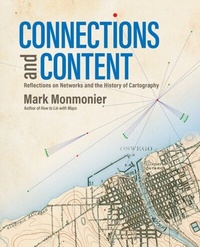
Connections and Content
Description
Alles über E-Books | Antworten auf Fragen rund um E-Books, Kopierschutz und Dateiformate finden Sie in unserem Info- & Hilfebereich.
Behind every great map is a network and behind every great network is a map.
In Connections and Content: Reflections on Networks and the History of Cartography, cartographic cogitator Mark Monmonier shares his insights about the relationships between networks and maps through a collection of essays. Using historical maps, he explores:
- Triangulation networks used to establish the baselines of a map's scale,
- Astronomical observations, ellipsoids, geodetic arcs, telegraph networks, and GPS constellations that establish latitude and longitude at control stations,
- Cartographic symbols that portray network features on a map,
- Survey networks used to situate and construct canals, railways, roads, and power lines,
- Postal and electronic networks that created and disseminated weather maps, and
- Topological networks that underlie modern census enumeration and satellite navigation systems.
Connecting the past to the present via maps and reflection, Monmonier continues his contribution to cartographic scholarship by demonstrating the network as a unifying concept for understanding and using maps.
All prices
More details
Other editions
Additional editions
Person
Mark Monmonier is Distinguished Professor of Geography at Syracuse University's Maxwell School of Citizenship and Public Affairs. He is the author of twenty books, including How to Lie with Maps, and was editor of Cartography in the Twentieth Century, the million-word encyclopedia published as volume 6 in the History of Cartography series. His awards include the American Geographical Society's O. M. Miller Medal (2001), the German Cartographic Society's Mercator Medal (2009), and induction into URISA's (Urban and Regional Information Systems Association) GIS Hall of Fame (2016).
Content
Preface
1 Baselines
2 Geometry
3 Symbols
4 Infrastructure
5 Telecommunications
6 Topology
7 Control
List of Acronyms
Index

System requirements
File format: ePUB
Copy protection: Adobe-DRM (Digital Rights Management)
System requirements:
- Computer (Windows; MacOS X; Linux): Install the free reader Adobe Digital Editions prior to download (see eBook Help).
- Tablet/smartphone (Android; iOS): Install the free app Adobe Digital Editions or the app PocketBook before downloading (see eBook Help).
- E-reader: Bookeen, Kobo, Pocketbook, Sony, Tolino and many more (not Kindle).
The file format ePub works well for novels and non-fiction books – i.e., „flowing” text without complex layout. On an e-reader or smartphone, line and page breaks automatically adjust to fit the small displays.
This eBook uses Adobe-DRM, a „hard” copy protection. If the necessary requirements are not met, unfortunately you will not be able to open the eBook. You will therefore need to prepare your reading hardware before downloading.
Please note: We strongly recommend that you authorise using your personal Adobe ID after installation of any reading software.
For more information, see our ebook Help page.
File format: ePUB
Copy protection: Watermark-DRM (Digital Rights Management)
System requirements:
- Computer (Windows; MacOS X; Linux): Use a reading software that can process the file format ePUB: e.g., Adobe Digital Editions or FBReader – both free (see eBook Help).
- Tablet/Smartphone (Android; iOS): Before downloading, install the free app Adobe Digital Editions (see eBook Help).
- E-reader: Bookeen, Kobo, Pocketbook, Sony, Tolino and many more (not Kindle).
The file format ePUB works well for novels and non-fiction books – i.e., „flowing” text without complex layout. On an e-reader or smartphone, line and page breaks automatically adjust to fit the small displays.
This eBook uses Watermark-DRM, a „soft” copy protection. This means that there are no technical restrictions to prevent illegal distribution. However, there is a personalised watermark embedded in the eBook that can be used to identify the purchaser of the eBook in the event of misuse and to provide evidence for legal purposes.
For more information, see our eBook Help page.