


Reframing Finance
New Models of Long-Term Investment Management
Published on 8. August 2017
216 pages
978-1-5036-0275-5 (ISBN)
Available for download
Description

Since the 2008 financial crisis, beneficiary organizations-like pension funds, sovereign wealth funds, endowments, and foundations-have been seeking ways to mitigate the risk of their investments and make better financial decisions. For them, Reframing Finance offers a path forward.
This book argues that institutional investors would better serve their long-term goals by putting money into large-scale, future-facing projects such as infrastructure, green energy, innovation in agriculture, and real estate development. At the same time, redirecting long-term investments would close significant financial gaps that government cannot. Drawing on key contributions in economic sociology, social network theory, and economics, the book conceptualizes a collaborative model of investment that is already becoming increasingly common: Large investors contribute more directly to private market assets, while financial intermediaries seek to foster co-investment partnerships, better aligning incentives for all. A combination of rich case studies and rigorous theory enables asset owners to move toward more efficient, private-market investing, while also laying groundwork for research at the frontier of finance.
This book argues that institutional investors would better serve their long-term goals by putting money into large-scale, future-facing projects such as infrastructure, green energy, innovation in agriculture, and real estate development. At the same time, redirecting long-term investments would close significant financial gaps that government cannot. Drawing on key contributions in economic sociology, social network theory, and economics, the book conceptualizes a collaborative model of investment that is already becoming increasingly common: Large investors contribute more directly to private market assets, while financial intermediaries seek to foster co-investment partnerships, better aligning incentives for all. A combination of rich case studies and rigorous theory enables asset owners to move toward more efficient, private-market investing, while also laying groundwork for research at the frontier of finance.
Reviews / Votes
"Beyond reporting the latest thinking on institutional investment, this book guides asset managers and owners through an increasingly complex environment. Skillfully blending theoretical insights with practical guidance and case studies, it is essential reading for owners and managers seeking to maximize the impact of their long-term investments."-Paul Rose, Ohio State University, Moritz College of Law "What gets measured gets managed. This book outlines the things that truly make the long-term difference to investment effectiveness and returns, namely: comparing global best practices, collaborating on issues of joint interest, and ultimately co-investing. These '3Cs' rely purely on trusted relationships, which need to be identified, built, and nurtured. I congratulate the authors on identifying this need, and providing the theoretical, empirical, and practical framework to guide us."-Adrian Orr, CEO of the Guardians of New Zealand Superannuation and Chairman of the International Forum of Sovereign Wealth Funds "Many of the most serious problems in our society-from crumbling infrastructure to environmental degradation-can only be addressed through long-run investments. Meanwhile, large pension funds are seeking higher returns than those traditional stocks and bonds can offer. Reframing Finance explores this critically important territory, deftly documenting both the barriers to long-run investing and how they can be overcome."-Josh Lerner, Harvard Business School "The authors shed light on the misalignment between long term investors and intermediaries when it comes to lower risk, long term real assets in private markets. They suggest solutions, many of which CPPIB employs-that enable investors to effectively utilize the advantages of long horizon and scale."-Mark Machin, President and CEO, CPPIB "Finally, a manifesto for the future of finance that is informed, has vision, and takes seriously what can be accomplished in the long-term. The authors have produced a roadmap that should be heeded by the financial services industry, government, and academia. With breadth to match its depth, this book is pathbreaking!"-Gordon L. Clark, Oxford University "This book raises provocative questions about our current capitalist system and suggests how long-term capital can be better allocated to address the world's toughest problems. The book's thoughtful analysis and comprehensive solutions are relevant for investors, CEOs, and policy-makers alike."-Dominic Barton, Global Managing Partner, McKinsey & Company "In this clearly written volume, Monk and Sharma (Stanford Univ.) and Sinclair (Deloitte) make a strong case for mobilizing the vast sums held in the institutional finance universe (endowments, sovereign funds, foundations, pension funds, insurance companies) to finance long-term investments (infrastructure, clean energy, toll roads, pollution control)...Recommended."-C. J. Siegman, Choice "Reframing Finance is one of few academic volumes that rigorously explore the potential and viability of alternative investment models, amidst critical literature on infrastructure finance that gives limited attention to possible alternatives."--Jenny McArthur, Journal of Economic GeographyMore details
Edition
New edition
Language
English
Place of publication
Palo Alto
United States
Publishing group
Stanford University Press
Target group
Professional and scholarly
Edition type
New edition
Illustrations
29 figures, 2 tables
ISBN-13
978-1-5036-0275-5 (9781503602755)
Copyright in bibliographic data and cover images is held by Nielsen Book Services Limited or by the publishers or by their respective licensors: all rights reserved.
Schweitzer Classification
Other editions
Additional editions
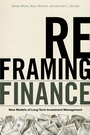
Ashby Monk | Rajiv Sharma | Duncan L. Sinclair
Reframing Finance
New Models of Long-Term Investment Management
Book
08/2017
Stanford Economics and Finance
€141.50
Shipment within 15-20 days
Persons
Ashby Monk is Executive and Research Director of Stanford University's Global Projects Center.Rajiv Sharma is Research Program Manager at Stanford's Global Projects Center and Visiting Research Associate at Oxford University's Smith School of Enterprise and the Environment. Duncan L. Sinclair is Vice Chair at Deloitte.
Content
1. A Collaborative Model for Long-Term Investing
2. Building an Institutional Investor's Collaborative Network and Social Capital
3. Re-intermediating Investment Management
4. New Vehicles to Drive the Collaborative Model
5. The Future of Long-Term Institutional Investment
2. Building an Institutional Investor's Collaborative Network and Social Capital
3. Re-intermediating Investment Management
4. New Vehicles to Drive the Collaborative Model
5. The Future of Long-Term Institutional Investment

