

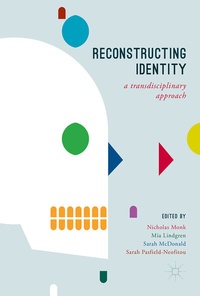
Reconstructing Identity
Description

This book examines the notion of identity through a multitude of interdisciplinary approaches. It collects current thinking from international scholars spanning philosophy, history, science, cultural studies, media, translation, performance, and marketing, each with an outlook informed by their own subject and a mission to reflect on a theme that is greater than the sum of its parts. This project was born out of a dynamic international and interdisciplinary pedagogical experience. While by no means a teaching guide or textbook, the authors' experience of sharing the module with their students reinforced the fluidity and elusiveness of identity and its persistent facility to escape disciplinary classification. Identity as a subject for analysis and discussion, and as a lived reality for all of us, has never been more complex and multi-faceted. Each chapter of this singular collection provides a lens through which the concept of identity can be viewed and as the book progresses it moves from ideas based in disciplinary contexts - biology, psychiatry, philosophy, to those developed in multi and inter disciplinary contexts such as area studies, feminism and queer studies.
More details
Other editions
Additional editions
Persons
Nicholas Monk is the director of the Institute for Advanced Teaching and Learning, University of Warwick, UK. He was the lead author of Open-space Learning: a Transdisciplinary Pedagogy .
Mia Lindgren is Head of Media, Film and Journalism at Monash University, Australia. She is co-author of two books about broadcasting: Australian Broadcast Journalism , now in its third edition, and D en Självkörda Radioboken.
Sarah McDonald is Associate Dean of Education in the Faculty of Arts at Monash University, Australia. She researches and publishes in the emerging field of cultural literacy, specifically the development of research-based practice models for embedding cultural literacy skills in the currculum.
Sarah Pasfield-Neofitou is an adjunct research fellow at Monash University, Australia. She has worked as a lecturer in sociolinguistics, applied linguistics and Japanese.
Content
1. Introduction.- 2. Identity and Mental Health.- 3. Philosophy and Identity: If My Brain is Damaged, do I Become a Different Person?.- 4. Biology and Identity.- 5. Technologically Mediated Forms of Identity.- 6. Narrative and Identity: Telling Your Own Stories in the Media.- 7. Hyphenated Identities.- 8, Translating the Self.- 9. National Identity.- 10. Gendered Identity and Performative Identity.- 11. The Role Brands Play in Creating Personal Identity.
