

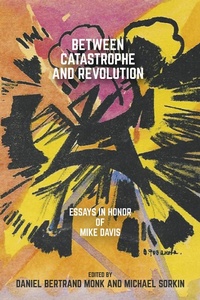
Between Catastrophe and Revolution
Description

It is all worse than we think. It is even worse than Mike Davis, for whom "every day is judgment day" (The Nation), could have imagined. The contributions to this volume are explorations of what Davis-in typical wry fashion-once referred to as the field of "disaster studies." Collectively, they show how our "disaster imaginary" has been rendered inadequate by the existing order's ability to feed off and coopt our resistance to it.
Contemporary mass protests are now subsumed as instances of an established, profitable politics of rage. Geopolitical conflict poses not as a threat to hegemonic power but rather serves the interests of a global market which capitalizes on lucrative, permanent war. Climate change itself, if it was ever thought to be a universalizing phenomenon, is now treated as an extensive market opportunity by global risk insurance conglomerates and predatory lenders who bet against any rescue of the planet.
Such catastrophic developments resist the language we use to describe and deconstruct them. The contributions to this volume seek to reimagine our understanding of disaster, and, following the example of Davis himself, to refuse outdated models of political transcendence as vigorously as they reject narratives of resignation.
More details
Other editions
Additional editions
Persons
Daniel Bertrand Monk holds the George R. and Myra T. Chair in Peace and Conflict Studies at Colgate University, where he is professor of Geography and Middle East Studies. He is the author of An Aesthetic Occupation, as well as a number of other studies on the territorial and spatial practices of the Israel-Palestine conflict. Monk is the recipient of a MacArthur Foundation Fellowship in International Peace and Security [SSRC-CIPS], as well as a Woodrow Wilson Fellowship [WWICS] for his contributions to research on contemporary conflict.
Michael Sorkin was Distinguished Professor of Architecture and Director of the Graduate Program in Urban Design at the City College of New York. He served as president of Terreform, a nonprofit urban research and advocacy center, publisher and editor of UR Books, and architecture critic for The Nation. Sorkin passed away from Covid-19 on 26 March 2020.
Content
- Front Cover
- Back Cover
- Half-Title Page
- Title Page
- Copyright Page
- Dedication
- Contents
- Preface: "How About Just Plain 'Catastrophe and Revolution'?"
- Introduction: A Dialectic of Catastrophe and Revolution
- A Sorrowful Storm: Between Penitence and Anthropolitics in the Anthropocene
- Planetary Events, Climate Catastrophes, and the Limits of the Human Sciences
- A Late Neoliberal Holocaust
- Settler Colonial Urbanism: From Waawiyaataanong to Detroit at Little Caesars Arena
- Steel Bloom: Lineages and Landmarks of Borderland Violence
- Where Did the Future Go? Notes on the Fantasies and Strategies of the Hyper-Right from the United States to Brazil
- Eruptions of Rage
- A Theory of the Middle East: Oil for Insecurity, Permanent War, and the Political Economy of Late Imperial America
- Maximalist Elites and the Ecological Burden of Southern History
- Aviation, Hijackings, and the Eclipse of the "American Century" in the Middle East
- Lineages of Infrastructural Power: Los Angeles as a Logistical Nightmare
- Death Cults of East Anglia
- The Calculus of Climate Change
- Gated Ecologies
- Othering the Mall
- Contributors
