

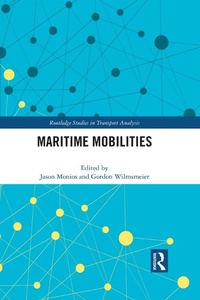
Maritime Mobilities
Published on 1. December 2017
238 pages
978-1-315-31135-7 (ISBN)
Description

The central concerns of mobilities research - exploring the broader context and human aspects of movement - are fundamental to an understanding of the maritime freight transport sector.
Challenges to the environment, attempts at more sustainable practices, changes in the geoeconomic system, political power, labour, economic development and governance issues are all among the topics covered in this book. The aim of this volume is to address issues of maritime transport not only in the simple context of movement but within the mobilities paradigm. The goal is to examine negative system effects caused by blockages and inefficiencies, examine delays and wastage of resources, identify negative externalities, explore power relations and identify the winners and losers in the globalised trade system with a particular focus on the maritime network. Maritime Mobilities therefore aims to build a bridge between "traditional" maritime academic approaches and the mobilities paradigm.
This volume is of great importance to those who study industrial economics, shipping industries and transport geography.
Challenges to the environment, attempts at more sustainable practices, changes in the geoeconomic system, political power, labour, economic development and governance issues are all among the topics covered in this book. The aim of this volume is to address issues of maritime transport not only in the simple context of movement but within the mobilities paradigm. The goal is to examine negative system effects caused by blockages and inefficiencies, examine delays and wastage of resources, identify negative externalities, explore power relations and identify the winners and losers in the globalised trade system with a particular focus on the maritime network. Maritime Mobilities therefore aims to build a bridge between "traditional" maritime academic approaches and the mobilities paradigm.
This volume is of great importance to those who study industrial economics, shipping industries and transport geography.
More details
Series
Language
English
Place of publication
London
United Kingdom
Publishing group
Taylor & Francis Ltd
Target group
College/higher education
Product notice
Reflowable
Illustrations
30 s/w Abbildungen, 2 s/w Tabellen, 5 s/w Photographien bzw. Rasterbilder, 25 s/w Zeichnungen
2 Tables, black and white; 25 Line drawings, black and white; 5 Halftones, black and white; 30 Illustrations, black and white
File size
2,27 MB
ISBN-13
978-1-315-31135-7 (9781315311357)
Copyright in bibliographic data and cover images is held by Nielsen Book Services Limited or by the publishers or by their respective licensors: all rights reserved.
Schweitzer Classification
Other editions
Additional editions
Jason Monios | Gordon Wilmsmeier
Maritime Mobilities
Book
08/2020
1st Edition
Routledge
€65.70
Shipment within 15-20 days
Jason Monios | Gordon Wilmsmeier
Maritime Mobilities
Book
12/2017
1st Edition
Routledge
€215.77
Shipment within 10-20 days
Persons
Jason Monios is Associate Professor in Maritime Logistics at Kedge Business School, Marseille, France. His research areas include intermodal transport and logistics, port system evolution, collaboration and integration in port hinterlands, port governance and policy, institutional and regulatory settings and port sustainability.
Gordon Wilmsmeier holds the Kuehne Professorial Chair in Logistics at the Universidad de los Andes in Bogota, Colombia. From 2011 to 2017, he worked as Economic Affairs Officer in the Infrastructure Services Unit at the United Nations Economic Commission for Latin America and the Caribbean (UN-ECLAC).
Gordon Wilmsmeier holds the Kuehne Professorial Chair in Logistics at the Universidad de los Andes in Bogota, Colombia. From 2011 to 2017, he worked as Economic Affairs Officer in the Infrastructure Services Unit at the United Nations Economic Commission for Latin America and the Caribbean (UN-ECLAC).
Content
INTRODUCTION
1. Introduction: applying the mobilities paradigm to the maritime sector
Jason Monios and Gordon Wilmsmeier
GEOGRAPHIC AND INSTITUTIONAL MOBILITIES
2. Critical geographies of the ocean: mobilities, placefulness and maritime relationalism
Basil Germond and Celine Germond-Duret
3. Ports as capitalist spaces
Jason Monios and Gordon Wilmsmeier
4. How people green the port
Kristianne Hendricks and Peter Hall
ECONOMIC MOBILITIES
5. Off shore: the sustainable city and its logistical costs
Boris Vormann and Patrick DeDauw
6. Costs and benefits of mobility: the case of Chinese seafarers
Lijun Tang and Gang Chen
7. 'Cruise to the Edge'. How 1970s prog-rock dinos found a safe haven on the cruise ship
Markus Hesse
SUSTAINABLE MOBILITIES
8. Ballast water and harmful aquatic organism mobilities
Matej David and Stephan Gollasch
9. Mobilities of waste, value and materials in the shadow of the maritime transport system: a case study of the Pakistani ship breaking industry
Lars Bomhauer-Beins and Anke Struever
INDUCED AND UNPRODUCTIVE MOBILITIES
10. Unproductive mobilities and maritime system capacity
Jason Monios and Gordon Wilmsmeier
11. Before the "hangover"
Gordon Wilmsmeier, Marta Gonzalez-Aregall and Ricardo J. Sanchez
12. The economic development effect of a transhipment port: the case of Gioia Tauro
Mario Genco, Emanuela Sirtori and Silvia Vignetti
13. The unproductive and induced mobility of empty container repositioning in peripheral regions
Jason Monios and Yuhong Wang
1. Introduction: applying the mobilities paradigm to the maritime sector
Jason Monios and Gordon Wilmsmeier
GEOGRAPHIC AND INSTITUTIONAL MOBILITIES
2. Critical geographies of the ocean: mobilities, placefulness and maritime relationalism
Basil Germond and Celine Germond-Duret
3. Ports as capitalist spaces
Jason Monios and Gordon Wilmsmeier
4. How people green the port
Kristianne Hendricks and Peter Hall
ECONOMIC MOBILITIES
5. Off shore: the sustainable city and its logistical costs
Boris Vormann and Patrick DeDauw
6. Costs and benefits of mobility: the case of Chinese seafarers
Lijun Tang and Gang Chen
7. 'Cruise to the Edge'. How 1970s prog-rock dinos found a safe haven on the cruise ship
Markus Hesse
SUSTAINABLE MOBILITIES
8. Ballast water and harmful aquatic organism mobilities
Matej David and Stephan Gollasch
9. Mobilities of waste, value and materials in the shadow of the maritime transport system: a case study of the Pakistani ship breaking industry
Lars Bomhauer-Beins and Anke Struever
INDUCED AND UNPRODUCTIVE MOBILITIES
10. Unproductive mobilities and maritime system capacity
Jason Monios and Gordon Wilmsmeier
11. Before the "hangover"
Gordon Wilmsmeier, Marta Gonzalez-Aregall and Ricardo J. Sanchez
12. The economic development effect of a transhipment port: the case of Gioia Tauro
Mario Genco, Emanuela Sirtori and Silvia Vignetti
13. The unproductive and induced mobility of empty container repositioning in peripheral regions
Jason Monios and Yuhong Wang
