

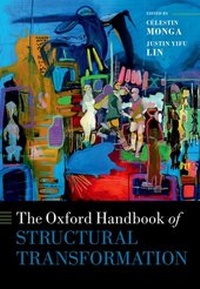
The Oxford Handbook of Structural Transformation
1st Edition
Published on 7. February 2019
608 pages
978-0-19-251269-7 (ISBN)
Description

The Oxford Handbook of Structural Transformation addresses the economics of structural transformation around the world. It deals with major themes, which include history and context, critical issues and concepts, methodological foundations, main theoretical approaches, policy issues, some illuminating country experiences of structural transformation, and important debates on the respective roles of the market and the state in that process.
The historical record provides a challenge for economists to understand the success of the rising economic powers (some of them initially considered unlikely candidates for prosperity) and the stagnation or decline of others. Five major questions emerge:
· Why has so much divergence occurred among nations of the world since the Industrial Revolution, and particularly during the 20th century?
· Why has the pattern changed recently with the emergence of a few developing economies (e.g. the multi-polar world), and can it be sustained?
· What are the key drivers, strategies, and policies, to foster structural transformation in various different country contexts and in a constantly evolving global economy?
· How could low- and middle-income countries avoid development traps and learn from past experiences whilst exploiting the new opportunities offered by the Fourth Industrial Revolution?
· What is the role of various development stakeholders and other important players in facilitating sustained economic convergence among nations?
This book addresses these questions, bringing the rigor, usefulness, and multi-disciplinary scope of the Oxford Handbook series to a critical topic in economics. The Oxford Handbook of Structural Transformation is an essential reference work and a stimulus to new research and creativity across all branches of the social sciences.
More details
Other editions
Additional editions
Celestin Monga | Justin Yifu Lin
The Oxford Handbook of Structural Transformation
Book
02/2019
Oxford University Press
€202.50
Shipment within 15-20 days
Persons
Dr. Célestin Monga is Vice-President, Economic Governance and Knowledge Management at the African Development Bank Group. He also teaches economics at the University of Paris 1 Panthéon-Sorbonne, France, and Peking University, China. He has held various board and senior executive positions in academia, financial services, and international development institutions, serving most recently as Managing Director at the United Nations Industrial Development Organization (UNIDO), and Senior Economic Adviser-Director at the World Bank. Dr. Monga has published extensively on various dimensions of economic and political development. His books have been translated into several languages and are widely used as teaching tools in academic institutions around the world.
Professor Justin Yifu Lin, former Senior Vice-President and Chief Economist of the World Bank, is Dean of the Institute for New Structural Economics and the Institute of South-South Cooperation and Development, and Honorary Dean at the National School of Development, Peking University. He is a member of the Standing Committee, Chinese People's Political Consultation Conference, and Vice Chairman of the All-China Federation of Industry and Commerce. He is a Corresponding Fellow of the British Academy and a Fellow of the Academy of Sciences for Developing World.
Content
- Introduction: Overcoming the Curse of Destiny
- Section I: Theories and Frameworks of Structural Change
- 1: Joseph E. Stiglitz: Structural Transformation, Deep Downturns, and Government Policy
- 2: Roger Rogerson: Structural Transformation and Growth: Theoretical Considerations,
- 3: Justin Yifu Lin and Yong Wang: Remodeling Structural Change
- 4: Ravi Kanbur: Structural Transformation and Income Distribution: Kuznets and Beyond
- 5: Terutomo Ozawa: The Flying Geese Theory: A Reassessment
- 6: C. Peter Timmer: Changing Income Inequality during Structural Transformation: The Role of Agricultural Prices
- 7: Christian Ketels: Structural Transformation: A Competitiveness-Based View
- Section II: Drivers, Channels, and Policy Instruments
- 8: Giovanni Federico: Trade and Structural Change over Two Centuries
- 9: Enisse Kharroubi and Luiz A. Pereira da Silva: Financial Reforms, Financial Development and Structural Change
- 10: Laura Alfaro and Maggie Xiaoyang Chen: Location Fundamentals, Agglomeration Economies, and the Geography of Multinational Firms
- 11: Pauline Lectard: Sustainable Structural Change in the Context of Global Value Chains
- 12: Xubei Luo and Gary Gereffi: Participation in Global Value Chains: Challenges and Opportunities
- 13: Xiaobo Zhang: Building Effective Clusters and Industrial Parks
- 14: Kevin Lu and Cledan Mandri-Perrott: Infrastructure Finance: Mobilizing Long-Term Liability Embedded Funds from International Institutional Investors to Emerging Markets
- Section III: Empirics of Structural Change
- 15: Célestin Monga and Samuel Standaert: Measuring Structural Change
- 16: Phillip Pardey and Julian M. Alston: Transforming Traditional Agriculture Redux
- 17: Nobuya Haraguchi: Manufacturing and Employment in Large Countries
- 18: Kalpana Kochhar, Sonali Jain-Chandra, and Monique Newiak: Global Megatrends and the Macroeconomics of Gender
- Section IV: Country and Regional Experiences
- 19: Jose Antonio Ocampo: The Transformation of Latin American Economies
- 20: Deepak Nayyar: India's Path to Transformation: An Exception to the Rule
- 21: Khalid Ikram: Structural Transformation in Egypt, 1965-2015
- 22: Dang Thi Thu Hoai, Finn Tarp, and Dirk van Seventer: Growth and Structural Transformation in Viet Nam: The Real Story Beneath
- 23: Barry Naughton: Economic Reform and Structural Change: The Chinese Experience
- 24: Keun Lee: Financing Industrial Development in Korea and Implications for Africa
- 25: Wan-wen Chu: How Taiwan Managed to Grow: Structural Transformation and Industrial Policy
- 26: Arkebe Oqubay: Ethiopia: Lessons from an Experiment
- 27: Xinshen Diao, Josaphat Kweka, and Margaret McMillan: Economic Transformation in Africa from the Bottom Up: New Evidence from Tanzania
- 28: Tchétché Nguessan: Growth and Structural Transformation in the WAEMU Countries
- Section V: Concluding Thoughts
- 29: Célestin Monga: Truth is the Safest Lie: A Reassessment of Development Economics
- 30: Roger Myerson: American Democracy: Lessons for Global Development
- 31: Edmund Phelps: Desirable Directions of Structural Transformation
