

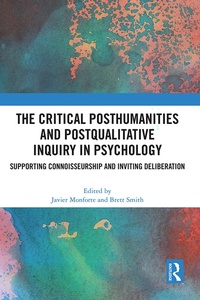
The Critical Posthumanities and Postqualitative Inquiry in Psychology
Supporting Connoisseurship and Inviting Deliberation
Published on 25. March 2026
180 pages
978-1-040-88716-5 (ISBN)
Description

At the turn of the 21st century, after decades of resisting the quantitative imperative, qualitative psychology and the psychological humanities seemed to have found some respite. However, the sense of stability was soon disrupted by the posthuman and postqualitative critique of humanism and the conventional assumptions and practices of qualitative research. How have (qualitative) psychologists responded to this? For the most part, they have chosen to either sweep the 'posts' under the rug or to carelessly dismiss them as faddish folderol. This collection supports a more grounded response, not by persuading readers that 'post inquiry' is good and should be accepted, but by helping them evaluate its claims thoughtfully. This is one of the first collections to address questions such as:
What is post qualitative inquiry and where did it come from?
What does posthumanism mean for our understanding of ourselves as persons?
What should we make of the 'critical' in critical posthumanisms?
Are qualitative and postqualitative inquiries incommensurable?
What might the 'posts' mean to phenomenology and ethnography?
This volume includes contributions from leading voices such as Elisabeth St.Pierre, Svend Brinkmann, and Vivienne Bozalek, as well as emerging scholars who were introduced to research in a period characterised by multiple competing paradigms. This book was originally published as a special issue of Qualitative Research in Psychology.
What is post qualitative inquiry and where did it come from?
What does posthumanism mean for our understanding of ourselves as persons?
What should we make of the 'critical' in critical posthumanisms?
Are qualitative and postqualitative inquiries incommensurable?
What might the 'posts' mean to phenomenology and ethnography?
This volume includes contributions from leading voices such as Elisabeth St.Pierre, Svend Brinkmann, and Vivienne Bozalek, as well as emerging scholars who were introduced to research in a period characterised by multiple competing paradigms. This book was originally published as a special issue of Qualitative Research in Psychology.
More details
Language
English
Place of publication
London
United Kingdom
Publishing group
Taylor & Francis Ltd
Target group
College/higher education
Product notice
Reflowable
File size
2,04 MB
ISBN-13
978-1-040-88716-5 (9781040887165)
Copyright in bibliographic data and cover images is held by Nielsen Book Services Limited or by the publishers or by their respective licensors: all rights reserved.
Schweitzer Classification
Other editions
Additional editions
Javier Monforte | Brett Smith
The Critical Posthumanities and Postqualitative Inquiry in Psychology
Supporting Connoisseurship and Inviting Deliberation
Book
03/2026
1st Edition
Routledge
€210.30
Shipment within 15-20 days
Persons
Javier Monforte is an assistant professor in the Department of Physical Education and Sport at the University of Valencia, Spain.
Brett Smith is a professor in the Department of Sport and Exercise Sciences at Durham University, UK.
Brett Smith is a professor in the Department of Sport and Exercise Sciences at Durham University, UK.
Content
The critical posthumanities and postqualitative inquiry in psychology: an introduction 1. A primer for post qualitative inquiry 2. Persons in a posthuman world 3. Experience without essentialism: on 'posting' phenomenology 4. Failing ethnographies as post-qualitative possibilities: reflections from critical posthumanities and critical disability studies 5. Critical posthumanisms, postqualitative inquiry, and conventional qualitative research: some interrogations and contemplations on their entangled identities and futurities 6. Making the universe together: Baradian inspirations for the future of qualitative psychology 7. Psychology, the posts, and qualitative research: a conclusion
