

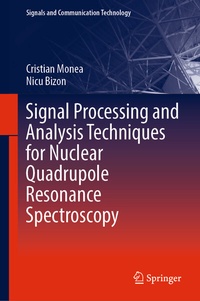
Signal Processing and Analysis Techniques for Nuclear Quadrupole Resonance Spectroscopy
Description

This book is about improving prohibited substances detection using the nuclear quadrupole resonance (NQR) technique at security checkpoints. The book proposes multiple signal processing and analysis techniques for improving detection of dangerous or contraband substances, such as explosives, narcotics, or toxic substances. Also, several hardware solutions are described and implemented in a custom-designed NQR spectrometer. A new approach to NQR signal detection is introduced using artificial intelligence/deep learning techniques. The book will be useful for for researchers and practitioners in the areas of electrical engineering, signal processing and analysis, applied spectroscopy, as well as for security or laboratory equipment manufacturers.
More details
Other editions
Additional editions
Persons
Nicu Bizon received a five-year degree in electronic engineering from the University Polytechnic of Bucharest, Romania, in 1986, and the PhD degree in Automatic Systems and Control from the same university, in 1996. Firstly, he was in hardware design with the Dacia Renault SA, Romania. Currently, he is Professor with the University of Pitesti, Romania, being the dean of the Faculty of Electronics (2012-2017), Communication and Computers. Also, he was head of University Research Department (2004-2008) and ExecutiveDirector of the Research Centre "Modeling and simulation processes and systems" (2008-2012), being manager of four research projects in field of Green and Hydrogen Energy, and teams member in other ten projects in the same research field. He is editor of seven books and author of five books in field of Green Energy, Hybrid Power Sources and Power Converters. His current research interests include the broad area of nonlinear systems, on both dynamics and control applied in the Green Energy field. He was authored or co-authored of several papers (over 300) in journals (web of knowledge (WoS) data base or other indexed data bases: WoS Hirsh index = 24) or international conferences proceedings. He has expertise in the field of renewable energy, being evaluator of Research Projects for H2020 and FP7 Calls, EVAL-INCO and EACI Calls, NSRF 2007-13 (Greece), NEWFELPRO 2013-17 (Croatia), CNCSIS Ideas and ANCS PN II Calls (Romania) etc. He is general chair and proceedings Editor of the Electronics, Computers and Artificial Intelligence - ECAI Conference, Editor-in-Chief of Journal of Electrical Engineering, Electronics, Control and Computer Science - JEEECCS, and member of the Editorial/Technical Board of several international WoS Journals and Conferences. He is IEEE Senior member from 2016. He was chair with Management of Technical Activities for IEEE Romania Section (2012).
