

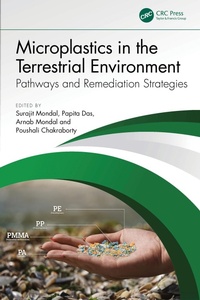
Microplastics in the Terrestrial Environment
Pathways and Remediation Strategies
1st Edition
Published on 29. November 2024
394 pages
978-1-040-25243-7 (ISBN)
Description

This book aims to address details and research gaps in the impacts of microplastics in terrestrial ecosystems. It addresses the impact of microplastics on the soil environment, and highlights and discusses their transport behavior, pollution level, and the combined effects of the microplastics with other pollutants on the soil ecology. Furthermore, it also highlights the effects of UV irradiations and mechanical abrasions from soil fauna and various agricultural practices.
Features:
Covers advances in plastic/micro-/nano-plastic pollution and possible pathways of pollution.
Demonstrates the mitigation measures to minimize such pollution loads, with a special focus on the application of nanotechnology.
Explores recycle and value-added products from waste plastic.
Promotes development of alternate clean energy sources.
Introduces appropriate alternatives and/or finding strategies to mitigate the existing microplastic crisis using suitable approaches.
This book is aimed at researchers and graduate students in environmental and chemical engineering, as well as remediation.
Features:
Covers advances in plastic/micro-/nano-plastic pollution and possible pathways of pollution.
Demonstrates the mitigation measures to minimize such pollution loads, with a special focus on the application of nanotechnology.
Explores recycle and value-added products from waste plastic.
Promotes development of alternate clean energy sources.
Introduces appropriate alternatives and/or finding strategies to mitigate the existing microplastic crisis using suitable approaches.
This book is aimed at researchers and graduate students in environmental and chemical engineering, as well as remediation.
More details
Edition
1. Auflage
Language
English
Place of publication
London
United Kingdom
Publishing group
Taylor & Francis Ltd
Target group
College/higher education
Professional and scholarly
Illustrations
21 Tables, black and white; 47 Line drawings, black and white; 20 Halftones, black and white; 67 Illustrations, black and white
File size
9,11 MB
ISBN-13
978-1-040-25243-7 (9781040252437)
Copyright in bibliographic data and cover images is held by Nielsen Book Services Limited or by the publishers or by their respective licensors: all rights reserved.
Schweitzer Classification
Other editions
Additional editions
Surajit Mondal | Papita Das | Arnab Mondal
Microplastics in the Terrestrial Environment
Pathways and Remediation Strategies
Book
approx. 07/2026
1st Edition
CRC Press
€69.50
Not yet published
Surajit Mondal | Papita Das | Arnab Mondal
Microplastics in the Terrestrial Environment
Pathways and Remediation Strategies
Book
11/2024
1st Edition
CRC Press
€207.50
Shipment within 10-20 days
Persons
Dr. Surajit Mondal completed his masters in Energy Systems and PhD on the Renewable Energy domain in 2020. Currently he is teaching in University of Petroleum and Energy Studies to UG and PG students. He has published more than 32 international research and review articles as an author/co-author. He has published 42 patents and granted eight patents against his name. He has completed 2 DST (Govt. of India) funded projects in the field of Energy Systems/Sustainability.
Professor Papita Das did her PhD in Chemical Engineering from Jadavpur University, India. She is Professor, Department of Chemical Engineering & Director, School of Advanced Studies in Industrial Pollution Control Engineering, Jadavpur University, Kolkata, India. She is known for her work in water treatment using different novel adsorbents materials. She is also working on biomass-based energy production and polymeric-nanocomposite synthesis and its degradation. She has published more than 175 International journal research articles and reviews and more than 50 book chapters in various SCI and Scopus indexed journals. She also Ranked in World Ranking among the top 2% Scientists (2020, 2021, and 2022), published by Stanford University, which represents the top 2% most cited scientists in various disciplines. She ranked 432 among 53,348 researchers in the field of Chemical Engineering (2022) based on career-long impact and 171 for a single year citations in 2021. She ranked 614 among 55,697 researchers in Chemical Engineering (2020) and 534 among 66,189 researchers in the field of Chemical Engineering (2021) based on career-long impact and ranked 217 for the single year 2020 discipline. She also guided ten PhD students (completed), two (submitted), and seven (ongoing). She was editor of two books published by Elsevier and Springer, and she is an editorial board member, Editor-in-Chief, and Associate Editor of various international journals. She has completed 17 projects funded by Indian Govt. agencies and industries.
Dr. Arnab Mondal earned his PhD from the Academy of Scientific and Innovative Research, conducting research at CSIR-National Physical Laboratory in New Delhi. Currently, he holds the position of Research Associate at Banaras Hindu University in Varanasi, India. Dr. Mondal has authored/co-authored over 15 international research and review articles. He pursued his master's degree at the Institute of Environment and Sustainable Development (IESD), Banaras Hindu University, Varanasi.
Ms. Poushali Chakraborty is currently pursuing her PhD in the Chemical Engineering Department of Jadavpur University. She has received her BSc degree from University of Calcutta in Zoology Hons in 2018 and her MSc degree in Biotechnology in 2020 from Jadavpur University. She has worked as Research Assistant in Manovikas Kendra. She is currently working in the field of advanced technologies for water treatment, synthesis of biopolymers for drug delivery, packaging purposes and water treatment, and microbial bioremediation. Her other interests are synthesizing membranes, Aerogel, and advanced bioremediation techniques. She has presented her research papers at several international conferences. She has published book chapters and research papers in international journals.
Professor Papita Das did her PhD in Chemical Engineering from Jadavpur University, India. She is Professor, Department of Chemical Engineering & Director, School of Advanced Studies in Industrial Pollution Control Engineering, Jadavpur University, Kolkata, India. She is known for her work in water treatment using different novel adsorbents materials. She is also working on biomass-based energy production and polymeric-nanocomposite synthesis and its degradation. She has published more than 175 International journal research articles and reviews and more than 50 book chapters in various SCI and Scopus indexed journals. She also Ranked in World Ranking among the top 2% Scientists (2020, 2021, and 2022), published by Stanford University, which represents the top 2% most cited scientists in various disciplines. She ranked 432 among 53,348 researchers in the field of Chemical Engineering (2022) based on career-long impact and 171 for a single year citations in 2021. She ranked 614 among 55,697 researchers in Chemical Engineering (2020) and 534 among 66,189 researchers in the field of Chemical Engineering (2021) based on career-long impact and ranked 217 for the single year 2020 discipline. She also guided ten PhD students (completed), two (submitted), and seven (ongoing). She was editor of two books published by Elsevier and Springer, and she is an editorial board member, Editor-in-Chief, and Associate Editor of various international journals. She has completed 17 projects funded by Indian Govt. agencies and industries.
Dr. Arnab Mondal earned his PhD from the Academy of Scientific and Innovative Research, conducting research at CSIR-National Physical Laboratory in New Delhi. Currently, he holds the position of Research Associate at Banaras Hindu University in Varanasi, India. Dr. Mondal has authored/co-authored over 15 international research and review articles. He pursued his master's degree at the Institute of Environment and Sustainable Development (IESD), Banaras Hindu University, Varanasi.
Ms. Poushali Chakraborty is currently pursuing her PhD in the Chemical Engineering Department of Jadavpur University. She has received her BSc degree from University of Calcutta in Zoology Hons in 2018 and her MSc degree in Biotechnology in 2020 from Jadavpur University. She has worked as Research Assistant in Manovikas Kendra. She is currently working in the field of advanced technologies for water treatment, synthesis of biopolymers for drug delivery, packaging purposes and water treatment, and microbial bioremediation. Her other interests are synthesizing membranes, Aerogel, and advanced bioremediation techniques. She has presented her research papers at several international conferences. She has published book chapters and research papers in international journals.
Content
1. Insights review of electrochemical sensors for microplastics monitoring and their remediation 2. Microplastics Degradation technologies and Remediation Techniques from Aquatic Systems 3. Efficacy of bacterial consortium on Microplastic mineralization at municipal dumping grounds 4. Microplastics in Atmospheric Pathways, Depositions, and Remediation Techniques 5. Microplastic Pollution in soil ecosystem and emerging recycling techniques 6. Impact of Microplastics in Terrestrial Food Production 7. Microplastics Degradation and Remediation Techniques 8. Exploring microplastic and natural fiber emissions from fabrics and textiles 9. Effect of microplastic pollution on soil, plants, and soil microbes 10. Unveiling the Microplastic Menace: Exploring Soil Microbiome and Ecological Consequences 11. Bioplastic: an alternate of plastic materials and its application 12. Ecological impact of microplastics in terrestrial ecosystem: a concise review 13. Bioremediation of Microplastic Wastes in Soil 14. Extraction of Microplastics from Rhizosphere 15. Microplastics in food Products 16. Current Microplastic Scenario and Their Adverse Effects On The Ecosystem 17. Bioremediation of microplastics by Cyanobacteria 18. Critical evaluation of remediation methods for microplastic pollution in sewage water 19. Investigation of Prevailing Directives Regarding Microplastic Pollution: Research Gaps and Recent Advancements
