

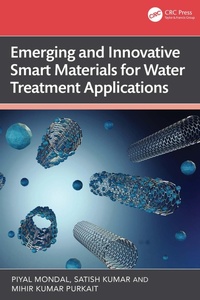
Emerging and Innovative Smart Materials for Water Treatment Applications
1st Edition
Published on 2. December 2025
242 pages
978-1-040-76524-1 (ISBN)
Description

This book explains the fundamental and advanced topics related to the field of different nano and macro structure-based materials toward combating the problem of water treatment, focusing on smart and advanced materials, their necessity, and advantages over other conventional materials. The sources and effects of hazardous contaminants, the shortcomings of conventional treatment, have been discussed in detail, along with the beneficial properties of various smart materials, including stimuli-responsive, carbon-based, bio, and nano-structured materials.
This book:
Features current state-of-the-art investigation and improvements in smart materials for water treatment
Analyzes the effects of smart materials on the environment and their long-term viability
Includes a performance improvement section in each chapter, including a comparison between smart and conventional materials
Discusses the drawbacks and shortcomings of the materials being used in traditional water treatment processes
Explores how to incorporate smart materials into current treatment methods
This book is aimed at researchers and graduate students in chemical and water engineering and materials science.
This book:
Features current state-of-the-art investigation and improvements in smart materials for water treatment
Analyzes the effects of smart materials on the environment and their long-term viability
Includes a performance improvement section in each chapter, including a comparison between smart and conventional materials
Discusses the drawbacks and shortcomings of the materials being used in traditional water treatment processes
Explores how to incorporate smart materials into current treatment methods
This book is aimed at researchers and graduate students in chemical and water engineering and materials science.
More details
Edition
1. Auflage
Language
English
Place of publication
London
United Kingdom
Publishing group
Taylor & Francis Ltd
Target group
Professional and scholarly
College/higher education
Illustrations
6 Tables, black and white; 41 Line drawings, black and white; 12 Halftones, black and white; 53 Illustrations, black and white
File size
8,54 MB
ISBN-13
978-1-040-76524-1 (9781040765241)
Copyright in bibliographic data and cover images is held by Nielsen Book Services Limited or by the publishers or by their respective licensors: all rights reserved.
Schweitzer Classification
Other editions
Additional editions
Piyal Mondal | Satish Kumar | Mihir Kumar Purkait
Emerging and Innovative Smart Materials for Water Treatment Applications
Book
approx. 12/2025
1st Edition
CRC Press
€177.10
Not yet published
Persons
Piyal Mondal received his BTech in Chemical Engineering from the National Institute of Technology Durgapur, West Bengal (INDIA) during 2012. He completed his master's degree (2015) and Ph.D. degree (2021) in Chemical Engineering from the Indian Institute of Technology Guwahati (INDIA). He is currently engaged as a Post Doctoral Research Associate under Professor Chair IIT Guwahati, Jal Jeevan Mission, Ministry of Jal Shakti (Government of India). His research work is dedicated to preparing various surface engineered polymers for specific environmental applications.
Satish Kumar is a dedicated chemical engineer who has a keen interest in new and cutting-edge smart materials for water treatment. He received his undergraduate degree in chemical engineering from Jiwaji University in Gwalior and his master's degree in chemical engineering from NIT Calicut, where he conducted research on nanomaterial-based materials for solar thermal energy storage. He is currently pursuing his Ph.D. in Chemical Engineering at the Indian Institute of Technology in Guwahati, Assam, India.
Mihir Kumar Purkait is a Professor in the Department of Chemical Engineering, Dean of Alumni and External Affairs and ex-Head of Centre for the Environment at Indian Institute of Technology Guwahati (IITG). Prior to joining as faculty in IITG (2004), he has received his Ph. D and M. Tech in Chemical Engineering from Indian Institute of Technology, Kharagpur (IITKGP) after completing his B. Tech and B.Sc. (Hons) in Chemistry from University of Calcutta.
Satish Kumar is a dedicated chemical engineer who has a keen interest in new and cutting-edge smart materials for water treatment. He received his undergraduate degree in chemical engineering from Jiwaji University in Gwalior and his master's degree in chemical engineering from NIT Calicut, where he conducted research on nanomaterial-based materials for solar thermal energy storage. He is currently pursuing his Ph.D. in Chemical Engineering at the Indian Institute of Technology in Guwahati, Assam, India.
Mihir Kumar Purkait is a Professor in the Department of Chemical Engineering, Dean of Alumni and External Affairs and ex-Head of Centre for the Environment at Indian Institute of Technology Guwahati (IITG). Prior to joining as faculty in IITG (2004), he has received his Ph. D and M. Tech in Chemical Engineering from Indian Institute of Technology, Kharagpur (IITKGP) after completing his B. Tech and B.Sc. (Hons) in Chemistry from University of Calcutta.
Content
1. Introduction to Smart Materials for Water Treatment
2. Various Hazardous Contaminants in Underground Water: Sources and Its Effects
3. Conventional Water Treatment Techniques: Materials Used and Their Limitations
4. Stimuli-Responsive Smart Materials for Water Treatment Applications
5. Advanced Carbon-Based Smart Materials for Water Treatment
6. Application of Bio-Based Smart Materials toward Water Remediation
7. Emerging Smart Materials for Water Treatment: Unique Properties and Characteristics
8. Nanostructured Smart Materials: Advancements and Limitations in Water Treatment Applications
9. Real-Life Applications of Smart Materials in Water Treatment
10. Potential Environmental, Health, and Safety Risks Associated with Smart Materials
11. Challenges and Future Opportunities
2. Various Hazardous Contaminants in Underground Water: Sources and Its Effects
3. Conventional Water Treatment Techniques: Materials Used and Their Limitations
4. Stimuli-Responsive Smart Materials for Water Treatment Applications
5. Advanced Carbon-Based Smart Materials for Water Treatment
6. Application of Bio-Based Smart Materials toward Water Remediation
7. Emerging Smart Materials for Water Treatment: Unique Properties and Characteristics
8. Nanostructured Smart Materials: Advancements and Limitations in Water Treatment Applications
9. Real-Life Applications of Smart Materials in Water Treatment
10. Potential Environmental, Health, and Safety Risks Associated with Smart Materials
11. Challenges and Future Opportunities
