

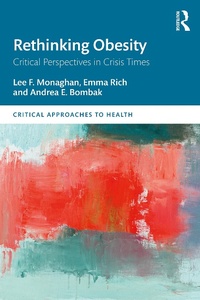
Rethinking Obesity
Critical Perspectives in Crisis Times
1st Edition
Published on 16. May 2022
300 pages
978-1-317-32999-2 (ISBN)
Description

Theoretically informed and empirically grounded, Rethinking Obesity invites readers to reconsider the medical and public health framing of population weight (gain) as a massive global problem, epidemic or crisis. Attentive to social values, scientific uncertainty and possible harms, the book furthers critique of the weight-centred health paradigm and world war on obesity. Building upon existing international literature from critical weight studies, fat studies and critical obesity research, the book advances scholarship with reference to body politics and health policy, epidemiology and obesity science, media reporting and weight-related stigma.
The authors resist the common moralised narrative that 'the overweight majority' are lazy, gluttonous, and personally responsible for their actual or potential ills and the solution ultimately necessitates individual lifestyle change. Critique is also extended to seemingly compassionate public health interventions that putatively avoid victim-blaming through an appeal to 'the obesogenic environment', a consequence of modern living. Empirical case studies are grounded in women's repeated and often frustrating experiences of dieting and schoolgirls' encounters with fat pedagogy, which challenges dominant obesity discourse. Recognising that declared public health crises may become layered and cascade through society, this book also includes timely research on the COVID-19 pandemic response amidst concerns about lockdown weight-gain, heightened risk of infection and death among people deemed overweight and obese.
Rethinking Obesity interrogates how social injustice is reproduced not only through cruelty but also through seemingly benevolent representations, pedagogies and policies. Alternative approaches and action, ranging from weight-inclusive health paradigms to broader social change, are also considered when seeking to foster collective hope in crisis times. This is valuable reading for students and researchers in medical sociology, social and population health sciences, physical education, critical weight and fat studies, and the social dimensions of the body.
The authors resist the common moralised narrative that 'the overweight majority' are lazy, gluttonous, and personally responsible for their actual or potential ills and the solution ultimately necessitates individual lifestyle change. Critique is also extended to seemingly compassionate public health interventions that putatively avoid victim-blaming through an appeal to 'the obesogenic environment', a consequence of modern living. Empirical case studies are grounded in women's repeated and often frustrating experiences of dieting and schoolgirls' encounters with fat pedagogy, which challenges dominant obesity discourse. Recognising that declared public health crises may become layered and cascade through society, this book also includes timely research on the COVID-19 pandemic response amidst concerns about lockdown weight-gain, heightened risk of infection and death among people deemed overweight and obese.
Rethinking Obesity interrogates how social injustice is reproduced not only through cruelty but also through seemingly benevolent representations, pedagogies and policies. Alternative approaches and action, ranging from weight-inclusive health paradigms to broader social change, are also considered when seeking to foster collective hope in crisis times. This is valuable reading for students and researchers in medical sociology, social and population health sciences, physical education, critical weight and fat studies, and the social dimensions of the body.
More details
Series
Edition
1. Auflage
Language
English
Place of publication
London
United Kingdom
Publishing group
Taylor & Francis Ltd
Target group
College/higher education
Professional and scholarly
Illustrations
6 Tables, black and white; 3 Halftones, black and white; 3 Illustrations, black and white
ISBN-13
978-1-317-32999-2 (9781317329992)
Copyright in bibliographic data and cover images is held by Nielsen Book Services Limited or by the publishers or by their respective licensors: all rights reserved.
Schweitzer Classification
Other editions
Additional editions
Lee F. Monaghan | Emma Rich | Andrea E. Bombak
Rethinking Obesity
Critical Perspectives in Crisis Times
Book
05/2022
1st Edition
Routledge
€61.70
Shipment within 10-20 days
Lee F. Monaghan | Emma Rich | Andrea E. Bombak
Rethinking Obesity
Critical Perspectives in Crisis Times
Book
05/2022
1st Edition
Routledge
€206.80
Shipment within 10-20 days
Persons
Lee F. Monaghan is Associate Professor of Sociology, University of Limerick, Ireland. His research and teaching largely fall within the areas of medical sociology and sociological theory. Besides advancing critical weight studies, Lee has published qualitative research on drug use among bodybuilders, physical violence in the night-time leisure economy, chronic illness among children and the embodiment of masculinities and heterosexualities.
Emma Rich is Professor of Physical Activity and Health Pedagogy, University of Bath, UK. Her research examines sport, physical activity and physical/health education from critical/socio-cultural perspectives. Working across sociology and education, her work around critical pedagogies of health and physical education has informed research projects addressing obesity policy, health education in schools, eating disorders and digital health technologies.
Andrea E. Bombak is currently Assistant Professor, University of New Brunswick, Canada. She is a social and population health scientist who leads provincially and federally funded studies on intersectional health inequities, weight stigmatisation and post-secondary food pedagogies.
Emma Rich is Professor of Physical Activity and Health Pedagogy, University of Bath, UK. Her research examines sport, physical activity and physical/health education from critical/socio-cultural perspectives. Working across sociology and education, her work around critical pedagogies of health and physical education has informed research projects addressing obesity policy, health education in schools, eating disorders and digital health technologies.
Andrea E. Bombak is currently Assistant Professor, University of New Brunswick, Canada. She is a social and population health scientist who leads provincially and federally funded studies on intersectional health inequities, weight stigmatisation and post-secondary food pedagogies.
Content
List of Tables
List of Abbreviations
Series Editors' Preface
Acknowledgements
Introduction
Part 1: The Politics of a 'Public Health Problem'
The Global Obesity Crisis: Situating Critique in a Broader Context
Critical Perspectives: Key Themes and Meta-Critique
Pedagogising Obesity Knowledges and the Recontextualisation of Policy
Part 2: Researching Matters of Fat
Obesity, Bodily Change and Health Identities: A Study of Canadian Women
Exploring Fat Pedagogy and Critical Health Education with Schoolgirls: Rethinking 'Britain's Child Obesity Disgrace'
Degrading Bodies in Pandemic Times: Politicising Cruelty during the COVID-19 and Obesity Crises
Part 3: Critically Exploring Alternatives, Fostering Collective Hope
Tired of Diets? From HAES (R) to a More Radical Approach
Rethinking Obesity in the (Post) COVID Society: Paving the Way for More 'Rounded' Knowledge and Collective Action
Epilogue: Resist TINA, Recognise TARA
References
Index
List of Abbreviations
Series Editors' Preface
Acknowledgements
Introduction
Part 1: The Politics of a 'Public Health Problem'
The Global Obesity Crisis: Situating Critique in a Broader Context
Critical Perspectives: Key Themes and Meta-Critique
Pedagogising Obesity Knowledges and the Recontextualisation of Policy
Part 2: Researching Matters of Fat
Obesity, Bodily Change and Health Identities: A Study of Canadian Women
Exploring Fat Pedagogy and Critical Health Education with Schoolgirls: Rethinking 'Britain's Child Obesity Disgrace'
Degrading Bodies in Pandemic Times: Politicising Cruelty during the COVID-19 and Obesity Crises
Part 3: Critically Exploring Alternatives, Fostering Collective Hope
Tired of Diets? From HAES (R) to a More Radical Approach
Rethinking Obesity in the (Post) COVID Society: Paving the Way for More 'Rounded' Knowledge and Collective Action
Epilogue: Resist TINA, Recognise TARA
References
Index
