

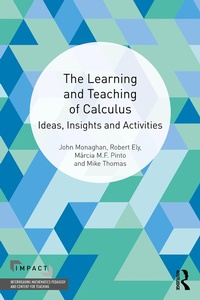
The Learning and Teaching of Calculus
Ideas, Insights and Activities
1st Edition
Published on 5. September 2023
304 pages
978-1-000-91766-6 (ISBN)
Description

This book is for people who teach calculus - and especially for people who teach student teachers, who will in turn teach calculus. The calculus considered is elementary calculus of a single variable. The book interweaves ideas for teaching with calculus content and provides a reader-friendly overview of research on learning and teaching calculus along with questions on educational and mathematical discussion topics.
Written by a group of international authors with extensive experience in teaching and research on learning/teaching calculus both at the school and university levels, the book offers a variety of approaches to the teaching of calculus so that you can decide the approach for you. Topics covered include
A history of calculus and how calculus differs over countries today
Making sense of limits and continuity, differentiation, integration and the fundamental theorem of calculus (chapters on these areas form the bulk of the book)
The ordering of calculus concepts (should limits come first?)
Applications of calculus (including differential equations)
The final chapter looks beyond elementary calculus. Recurring themes across chapters include whether to take a limit or a differential/infinitesimal approach to calculus and the use of digital technology in the learning and teaching of calculus. This book is essential reading for mathematics teacher trainers everywhere.
Written by a group of international authors with extensive experience in teaching and research on learning/teaching calculus both at the school and university levels, the book offers a variety of approaches to the teaching of calculus so that you can decide the approach for you. Topics covered include
A history of calculus and how calculus differs over countries today
Making sense of limits and continuity, differentiation, integration and the fundamental theorem of calculus (chapters on these areas form the bulk of the book)
The ordering of calculus concepts (should limits come first?)
Applications of calculus (including differential equations)
The final chapter looks beyond elementary calculus. Recurring themes across chapters include whether to take a limit or a differential/infinitesimal approach to calculus and the use of digital technology in the learning and teaching of calculus. This book is essential reading for mathematics teacher trainers everywhere.
Reviews / Votes
Back cover quotes:'I highly recommend this book. You will undoubtably be inspired and awed at the beauty of the ideas presented.' Chris Rasmussen
'The most impressive aspect of this book is that the authors cover so much ground without taking a stance on any of the controversies they so carefully explain.' Pat Thompson
'When we teach calculus, we need to know about differential and infinitesimal ways to understand calculus ... how calculus ideas evolved over time ... calculus curricula around the world ... calculus education research ... alternatives to the classic order ... calculus in solving real-world problems ... [this book] does quite a bit of all of that.' Elena Nardi
More details
Series
Edition
1. Auflage
Language
English
Place of publication
London
United Kingdom
Publishing group
Taylor & Francis Ltd
Target group
Professional and scholarly
Adult education
Product notice
Reflowable
Illustrations
2 Tables, black and white; 146 Line drawings, black and white; 3 Halftones, black and white; 149 Illustrations, black and white
ISBN-13
978-1-000-91766-6 (9781000917666)
Copyright in bibliographic data and cover images is held by Nielsen Book Services Limited or by the publishers or by their respective licensors: all rights reserved.
Schweitzer Classification
Other editions
Additional editions
John Monaghan | Robert Ely | Marcia M.F. Pinto
The Learning and Teaching of Calculus
Ideas, Insights and Activities
Book
09/2023
1st Edition
Routledge
€206.80
Shipment within 10-20 days
John Monaghan | Robert Ely | Marcia M.F. Pinto
The Learning and Teaching of Calculus
Ideas, Insights and Activities
Book
09/2023
1st Edition
Routledge
€60.70
Shipment within 10-20 days
Persons
John Monaghan is a professor at the University of Agder, Norway and an emeritus professor at the University of Leeds, UK. He has taught in schools and universities, and the learning and teaching of calculus has been a research interest throughout his career.
Robert Ely is a professor of mathematics education at the University of Idaho, United States. He studies the reasoning of students with infinitesimals, integrals, variables, and argumentation, and he is particularly interested in the perspectives that history can bring to such reasoning.
Marcia M.F. Pinto is Associate Professor at a public university in Brazil. She has experience teaching mathematics to prospective teachers, mathematicians and engineers and co-authoring textbooks for distance learning courses on calculus.
Mike Thomas is Professor Emeritus in the Mathematics Department at Auckland University, New Zealand. His research explores advanced mathematical thinking at school and university, including the role of representations, versatility and digital technology.
Robert Ely is a professor of mathematics education at the University of Idaho, United States. He studies the reasoning of students with infinitesimals, integrals, variables, and argumentation, and he is particularly interested in the perspectives that history can bring to such reasoning.
Marcia M.F. Pinto is Associate Professor at a public university in Brazil. She has experience teaching mathematics to prospective teachers, mathematicians and engineers and co-authoring textbooks for distance learning courses on calculus.
Mike Thomas is Professor Emeritus in the Mathematics Department at Auckland University, New Zealand. His research explores advanced mathematical thinking at school and university, including the role of representations, versatility and digital technology.
Content
Series foreword
1 - Introduction
2 - Calculus across time and over countries
3 - Making sense of limits and continuity
4 - Making sense of differentiation
5 - Integration and the fundamental theorem of calculus
6 - Interlude: The ordering of chapters 3, 4 and 5
7 - Calculus applications: differential equations and integration
8 - Beyond elementary calculus
Index
1 - Introduction
2 - Calculus across time and over countries
3 - Making sense of limits and continuity
4 - Making sense of differentiation
5 - Integration and the fundamental theorem of calculus
6 - Interlude: The ordering of chapters 3, 4 and 5
7 - Calculus applications: differential equations and integration
8 - Beyond elementary calculus
Index
