

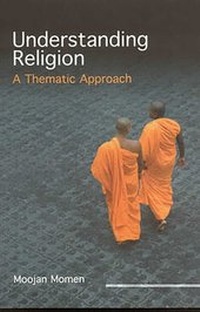
Understanding Religion
A Thematic Approach
1st Edition
Published on 20. June 2019
640 pages
978-1-78607-747-9 (ISBN)
Description

Drawing from all major religious traditions in the world, as well as a variety of non-religious disciplines such as psychology, philosophy and sociology, Momen's study is an innovative, thematic presentation of the role of religion in society, covering everything from art and history to theology and the World Wide Web.
Reviews / Votes
"This is a powerful new tool to introduce the many-sided phenomenon of religion. It is clearly written, comprehensive, and packed with information ... A very useful volume."John Hick-University of Birmingham, author of 'Philosophy of Religion'"The text is fluently and clearly written; it reads engagingly and is easy to follow." Ursula King, Professor Emerita, Senior Research Fellow, and Associate Member of the Institute for Advanced Studies, University of Bristol.More details
Language
English
Place of publication
Oxford
United Kingdom
File size
33,80 MB
ISBN-13
978-1-78607-747-9 (9781786077479)
Copyright in bibliographic data and cover images is held by Nielsen Book Services Limited or by the publishers or by their respective licensors: all rights reserved.
Schweitzer Classification
Other editions
Additional editions
Book
11/2008
Oneworld Publications
€28.50
Shipment within 3-4 weeks
Person
Dr Moojan Momen is author of a number of books on world religions including An Introduction to Shi'i Islam.
Content
- Intro
- Title
- Dedication
- Contents
- List of Maps and Timelines
- Notes and Acknowledgements
- Introduction
- The Study of Religion
- Three Aspects of Religion
- The Religions of the World
- Concept and Category
- Part I Understanding Religion
- Chapter 1 The Concept of Religion
- What is Religion?
- Definitions of Religion
- The Religious Person or Society
- Chapter 2 Religion East and West - A General Surveym
- The Nature of Ultimate Reality
- Concepts of Suffering and Evil
- The Path to Salvation
- The Goal of Salvation
- Ritual and Religious Practices
- Time and Creation
- Theism and Monism
- The Universality of Modes of Religious Thought
- Mutual Attitudes of Theism and Monism
- Relativism
- Chinese and Japanese Religion
- Primal Religions
- The Modern World
- Chapter 3 Theories of Religion
- Sociological and Anthropological Theories
- Psychological Theories
- Philosophical and Historical Theories
- Theological and Normative Theories
- Typologies of Religion
- Approaches to the Study of Religion
- The Goal of the Study of Religion
- Part II The Religious Experience And its Expressionm85
- Chapter 4 The Religious Experience
- Describing the Central Experience of Religion
- Types of Religious Experience
- The Religious Crisis
- A Psychological Model of the Stages of Religious Experience
- Mediators of Religious Experience
- The Social Influence on Religious Experience
- Chapter 5 Pathways to Religious Experience
- Ritualism
- Legalism
- Evangelism
- Social Reformism
- Asceticism
- Monasticism
- Gnosticism
- Mysticism
- The Evolution of the Pathways
- A Classification of Religious Groups
- Chapter 6 Faith, Belief and Conversion
- The Nature of Faith and Belief
- Acquisition of Religious Belief and Behaviour
- The Language of Faith
- Conversion, Reform and Renewa
- The Social Psychology of Conversion and Religious Commitment
- Motifs of Religious Conversion
- The Conversion of Whole Societies
- The Religious Life
- Chapter 7 Towards a Scientific Understanding of Religious Experience
- Piaget and the Perceptual Development of Children
- State-Dependent Learning and State-Bound Knowledge
- Fischer and a Map of Mental States
- The Neurophysiological Basis of Religious Experience
- Sperry and Split-Brain Experiments
- Types of Religious Experience
- Cautionary Notes
- Part III Conceptual Aspects of Religion
- Chapter 8 The Nature of Reality
- The Nature of Ultimate Reality
- Transcendent Worlds and Beings
- Revelation and Enlightenment
- Human Nature
- The Physical World
- Time, the Origins and the End of the World
- Epistemology
- Chapter 9 Suffering, Sacrifice and Salvation
- Evil, Sin and Suffering
- Sacrifice and Detachment
- Martyrdom
- Concepts of Liberation and Salvation Before and After Death
- Chapter 10 The Promise of a Future Saviour
- Descriptions of the Coming of the World Saviour
- A Typology of Future Saviours and Millennialist Movements
- Eschatology and the New Religious Movements
- Disconfirmed Prophecy
- Causes of Millennialist Movements
- Chapter 11 Archetype, Myth and the Sacred
- Some Religious Archetypes and Myths
- Sacred Place and Sacred Time
- Religious Symbols
- Ritual
- Rites of Passage
- The Function of Myth and Symbol
- Myth and Religious History
- Myth and Modernity
- Part IV Religion in Society
- Chapter 12 Comparative Religious History
- The Founders of the Religions
- The Development of a Religion
- Schism and Heresy
- From Personal Piety to Organized Religion
- The Nature of the Historical Record
- Chapter 13 Religion and Ethics
- Moral Development
- The Foundations of Religious Ethics
- The Boundaries of Ethical Action
- Ethics and Social Laws
- Social and Environmental Ethics
- Chapter 14 Fundamentalism and Liberalism
- Characteristics of Fundamentalism and Liberalism
- Towards a Social Definition of Fundamentalism and Liberalism
- The Social and Intellectual Basis
- The Psychological Basis
- Fundamentalism and Modernity
- A Historical Perspective
- Chapter 15 Official Religion and Popular Religion
- The Relationship between Official and Popular Religion
- The Evolution of Popular Religion
- Three Examples of Popular Religion
- Chapter 16 Religion, Power and Government
- Religion and Legitimation
- Religion and the State
- Religion and Politics
- Civil Religion
- Power and the Religious Professional
- Chapter 17 Religion and Gender
- The History and Characteristics of Patriarchy
- The Suppression of Women by Religion
- The Eternal Female Archetype
- Religion and Sexuality
- The Modern Debate
- The Feminist Study of Religion
- Chapter 18 Religion and the Arts
- Art and Popular Religion
- Art and the Symbolic Universe
- The Historical Development of Religious Art
- Chapter 19 Religion in the Modern World
- Social Challenges to Religion
- The Intellectual Challenge to Religion
- Religious Adaptations to the Modern World
- The Response of Religion in Traditional Societies
- Ecumenism and Interreligious Dialogue
- A Survey of Religions Today
- New Religious Movements
- Religious Freedom
- Religion and the Media
- Religion as Meaning
- Conclusion
- From Individual Experience to Social Expression
- The History of a Religion
- Analysis and Categorization
- The Definition of Religion
- Glossary
- Notes
- Bibliography
- Index
- Copyright
