

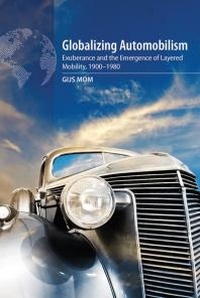
Globalizing Automobilism
Exuberance and the Emergence of Layered Mobility, 1900-1980
1st Edition
Published on 7. August 2020
688 pages
978-1-78920-462-9 (ISBN)
Description

Why has "car society" proven so durable, even in the face of mounting environmental and economic crises? In this follow-up to his magisterial Atlantic Automobilism, Gijs Mom traces the global spread of the automobile in the postwar era and investigates why adopting more sustainable forms of mobility has proven so difficult. Drawing on archival research as well as wide-ranging forays into popular culture, Mom reveals here the roots of the exuberance, excess, and danger that define modern automotive culture.
Reviews / Votes
"[Mom presents two] distinct yet well-integrated perspectives, that of the historical and the methodological craftsman. The effective nexus of those perspectives allows Mom to tell a story too often overlooked and even blatantly ignored by Western-centric texts on the same subject. Despite its considerable length, this text is a dense work of research best suited for academics who are serious about mobility studies and/or non-Western 20th-century (or postcolonial) history." * Choice"... a nuanced and complex account of the histories of mobility... [Some chapters] are real gems for the outline of a diverse world often invisible in mobility literature, as well as for a detailed anatomy of motorization and development practices." * TSEG- The Low Countries Journal of Social and Economic History
"Mom has access to an extraordinarily broad palette of source materials and methods. There is no other monograph in the field of such vast comparative scope." * Peter Norton, University of Virginia
More details
Edition
1. Auflage
Language
English
Place of publication
Oxford
United Kingdom
Target group
Professional and scholarly
Illustrations
Bibliography; Index; 23 Illustrations
ISBN-13
978-1-78920-462-9 (9781789204629)
DOI
10.3167/9781789204612
Copyright in bibliographic data and cover images is held by Nielsen Book Services Limited or by the publishers or by their respective licensors: all rights reserved.
Schweitzer Classification
Other editions
Additional editions
Book
approx. 02/2026
Berghahn Books
€55.20
Not yet published
Book
06/2020
1st Edition
Berghahn Books
€197.80
Shipment within 3-4 weeks
Person
Gijs Mom is Associate Professor emeritus at Eindhoven University of Technology. His monograph Atlantic Automobilism: Emergence and Persistence of the Car, 1895-1940, was published by Berghahn Books in 2015. He is a co-editor, with Georgine Clarsen and Mimi Sheller, of the Berghahn Books series "Explorations in Mobility."
Content
List of Illustrations
Preface
Introduction: Questioning the Car: Prolegomena for a Historical Analysis of Global Mobility
New Perspectives, New Questions
Looking Back: Emergence and Persistence of the Adventure Machine
Extending Adventure: The Car as Possession and Status Symbol
Producing Commodification: Status, Narcissism, and Self-Development
Diversifying Automotive Identities: The Non-Hegemonic Self
New Mobility Studies: Bodily Senses, The Car as Medium, and the Challenge of Representation
The Trouble with Travel Writing: Meandering between Fictionality and Representation
This Study: Sources and Terminology
Part I. Emergence and Persistence (Again): The Shaping of Mobility Layerdness beyond the West
Chapter 1. Modernizing without Automobilization: Subverting and Subalternizing Mobility History (1890-1945/1950)
Imperialist Mobilities: Japan and the Modernization of Manchuria
Urban Mobilities: The Rickshaw and the Motorization of Asian Cities
Between Long March and Long-Haul: Rail and Road Network Building in China
Dual Networks of Rails and Roads: The Modal Configuration in Other Asian Countries
Migration, Colonialism and the Struggle between Rail and Road: The Case of Africa
More than Modern: Constructing a Latin American Adventure Machine
The Rest and the West: Subversive and Subaltern Mobilities?
Part II: Exuberance, with a Twist: Spreading the Gospel of Automobilism
Chapter 2. Fragmenting Automotive Adventure: Western Exuberant Automobilism and Middle-Class Guilt (1945-1973)
"Why I Want to Fuck Ronald Reagan"
A Multimedia Feast: Folk, Beat, Rock and Other Mobilities
Motorizing the Worker: Fragmentation and Convergence of Western Car Cultures
The Attack on Public Transport: Hegemonic Car Cultures in a Cold War Setting
Experiencing the Car in a Fragmented Culture: Shifts in Autopoetic Adventures
Songs and Movies: Rejuvenating the Adventure Machine in Popular Culture
Flow Interrupted: Crash and the Systemic Aspects of Automobilism
Chapter 3. Layered Development: The Transnational Construction of a World Mobility System (1940s-1970s)
What is 'Layered Development'?
Alternative Developments: Soviet Mobility and the Modernization of China and India
Conceiving 'Development': Mobilizing the 'Rest'
Mediating Modernization: Japan and Asian 'Development'
Constructing 'Circulation': The IRF and the "Development" of Africa
Developmentalism vs. Dependentismo: Latin American Mobilities and the Frustrations of Middle-Class Modernity
Conclusions: Road, Rail, and Development
Layered, Fragmented, Subversive, Subaltern: Conclusions
Bibliography
Index
Preface
Introduction: Questioning the Car: Prolegomena for a Historical Analysis of Global Mobility
New Perspectives, New Questions
Looking Back: Emergence and Persistence of the Adventure Machine
Extending Adventure: The Car as Possession and Status Symbol
Producing Commodification: Status, Narcissism, and Self-Development
Diversifying Automotive Identities: The Non-Hegemonic Self
New Mobility Studies: Bodily Senses, The Car as Medium, and the Challenge of Representation
The Trouble with Travel Writing: Meandering between Fictionality and Representation
This Study: Sources and Terminology
Part I. Emergence and Persistence (Again): The Shaping of Mobility Layerdness beyond the West
Chapter 1. Modernizing without Automobilization: Subverting and Subalternizing Mobility History (1890-1945/1950)
Imperialist Mobilities: Japan and the Modernization of Manchuria
Urban Mobilities: The Rickshaw and the Motorization of Asian Cities
Between Long March and Long-Haul: Rail and Road Network Building in China
Dual Networks of Rails and Roads: The Modal Configuration in Other Asian Countries
Migration, Colonialism and the Struggle between Rail and Road: The Case of Africa
More than Modern: Constructing a Latin American Adventure Machine
The Rest and the West: Subversive and Subaltern Mobilities?
Part II: Exuberance, with a Twist: Spreading the Gospel of Automobilism
Chapter 2. Fragmenting Automotive Adventure: Western Exuberant Automobilism and Middle-Class Guilt (1945-1973)
"Why I Want to Fuck Ronald Reagan"
A Multimedia Feast: Folk, Beat, Rock and Other Mobilities
Motorizing the Worker: Fragmentation and Convergence of Western Car Cultures
The Attack on Public Transport: Hegemonic Car Cultures in a Cold War Setting
Experiencing the Car in a Fragmented Culture: Shifts in Autopoetic Adventures
Songs and Movies: Rejuvenating the Adventure Machine in Popular Culture
Flow Interrupted: Crash and the Systemic Aspects of Automobilism
Chapter 3. Layered Development: The Transnational Construction of a World Mobility System (1940s-1970s)
What is 'Layered Development'?
Alternative Developments: Soviet Mobility and the Modernization of China and India
Conceiving 'Development': Mobilizing the 'Rest'
Mediating Modernization: Japan and Asian 'Development'
Constructing 'Circulation': The IRF and the "Development" of Africa
Developmentalism vs. Dependentismo: Latin American Mobilities and the Frustrations of Middle-Class Modernity
Conclusions: Road, Rail, and Development
Layered, Fragmented, Subversive, Subaltern: Conclusions
Bibliography
Index
