

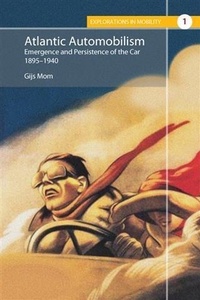
Atlantic Automobilism
Emergence and Persistence of the Car, 1895-1940
1st Edition
Published on 1. December 2014
768 pages
978-1-78238-378-9 (ISBN)
Description

Our continued use of the combustion engine car in the 21st century, despite many rational arguments against it, makes it more and more difficult to imagine that transport has a sustainable future. Offering a sweeping transatlantic perspective, this book explains the current obsession with automobiles by delving deep into the motives of early car users. It provides a synthesis of our knowledge about the emergence and persistence of the car, using a broad range of material including novels, poems, films, and songs to unearth the desires that shaped our present "car society." Combining social, psychological, and structural explanations, the author concludes that the ability of cars to convey transcendental experience, especially for men, explains our attachment to the vehicle.
Reviews / Votes
"Mom succeeded brilliantly with this extensive work to fulfill his intention to write a cultural history of technology." ? Zeitschrift fuer Technikgeschichte"Atlantic Automobilism is an impressive and somewhat intimidating text, incorporating the results of a lifetime's work into 766 pages... The book is the first volume in Berghahn's new 'Explorations in Mobility' series... Both the series and this volume are welcome additions to the field of mobility history, and one of the undoubted strengths of Atlantic Automobilism is its breadth and multi-national focus. Mom demonstrates a rare ability and will to synthesise the multi-lingual secondary literatures of seven countries, as well as undertaking primary research in five national contexts... a unique book which will provide an invaluable source for automotive historians around the world." ? The Journal of Transport History
"This is a big book, in every sense of the word. Gijs Mom, a leading scholar of transnational interdisciplinary mobility and one of the driving forces of this new sub/meta field ...has provided a vast synthesis that seeks to answer one of the most fundamental questions of modern life: Why the car?... Impressively, Mom's contribution here is only the first volume of the intended project...For those of us around the globe who are interested in the multitudinous impacts of the automobile and all it has wrought on society and space, we impatiently await the completion of this seminal masterpiece." ? Canadian Journal of History
"With Atlantic Automobilism Gijs Mom presents a well-informed, extraordinarily richly sourced study that will be considered a standard work for a long time to come, especially when attention is not primarily focused on technical but rather historical aspects of the automobile and its culture." ? Vierteljahrschrift fuer Sozial- und Wirtschaftsgeschichte
"The strength of Mom's argument comes from its breadth: that this body of literature grew out of and helped to create a new international realm of mobility linking German motorcyclists and Parisian chauffeurs and Kansan farmers. Scholars of mobility moving forward will no doubt move to suss out the specific cities and finer questions that elude a work of this size. But Mom has shown, with authority, that the parts must be understood in light of the whole." ? Transfers
"A vast and rich conclusion proves that the author did master his huge amount of sources and the analytical structure of his demonstrations and interpretations of the connections between cognitive issues and the diversification of mobility cultures." ? Business History Review
"Atlantic Automobilism is a study that is audacious in its scope and ambition. Gijs Mom has achieved what no one else has so far has dared attempt - a history of automobile culture that (like automobiles themselves) crosses national borders.... This is a rare achievement - a book that will re-shape our understanding of the technology that defined the twentieth century." ? Georgine Clarsen, The University of Wollongong
"What makes this work sui generis is Professor Mom's ability to access archives in six languages and his unique background with degrees in engineering, literature and history... Typically the early history of the automobile is explained as a purely technological triumph. Dr. Mom knows better. Yes the technology was important, but the car culture was more important. How owners perceived and drove their cars was far more important, and a precondition for how the vehicles worked. The technology derived from the culture, not the other way around." ? Clay McShane, Professor Emeritus, Northeastern University
"This book is a synthetic work of unique scope. It is the breadth of scope that, above everything else, sets it apart from all other syntheses... Mom has synthesized the scholarship of seven countries, with some relevant inclusion of about seven more... A trained engineer, a credentialed student of literature, and a policy expert with a long association with a national department of transportation, [have equipped him with] a breadth of expertise [that has made him] a pioneer of mobility studies, which rescues the history of transportation from narrower studies of artifacts and politics to contextually rich analyses." ? Peter Norton, University of Virginia
"Mom has put together a remarkable project with an exceptionally broad scope, in which he delivers timely and compelling analyses that will enrich how the rise of car culture in Europe and America is understood by scholars and lay readers alike for a very long time... The sheer scale of Mom's corpus is breathtaking, as he references books, newspapers, magazines, and other cultural artifacts spanning fifty years of cultural production in the US, UK, Germany, France and many other countries..., [thus] conveying a careful, deliberate and nuanced understanding of an extremely complex chain of cultural processes." ? Steven D. Spalding, United States Naval Academy
More details
Series
Language
English
Place of publication
Oxford
United Kingdom
Target group
College/higher education
Illustrations
Bibliography; Index; 37 Illustrations; 3 Tables, unspecified
File size
3,97 MB
ISBN-13
978-1-78238-378-9 (9781782383789)
DOI
10.3167/9781782383772
Copyright in bibliographic data and cover images is held by Nielsen Book Services Limited or by the publishers or by their respective licensors: all rights reserved.
Schweitzer Classification
Other editions
Additional editions
Book
12/2014
1st Edition
Berghahn Books
€218.80
Shipment within 3-4 weeks
Person
Gijs Mom is an historian of technology and teaches at Eindhoven University of Technology. A literary historian turned automotive engineer, Mom is author of The Electric Vehicle: Technology and Expectations in the Automobile Age (Johns Hopkins 2004); founder of the International Association for the History of Transport, Traffic and Mobility (T2M); and editor of Transfers: Interdisciplinary Journal of Mobility Studies (Berghahn Books).
Content
List of Figures
Preface
Introduction
Explaining the car: Prolegomena for a history of North-Atlantic automobilism
Introduction: writing a synthesis
Do narratives explain?
Constructing a master narrative
Developing an explanatory toolbox
Conclusions
PART I: EMERGENCE (1895 - 1918)
Chapter 1. Racing, touring, tinkering: constructing the adventure machine (1895 - 1914/1917)
Introduction
First phase: emergence and roots of the petrol car (until 1902)
Second phase: resistance against elite touring in heavy family cars (1902 - 1908)
A first analysis of automotive adventure: the masculine 'conquest of nature'
Third phase: the "small capitalist" and the "average man" (1908 until the war)
Conclusions
Chapter 2. How it feels to be run over: the grammar of early automobile adventure
Introduction
Driving and writing: Analyzing 'affinities' of touristic and artistic experiences
'Auto-poetics': mainstream authors
Literary resistance against the car: Critical voices from the UK
Colonialism by car: Gendered travel writing
Male violence and aggression: A French-Belgian group of writer-motorists
Sub-literary novels: the Williamsons and youth novels
Flight Forward: The avant-garde, silent movies, and the celebration of automotive violence
Tarkington, Cather and Dreiser: auto-poetics before America's entry into the war
Enhanced Adventures: Analysis and conclusions
Chapter 3. Driving on aggression: The First World War and the systems approach to the car
Introduction
Preparing for war (1): clubs, the military, and aggression
Preparing for war (2): organizing mobility
Mobilization, immobility, remobilization: aggression, violence and atrocities
War trophies 1 to 3: the truck, logistics and maintenance
War trophy 4: thanatourism and other adventures
Ending the war, ending the chapter: conclusions
PART II: PERSISTENCE (1918 - 1940)
Chapter 4. "Why apologize for pleasure?" Consuming the Car in Boom and Bust
Introduction
The car as commodity; its spread among the Atlantic middle class
European car consumption and 'Americanization': eagerness compared
The car as 'necessity': A profile of car use in the Interbellum
Migration, mass tourism and the family car
Conclusions
Chapter 5. Translation and Transition: Re-adjusting the Technology and Culture of Middle Class Family Adventures
Introduction
Orchestrating Car Technology: Constructing the Closed Automobile
The process of Prosthetization: Mutually Adjusting Skills and Technology
Multiple Adventures: Thrills, Skills, and Risks
Conclusions
Chapter 6. Conquest and Domination: Domesticated Violence and the Coldness of Distance
Introduction
An avant-garde in autopoetic travel experience: the conquest of the 'periphery'
Domesticating adventure: the family as collective subject
Flows and violence: urban culture and the middleclass family
With or without a car: a women's adventure?
The ubiquitous car: a spectrum of adventures, adjusted to middleclass taste
The cult of cool: becoming cyborg
Symbolisms and affinities: avant-garde and popular culture
Conclusions
Chapter 7. Swarms into flow: The Contested Emergence of the Automobile System
Introduction
Coping with the car's unreliability: maintenance, repair, and the functional adventure
Transnationalizing the local: planning and building national road networks
Contested order: spatial planners versus engineers
Rescuing automotive adventure: the construction of road safety
The battle of the systems: road versus rail and the 'coordination crisis'
Conclusions
Transcendence and the automotive production of mobility: Conclusions on half a century of North-Atlantic automobilism
Introduction
Crossing borders: Half a century of North-Atlantic automobilism
Crossing boundaries: Adventure, fiction and the explanation of the car's persistence
Some closing remarks on methodology and future research
Preface
Introduction
Explaining the car: Prolegomena for a history of North-Atlantic automobilism
Introduction: writing a synthesis
Do narratives explain?
Constructing a master narrative
Developing an explanatory toolbox
Conclusions
PART I: EMERGENCE (1895 - 1918)
Chapter 1. Racing, touring, tinkering: constructing the adventure machine (1895 - 1914/1917)
Introduction
First phase: emergence and roots of the petrol car (until 1902)
Second phase: resistance against elite touring in heavy family cars (1902 - 1908)
A first analysis of automotive adventure: the masculine 'conquest of nature'
Third phase: the "small capitalist" and the "average man" (1908 until the war)
Conclusions
Chapter 2. How it feels to be run over: the grammar of early automobile adventure
Introduction
Driving and writing: Analyzing 'affinities' of touristic and artistic experiences
'Auto-poetics': mainstream authors
Literary resistance against the car: Critical voices from the UK
Colonialism by car: Gendered travel writing
Male violence and aggression: A French-Belgian group of writer-motorists
Sub-literary novels: the Williamsons and youth novels
Flight Forward: The avant-garde, silent movies, and the celebration of automotive violence
Tarkington, Cather and Dreiser: auto-poetics before America's entry into the war
Enhanced Adventures: Analysis and conclusions
Chapter 3. Driving on aggression: The First World War and the systems approach to the car
Introduction
Preparing for war (1): clubs, the military, and aggression
Preparing for war (2): organizing mobility
Mobilization, immobility, remobilization: aggression, violence and atrocities
War trophies 1 to 3: the truck, logistics and maintenance
War trophy 4: thanatourism and other adventures
Ending the war, ending the chapter: conclusions
PART II: PERSISTENCE (1918 - 1940)
Chapter 4. "Why apologize for pleasure?" Consuming the Car in Boom and Bust
Introduction
The car as commodity; its spread among the Atlantic middle class
European car consumption and 'Americanization': eagerness compared
The car as 'necessity': A profile of car use in the Interbellum
Migration, mass tourism and the family car
Conclusions
Chapter 5. Translation and Transition: Re-adjusting the Technology and Culture of Middle Class Family Adventures
Introduction
Orchestrating Car Technology: Constructing the Closed Automobile
The process of Prosthetization: Mutually Adjusting Skills and Technology
Multiple Adventures: Thrills, Skills, and Risks
Conclusions
Chapter 6. Conquest and Domination: Domesticated Violence and the Coldness of Distance
Introduction
An avant-garde in autopoetic travel experience: the conquest of the 'periphery'
Domesticating adventure: the family as collective subject
Flows and violence: urban culture and the middleclass family
With or without a car: a women's adventure?
The ubiquitous car: a spectrum of adventures, adjusted to middleclass taste
The cult of cool: becoming cyborg
Symbolisms and affinities: avant-garde and popular culture
Conclusions
Chapter 7. Swarms into flow: The Contested Emergence of the Automobile System
Introduction
Coping with the car's unreliability: maintenance, repair, and the functional adventure
Transnationalizing the local: planning and building national road networks
Contested order: spatial planners versus engineers
Rescuing automotive adventure: the construction of road safety
The battle of the systems: road versus rail and the 'coordination crisis'
Conclusions
Transcendence and the automotive production of mobility: Conclusions on half a century of North-Atlantic automobilism
Introduction
Crossing borders: Half a century of North-Atlantic automobilism
Crossing boundaries: Adventure, fiction and the explanation of the car's persistence
Some closing remarks on methodology and future research
