

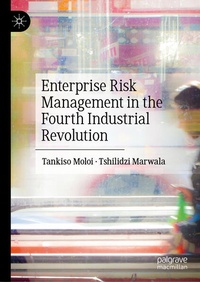
Enterprise Risk Management in the Fourth Industrial Revolution
Description

This book examines enterprise risk management in the fourth industrial revolution, and the technologies associated with this phenomenon. In doing so, it seeks to understand these technologies' potential capabilities, and how they could be utilised in the enterprise risk management setting. With this, the book first details the fourth industrial revolution (4IR), and discusses the concept of enterprise risk management, the stakeholders involved, the typical information stakeholders will be responsible for, and their role in integrating risk management information. The book then examines the information processing steps and the new capabilities in the enterprise risk setting necessitated by the capabilities of the 4IR technologies to harness, analyse and integrate information for decision-making and understanding internal and external contexts. In the final chapter, the book conceptualises enterprise risk management in the 4IR, and maps out potential role changes in this space.
More details
Other editions
Additional editions
Persons
Tshilidzi Marwala is the Rector of the United Nations University and UN Under-Secretary-General. He is former Vice-Chancellor and Principal of the University of Johannesburg. From 2013 to 2017, he was Deputy Vice-Chancellor for Research and Internationalisation, and from 2009 to 2013, he was Executive Dean of the Faculty of Engineering and the Built Environment both at the University of Johannesburg.
Tankiso Moloi is Director: Academic and Full Professor (Accountancy) at the Johannesburg Business School, University of Johannesburg. He was Professor of Accountancy and ETDP SETA-UJ Research Chair in 4IR at the University of Johannesburg. He has led strategic business units in the higher education, mining and national statistical services sectors.
Content
Chapter 1. Introduction to Enterprise Risk Management in the Fourth Industrial Revolution.- Chapter 2. The Fourth Industrial Revolution.- Chapter 3. Technologies of the Fourth Industrial Revolution.- Chapter 4. Enterprise Risk Management.- Chapter 5. Stakeholders in the Enterprise Risk Management.- Chapter 6. Information processing steps and the new capabilities in the enterprise risk management.- Chapter 7. Enterprise risk management in the fourth industrial revolution.- Chapter 8. The changing operating environment and potential role changes to enterprise risk management in the fourth industrial revolution.- Chapter 9. Synopsis: Enterprise Risk Management in the Fourth Industrial Revolution.
