

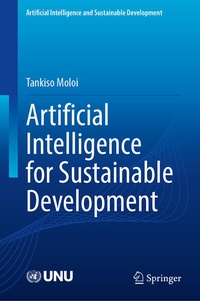
Artificial Intelligence for Sustainable Development
Description

This book presents a unique and a new resource for corporates, policymakers, academics, researchers, and graduate students in the quest for determining the role of intelligent tools in sustainable development. It approaches sustainable development by figuring variables for measurement (data types) and by investigating emerging intelligent tools to be used for harnessing, analysing, and presenting a track mechanism for progress made in each sustainable development goal. It presents a conceptual framework of artificial intelligence as an agent for global collaboration and progress towards the achievement of sustainable development goals.
More details
Other editions
Additional editions
Person
Tankiso Moloi currently serves as the Executive Dean of the College of Business and Economics at the University of Johannesburg . A Full Professor and NRF-rated scholar, he holds an extensive academic portfolio including a PhD in Finance, a DBA, and three masters Master's degrees specialising in Financial Management, Accounting, and International Relations. His professional standing is underscored by his status as a Chartered Accountant (SA) and a Fellow of the Chartered Institute of Management Accountants (CIMA) , where he also serves as an elected member of the Global Governing Council.
His research explores the transformative impact of Artificial Intelligence and digital technologies on accounting, auditing, and financial and non-financial reporting. Tankiso Moloi has authored or edited numerous influential books with top-tier publishers like Springer and Palgrave, including works on AI in economics and enterprise risk management. His commitment to bridging the gap between emerging technology and professional practice continues to shape the future of business education and financial governance across the African continent and beyond.
Content
An overview of artificial intelligence.- An overview of sustainable development goals.- Typical data types for sustainable development goals.- Artificial intelligence: Emerging tools for data types relating to sustainable development goals.- Artificial intelligence: A transformational and data harnessing tool for sustainable development goals.- Artificial intelligence: The power of data analytics and a tool for tracking progress in sustainable development goals.- Artificial intelligence: An agent for global collaboration and progress towards the achievement of sustainable development goals.- Synopsis of the book.
