

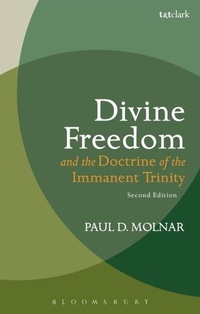
Divine Freedom and the Doctrine of the Immanent Trinity
In Dialogue with Karl Barth and Contemporary Theology
2nd Edition
Published on 23. February 2017
544 pages
978-0-567-65680-3 (ISBN)
Description

Divine Freedom and the Doctrine of the Immanent Trinity is widely acclaimed by scholars in the field of Christian systematic theology. Molnar's quest to place the doctrine of the immanent Trinity on the agenda of the Christian doctrine of God has proven to be a signal contribution to the debate in contemporary Christian theology.
The material in this second edition has been thoroughly updated: it contains a new preface and a new introduction, as well as a revised bibliography. The book includes a brand new chapter titled 'Divine Freedom Revisited' which addresses those questions that have arisen in connection with Molnar's original presentation of the divine freedom. Molnar re-visits here his discussion of the Logos Asarkos, the theologies of Karl Rahner and Wolfhart Pannenberg. He sheds new light on Rahner's and Torrance's discussions of the Resurrection; and incorporates modern discussions by contemporary theologians to offer new insights into Eberhard Jüngel's thinking.
The material in this second edition has been thoroughly updated: it contains a new preface and a new introduction, as well as a revised bibliography. The book includes a brand new chapter titled 'Divine Freedom Revisited' which addresses those questions that have arisen in connection with Molnar's original presentation of the divine freedom. Molnar re-visits here his discussion of the Logos Asarkos, the theologies of Karl Rahner and Wolfhart Pannenberg. He sheds new light on Rahner's and Torrance's discussions of the Resurrection; and incorporates modern discussions by contemporary theologians to offer new insights into Eberhard Jüngel's thinking.
More details
Edition
2nd edition
Language
English
Place of publication
London
United Kingdom
Publishing group
Bloomsbury Publishing PLC
Target group
College/higher education
ISBN-13
978-0-567-65680-3 (9780567656803)
Copyright in bibliographic data and cover images is held by Nielsen Book Services Limited or by the publishers or by their respective licensors: all rights reserved.
Schweitzer Classification
Other editions
Additional editions
Paul D. Molnar
Divine Freedom and the Doctrine of the Immanent Trinity
In Dialogue with Karl Barth and Contemporary Theology
Book
02/2017
2nd Edition
T.& T.Clark Ltd
€58.40
Shipment within 10-20 days
Person
Paul D. Molnar is Professor of Systematic Theology at St. John's University in New York, USA. He has published numerous articles in the world's leading journals together with four other books including: Thomas F. Torrance: Theologian of the Trinity (2009).
Content
Preface
Acknowledgements
Abbreviations
New Introduction by Paul D. Molnar
1. The Purpose of a Doctrine of the Immanent Trinity and Its Neglect Today
2. Christology and the Trinity: Some Dogmatic Implications of Barth's Rejection of Ebionite and Docetic Christology
3. Christology, Resurrection, Election and the Trinity: The Place of the Logos Asarkos in Contemporary Theology
4. Reconsidering Divine Freedom
5. Experience and the Theology of the Trinity: How Karl Rahner's Method Affects His Understanding of Revelation, Grace and the Trinity
6. Can a Metaphysical Principle of Relationality Be Substituted for the Relations of the Immanent Trinity? Karl Barth and the Current Discussion
7. Karl Rahner and Thomas T. Torrance: God's Self-Communication in Christ with Special Emphasis on Interpreting Christ's Resurrection
8. The Function of the Trinity in Jurgen Moltmann's Ecological Doctrine of Creation
9. Persons in Communion and God as the Mystery of the World: Alan Torrance, Eberhard Jungel and the Doctrine of the Immanent Trinity
10. The Promise of Trinitarian Theology: Colin Gunton, Karl Barth and the Doctrine of the Immanent Trinity
11. Conclusion
Appendix
Selected Bibliography
Index of Names
Index of Subjects
Acknowledgements
Abbreviations
New Introduction by Paul D. Molnar
1. The Purpose of a Doctrine of the Immanent Trinity and Its Neglect Today
2. Christology and the Trinity: Some Dogmatic Implications of Barth's Rejection of Ebionite and Docetic Christology
3. Christology, Resurrection, Election and the Trinity: The Place of the Logos Asarkos in Contemporary Theology
4. Reconsidering Divine Freedom
5. Experience and the Theology of the Trinity: How Karl Rahner's Method Affects His Understanding of Revelation, Grace and the Trinity
6. Can a Metaphysical Principle of Relationality Be Substituted for the Relations of the Immanent Trinity? Karl Barth and the Current Discussion
7. Karl Rahner and Thomas T. Torrance: God's Self-Communication in Christ with Special Emphasis on Interpreting Christ's Resurrection
8. The Function of the Trinity in Jurgen Moltmann's Ecological Doctrine of Creation
9. Persons in Communion and God as the Mystery of the World: Alan Torrance, Eberhard Jungel and the Doctrine of the Immanent Trinity
10. The Promise of Trinitarian Theology: Colin Gunton, Karl Barth and the Doctrine of the Immanent Trinity
11. Conclusion
Appendix
Selected Bibliography
Index of Names
Index of Subjects
