

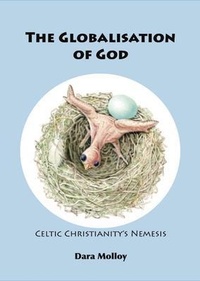
THE GLOBALISATION OF GOD
Description

In today's world, globalisation is a word that describes the ubiquitous spread of multinational corporations and their influence into every region and every country. Those who oppose globalisation today point to the damage it is doing to the natural environment, to cultural heritage and to biological diversity. They argue that it is neither transparent nor accountable, neither ecologically nor economically sustainable and that it puts profit before the democratic will of the people.
This book traces the roots of this globalisation process to a belief in one god who rules the universe. The predominant god of Moses is a god shared by three major world religions and many other lesser ones. Together they constitute more than half the world's population. The god of Moses dismisses all other gods and goddesses and establishes one way, and one way only, of seeing the world.
Before Moses, polytheism was the norm. Each culture had its own set of gods and goddesses who lived locally. This ensured diversity. Beliefs were as diverse as languages.
Historically, in the language of globalisation, the first 'product' to be 'marketed' at a global level was a belief in the one god of Moses. This belief was wrapped in the Christian message and 'advertised' by Christian missionaries who were willing to travel anywhere and give everything for the cause.
From the 4th century CE the Christian church of Rome began building itself into a global corporation. When one looks at how global corporations operate today, one can see how their structures and operations mimic in many ways those developed over centuries by the Roman church.
In order for the Roman church to remain in control of its global operations, it had to insist on uniformity in its 'products' and 'services'. This led to the removal of local and diverse expressions of Christianity.
One of the many casualties of this globalisation process was Celtic Christianity. The second half of this book traces the history of the conflict between the Celtic monastic movement and Rome. The story demonstrates that what the Roman church did then and what multinational corporations do now is much the same.
This book was first published in 2009. Its message remains relevant and even more pressing now.
All prices
More details
Person
Content
CONTENTS
INTRODUCTION
1 POLYTHEISM: A WORLD OF DIVERSITY
Mist and Magic by Tess Harper
2 MONOTHEISM: THE MOTHER OF GLOBALISATION
Goddess by Tess Harper
3 JUDAISM: A JOURNEY TOWARDS DISCONNECTEDNESS
Awe by Tess Harper
4 JESUS AND ORGANISED RELIGION
Stillness by Tess Harper
5 CHRISTIANITY: EVOLVING FROM JUDAISM
Questioning God
6 ROMAN CHRISTIANITY: FIRST GLOBAL CORPORATION
Silenced Son by Tess Harper
7 CORPORATE CHRISTIANITY: PRODUCTS AND SERVICES
Stale Bread and Sore Knees by Tess Harper
8 GLOBAL AMBITIONS OF CORPORATE CHRISTIANITY
Shuddering Silence by Tess Harper
9 CELTIC CHRISTIANITY
The Wish of Manchán of Liath
10 PELAGIUS AND AUGUSTINE
Night Prayer by Tess Harper
11 CELTIC CHRISTIANITY CONFRONTED IN BRITAIN
Vision Song by Tess Harper
12 CELTIC CHRISTIANITY CONFRONTED IN EUROPE
Sailing with Brendan
13 ROMAN CHRISTIANITY IN IRELAND
Reluctant Homecoming by Tess Harper
14 BETRAYAL FROM WITHIN IRELAND
Church Meeting by Tess Harper
15 ECCLESIASTICAL CONQUEST IN IRELAND
Woman by Tess Harper
16 THE HISTORY OF GLOBALISATION
The Ten Commandments of Globalisation
17 SPIRITUALITY AND SUSTAINABILITY
The New Wine 315
Appendix I: Dedication to Ivan Illich and John Seymour
Appendix II: About The Author
Chronological Table
Bibliography
Index
