

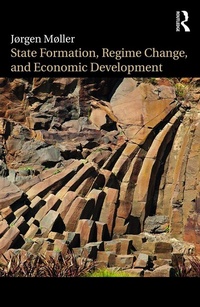
State Formation, Regime Change, and Economic Development
Published on 19. December 2016
282 pages
978-1-134-82707-7 (ISBN)
Description

Failed or weak states, miscarried democratizations, and economic underdevelopment characterize a large part of the world we live in. Much work has been done on these subjects over the latest decades but most of this research ignores the deep historical processes that produced the modern state, modern democracy and the modern market economy in the first place.
This book elucidates the roots of these developments. The book discusses why China was surpassed by Europeans in spite of its early development of advanced economic markets and a meritocratic state. It also hones in on the relationship between geopolitical pressure and state formation and on the European conditions that - from the Middle Ages onwards - facilitated the development of the modern state, modern democracy, and the modern market economy. Finally, the book discusses why some countries have been able to follow the European lead in the latest generations whereas other countries have not.
State Formation, Regime Change and Economic Development will be of key interest to students and researchers within political science and history as well as to Comparative Politics, Political Economy and the Politics of Developing Areas.
This book elucidates the roots of these developments. The book discusses why China was surpassed by Europeans in spite of its early development of advanced economic markets and a meritocratic state. It also hones in on the relationship between geopolitical pressure and state formation and on the European conditions that - from the Middle Ages onwards - facilitated the development of the modern state, modern democracy, and the modern market economy. Finally, the book discusses why some countries have been able to follow the European lead in the latest generations whereas other countries have not.
State Formation, Regime Change and Economic Development will be of key interest to students and researchers within political science and history as well as to Comparative Politics, Political Economy and the Politics of Developing Areas.
Reviews / Votes
"Recently social scientists have begun re-visiting historical processes of state formation, regime change and economic development. This book will be a must-read in this emerging and exciting field of study, providing an outstanding overview of past classics and current debates as well as offering promising and provocative insights into how scholarship might move forward." - Sheri Berman, Barnard College, USA."If you haven't read the classics on state and regime formation, read Moller. If you have read the classics on state and regime formation, but need a brilliant synthesis and a thought-provoking independent argument, read Moller." - Jan Teorell, Lund University, Sweden.
"This book provides a clear and concise overview of the classical and contemporary social science literature, both qualitative and quantitative, on the origins of the modern state, modern democracy and modern market economy. It is unmatched in its even-handedness, acuity of judgement and geographic coverage. In addition, it casts new light on the conditions that led to the emergence of representative institutions in medieval Europe. A must read for anyone interested in the current debates on the divergence (and recent convergence) in economic and political development between the West and Asia." - Thomas Ertman, New York University, USA.
More details
Language
English
Place of publication
London
United Kingdom
Publishing group
Taylor & Francis Ltd
Target group
College/higher education
Product notice
Reflowable
Illustrations
11 Tables, black and white; 13 Line drawings, black and white; 13 Illustrations, black and white
File size
2,27 MB
ISBN-13
978-1-134-82707-7 (9781134827077)
Copyright in bibliographic data and cover images is held by Nielsen Book Services Limited or by the publishers or by their respective licensors: all rights reserved.
Schweitzer Classification
Other editions
Additional editions
Jorgen Moller
State Formation, Regime Change, and Economic Development
Book
01/2017
1st Edition
Routledge
€230.27
Shipment within 10-20 days
Jorgen Moller
State Formation, Regime Change, and Economic Development
Book
01/2017
1st Edition
Routledge
€77.20
Shipment within 10-20 days
Person
Jorgen Moller is Professor at the Department of Political Science, Aarhus University, Denmark.
Content
Introduction
Part I: Big Questions
1. State Formation, Regime Change, and Economic Development
2. Comparative Historical Analysis
Part II: Classic Comparative Historical Analyses
3. The Classic Analyses I: Tocqueville
4. The Classic Analyses II: Weber
5. The Classic Analyses III: Hintze, Schumpeter, and Bloch
Part III: The Barrington-Moore Research Programme
6. Barrington Moore and the Rebirth of the Discipline
7. Perry Andersen on the Absolutist State
8. Skocpol: Revolutions and the State
9. War, State Formation, and Regime Change: Tilly, Downing, and Ertman
Part IV: Recent Contributions
10. Representative Institutions Redux
11. The West versus the Rest: The Debate on the Great Divergence
12. Europe and the Emergence of the Market Economy
13. Colonization Processes, Economic Growth, and Political Development
14. War and State Formation in Ancient China
15. War and State Formation in Latin America and Sub-Saharan Africa
16. Neo-Weberian Perspectives on State Formation and Regime Change
Part V: Explaining the Rise of Representative Institutions
17. The Theoretical Argument
18. The Methodological Challenges
19. The Empirical Evidence
20. The General Conclusions
Conclusions
Part I: Big Questions
1. State Formation, Regime Change, and Economic Development
2. Comparative Historical Analysis
Part II: Classic Comparative Historical Analyses
3. The Classic Analyses I: Tocqueville
4. The Classic Analyses II: Weber
5. The Classic Analyses III: Hintze, Schumpeter, and Bloch
Part III: The Barrington-Moore Research Programme
6. Barrington Moore and the Rebirth of the Discipline
7. Perry Andersen on the Absolutist State
8. Skocpol: Revolutions and the State
9. War, State Formation, and Regime Change: Tilly, Downing, and Ertman
Part IV: Recent Contributions
10. Representative Institutions Redux
11. The West versus the Rest: The Debate on the Great Divergence
12. Europe and the Emergence of the Market Economy
13. Colonization Processes, Economic Growth, and Political Development
14. War and State Formation in Ancient China
15. War and State Formation in Latin America and Sub-Saharan Africa
16. Neo-Weberian Perspectives on State Formation and Regime Change
Part V: Explaining the Rise of Representative Institutions
17. The Theoretical Argument
18. The Methodological Challenges
19. The Empirical Evidence
20. The General Conclusions
Conclusions
