

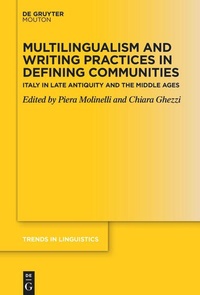
Multilingualism and Writing Practices in Defining Communities
Description

How did everyday writing forge communities in Italy from Late Antiquity to the late Middle Ages? This interdisciplinary volume maps multilingual practices across public and private texts produced in diverse social settings. Professional documents, private letters, and other text types reveal a rich linguistic and historical landscape. By reading non-literary documents as socially situated acts, the volume brings together historical sociolinguistics, discourse analysis, paleography, and diplomatics, and invites a rethinking of communities of practice, discourse, and text. Case studies show how "writing from below" shaped communities across multiple social contexts.
More details
Other editions
Additional editions
Persons
Piera Molinelli & Chiara Ghezzi , Università degli Studi di Bergamo, Italy.
Content
- Intro
- Preface
- Contents
- Practical scripts: Writing practices, languages, and communities in Italy. Latin Antiquity and the Middle Ages
- 1 Overview
- 2 From theory to case studies (back and forth)
- References
- Part 1: Writers, texts, and contexts
- 1 Communities of practice, communities of discourse, and text communities between synchrony and diachrony
- 1 Background
- 2 Towards the concept of community of practice
- 2.1 Definitional criteria and operationalisation of the community of practice
- 3 The discourse community
- 4 From discourse community to textual community?
- 4.1 Textual community in historical sociolinguistics between orality and writing
- 4.2 The key role of the interpreter as a mediator between written and oral
- 4.3 Texts, training and learning
- 4.4 The problem of the size of text communities
- 4.5 The process of forming text communities
- 4.6 Textual genres and processes of community communication
- 4.7 Types of textual communities
- 5 Concluding remarks: A synthesis of key themes
- References
- 2 Sophists, the construction of judgement and linguistic registers. A community of discourse in Sardinia: Sos cantadores a bolu (the improvising poets)
- 1 Introduction
- 2 The structure of the poetic contest
- 3 Sos cantadores a bolu: Enacting language through contrast
- 4 Concluding remarks: Cantadores a bolu and community of discourse
- Sources
- References
- 3 Formulaic language in medieval administrative and legal writing: From variation to shared repertoire
- 1 Introduction: Medieval administrative and legal writing, and communities of practice
- 2 How to study formulaic language in medieval texts?
- 2.1 Defining formulaic language
- 2.2 Oral formulaic language, written practices, and legal discourse
- 2.3 Accessing and retrieving formulaic language
- 2.4 Can formulaic language contain variation?
- 2.5 Formulaic language in a multilingual setting
- 2.6 From function to formula
- 2.7 Formulaic language as a shared repertoire
- 3 Formulaic language as a key element of administrative discourse: Conclusions and future directions
- References
- 4 Writing delegation and community agency in fifteenth-century Northern Italy
- 1 Late medieval communities and the "bureaucratic demand" to produce documents
- 2 Supplication, orality, and notarial mediation in a fragmented community
- 3 Delegated writing and communicative strategies in fiscal documentation
- 4 The collective delegation of writing between communities of practice and discourse communities
- References
- 5 Linguistic variation in the magical-religious documents from late antique Sicily
- 1 Introduction
- 2 Variation in content
- 2.1 Documents of rural magic
- 2.2 Documents for personal protection
- 3 Spelling and linguistic variation
- 3.1 Variation in writers' literacy and spelling
- 3.2 Morpho-syntactic variation
- 3.3 Lexical variation
- 4 Commentary and conclusion
- 4.1 The internal elements, both formal and content-related
- 4.2 The social and cultural framework
- 4.3 The language of magico-religious documents in comparison with other sectorial languages
- References
- 6 Features of multilingualism and plurilingualism in the so-called Papiri Italiani
- 1 The Papiri Italiani
- 2 Multilingualism and plurilingualism
- 3 Languages directly attested in the papyri
- 3.1 Latin
- 3.2 Gothic
- 3.2.1 Ufitahari
- 3.2.2 Gahlaiba
- 4 The case of Greek
- 5 In search of languages in the background
- 5.1 Onomastics
- 5.2 Was Pakeiphikos a Jew?
- 5.3 Tzitta
- 6 Conclusions
- References
- 7 Writing and reading practices of the Jewish communities in medieval and early modern Italy
- 1 Introduction
- 2 The revival of Hebrew and the rise of Romance
- 3 From glossaries to vernacular texts
- 4 Hebrew vs vernacular production
- References
- Part 2: Writings and religious communities
- 8 Notarial documentation and historical representation in the Chronicles of Montecassino (11th-12th century)
- 1 Introduction
- 2 Chronicles and documents: The Chronica Monasterii Casinensis and the other medieval cartulary-chronicles of central and southern Italy
- 3 The Chronica Monasterii Casinensis and the Registrum Petri Diaconi
- 4 Notarial documentation and the Chronica Monasterii Casinensis: The role of paraphrase in the construction of the monastery's history
- 5 Conclusions and sociolinguistic implications
- References
- 9 Sisters in spirit: Kinship terms and community of practice among late medieval Italian nuns
- 1 Kinship terms and monastic communities
- 2 Kinship terms and monastic communities in the Middle Ages
- 3 Letters and address terms
- 4 Data and methodology
- 5 Nominal address in female monastic communities
- 5.1 Saint Catherine's letters
- 5.2 15th century letters
- 6 Conclusions
- References
- 10 For an integrated notion of "community of practice": Textual and linguistic evidence with a focus on women in confraternities in the Italo-Romance area between the Middle Ages and Modern Age
- 1 Introduction
- 1.1 The historical context
- 1.2 The sociolinguistic situation
- 2 The history of women in confraternities: Salient aspects
- 2.1 The exclusion and inclusion of women: A question of economics
- 2.1.1 Third level of inclusion: To be there and to count
- 3 The notion of integrated communities of practice: The case of mixed and women's confraternities
- 3.1 Application of criteria according to Putzu (this volume)
- 3.1.1 The criteria of communities of practice: Textual evidence
- 3.1.2 The criteria of discourse communities: Textual evidence
- 3.1.3 The criteria of text communities: Textual evidence
- 4 Summary and results
- References
- 11 On the technical-juridical lexicon of the chartae in medieval Sardinian
- 1 The old Sardinian legal documents
- 2 Formulaic sections and specific vocabulary
- 3 Semantic and etymological aspects
- 3.1 Asoltura
- 3.2 Arminantia
- 3.3 Punnare
- 3.4 Sterminare/istrumare
- 4 Conclusions
- Sources
- References
- Part 3: Writings and notaries
- 12 When historical linguistics matters to historical sociolinguistics. Italian legal documents from the Early Middle Ages and their scribes
- 1 Aims of the work
- 2 The relevance of Early Middle Ages documents from Italy
- 2.1 Factors of interest for historical linguistics
- 2.2 Factors of interest to historical sociolinguistics
- 2.2.1 The scribes' level of literacy
- 2.2.2 Tabelliones, notarii, scribae and the survival of legal practices in EMA Italy
- 2.3 Heirs and guardians: Some implications for historical linguistics and sociolinguistics
- 2.4 The distinct character of EMA legal documents of Italy
- 3 Were there "communities" of scribes in EMA Italy?
- 3.1 Community of practice, community of discourse, community of text
- 3.2 The vacillation of discourse traditions / formularies
- 4 Discourse tradition is not the same notion as linguistic tradition
- 4.1 A few definitional distinctions
- 4.2 Polymorphism in formulaic and non-formulaic structures: Three case studies
- 4.2.1 The case of the formulae from the Ravenna testaments (P. Ital. 4-5)
- 4.2.2 The case of morphological variations in the indictio formula by the scriptor Maurace (CDL I, II)
- 4.2.3 The case of the countryside scribes from the Salerno area (ChLA L)
- 5 History of language as permanence and change of patterns
- 5.1 Karstic structures in the Ravenna documents (P. Ital. 4-5, 8, 17, 34, 43, 44, 47-48)
- 5.2 When scribes testify to language change: Two cases from charters of the Benevento area
- Sources
- References
- 13 Notaries and scribes in the Principality of Benevento: Linguistic structures, writing expertise, and discourse traditions
- 1 Aims and corpus of the analysis
- 2 Methodological background
- 3 Basic issues on complex clauses structure and discourse traditions in private and public documents
- 4 Clausal complementation, stylistic layering, and discourse traditions in public and private documents
- 5 Simplification and stylistic layering in relative pronouns
- 6 Conclusions
- Sources
- References
- 14 Comparing language, style, and formulary in notarial documents in early medieval Italy
- 1 Introduction
- 2 Formulas and lexicon between Langobardia Maior and Langobardia Minor
- 2.1 Formulaic language
- 2.2 Lexical choice
- 3 Defining boundaries: Locating and identifying land properties
- 4 The adnominal function of the preposition de
- 4.1 Expressing partitivity
- 4.2 Expression of material possession
- 4.3 Expression of the place of provenance
- 5 Concluding remarks
- Sources
- References
- Part 4: Writings and merchants
- 15 Women's writings in late medieval Tuscan mercantile correspondence
- 1 Introduction
- 2 The development of female literacy in late medieval Tuscany
- 2.1 Indirect documentary sources
- 2.2 Direct documentary sources
- 3 Women's writings: Epistolary texts
- 3.1 Margherita Datini's letters
- 3.2 Alessandra Macinghi Strozzi's letters
- 4 Concluding observations
- Sources
- References
- 16 Formulaicity and idiosyncrasy in mercantile letters. Evidence from the Datini archive (1382-1402)
- 1 Introduction
- 2 The Milanese correspondence
- 3 At the boundary between formulaicity and idiosyncrasy
- 4 Closing mercantile letters: Formality and closeness signals
- 4.1 Strict adherence to the norms
- 4.2 Personal content in mercantile letters
- 5 Discussion
- 6 Conclusion
- References
- 17 Writing practices in mercantile letters. Multilingual repertoire among merchants of Datini branches (1392-1401)
- 1 Multilingualism in merchants' writings: Issues and challenges
- 2 The corpus
- 3 LOLIs and the language of commerce
- 3.1 Bianchetto
- 3.2 Pocca
- 3.3 Inpac(h)ate
- 4 Summing up
- 5 Stable multilingual repertoire?
- 6 Towards a community based-approach
- Sources
- References
- 18 The pragmatic dimension of practical writing and the emergence of discourse communities: The case of some 15th-century Catalan merchant letters
- 1 Letters of merchants and practices of mercantile writing
- 2 Mercantile letters and discourse communities: Pragmatic dimensions for practical purposes and practices of processualisation
- 3 Results: A pragmatic writing and its practices between written and (quasi-) spoken mode
- 3.1 Meta-text: The practice of contextualisation and the necessity of providing clues for interpretation
- 3.2 Syntax, textual connectives, and thematic discontinuity: Writing practices similar to spoken modality
- 3.3 The pragmatic function of politeness
- 4 Concluding remarks
- References
- Conclusion
- 19 Multilingualism and writing practices in defining communities in Italy (Late Antiquity and the Middle Ages): Achievements and perspectives
- 1 Writing practices, texts and actors
- 2 Defining communities in the past: Communities of practice, discourse, text
- References
- Author index
- Subject index
