

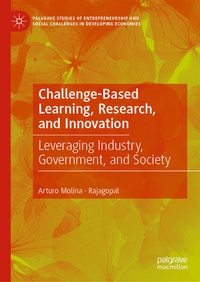
Challenge-Based Learning, Research, and Innovation
Description

The work is divided into three sections: Part 1 discusses social challenges, triple bottom line, and entrepreneurship as drivers for research, learning, and innovation while Part 2 links challenge-based research to social and industrial development in emerging markets. The final section considers research-based innovation and the role of technology, with the final chapter bridging concepts and practices to shape the future of society and industry. The authors present the RISE paradigm, which integrates people (society), planet (sustainability),and profit (industry and business) as critical constructs for socio-economic and regional development.
Arguing that the converging of society and industry is essential for the business ecosystem to stay competitive in the marketplace, this book analyzes possible approaches to linking challenge-based research with social and industrial innovations in the context of sectoral challenges like food production, housing, energy, biotechnology, and sustainability. It will serve as a valuable resource to researchers interested in topics such as social challenges, innovation, technology, sustainability, and society-industry linkage.
Reviews / Votes
".there is a dire need to drive appropriate discourses on challenge-based research to converge knowledge, action, and practice by deeply understanding the people and planet. Authors discuss applied research by mapping the potential problems, needs, and solutions around the community. This book is worth for researchers, industrialists, and policymakers."- Jaime Puente, Chief Technology Officer, Bocar Group, Mexico
"Every research addresses a problem and explores its implications. However, some problems remain unearthed, and humanity pays for them over time. Challenge-based research is a true leap to examine the hidden problems, understand needs, and deliver solutions.academics, society, and policymakers need such charter, which this book offers. A timely and good read for all."
- Guillermo Torre, PhD, Vice President of Research at Tecnológico de Monterrey, Mexico
More details
Other editions
Additional editions
Persons
Arturo Molina, PhD is currently Professor and Director of the Institute of Advanced Materials for Sustainable Manufacturing at Tecnológico de Monterrey, Mexico and served as Vice-Rector for Research and Technology Transfer. He is member of the National Researchers System of Mexico of highest level (SNI-Level III), Mexican Academy of Sciences, Mexican Engineering Academy, Mexican Academy of Computation.
Rajagopal, PhD is Distinguished Professor of Marketing at EGADE Business School of Tecnológico de Monterrey, Mexico, Visiting Professor at Boston University, USA, and Life Fellow of the Royal Society for Encouragement of Arts, Manufacture and Commerce, UK. He is member of the National Researchers System of Mexico of highest level (SNI-Level III). Rajagopal has received highest civilian honor of the Government of India for non-resident Indian citizen in the field of education.
Content
Chapter 1: Social Challenges in Developing Economies: Converging Research and Industrial Needs.- Chapter 2: People, Planet, and Profit: Crossing the Triple Bottom Line.- Chapter 3: Sensitizing Entrepreneurship: Managing Growth Touchpoints.- Chapter 4: A Challenge-based University: Learning, Research, Innovation and Entrepreneurship.- Chapter 5: Linking Research and Business: Raising Social Wellbeing.- Chapter 6: Research Technology and Institutions: Fostering Role, Relationship, and Responsiveness.- Chapter 7: Research-based Innovation: Economics, Transferability, and Consumerism.- Chapter 8: Technology Thrust: Design, Development, and Diffusion.- Chapter 9: Social Innovation and Technology: The Road Ahead.
