

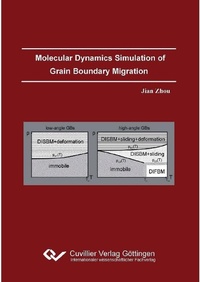
Molecular Dynamics Simulation of Grain Boundary Migration
Cuvillier Verlag eBooks
Published on 5. March 2012
100 pages
978-3-7369-4042-0 (ISBN)
Description

Migration of tilt <111> grain boundaries (GBs) in aluminum has been simulated in a wide temperature range with various magnitudes of driving force. It is found that under different conditions GBs migrate through either a diffusionless or a diffusional mechanism. The essence of the diffusionless mechanism is determined to be GB dislocation glide. This mechanism agrees with many previously reported mechanisms, consisting of the collective motion of atom groups, the four-atom shuffling and the boundary motion by glide of primary/secondary GB dislocations. GB dislocation glide therefore serves as a generalized mechanism for all of them. The diffusional mechanism is merely observed to occur for high-angle GBs at high temperatures when a relatively small driving force of several MPa is applied. For these GBs featured in thick and highly disordered structures, GB migration is controlled by GB diffusion. The effects of structural constraints, temperature, GB misorientation and driving force magnitude, on the activation of either mechanism as well as on concrete GB migration behaviors are discussed. Based on these discussions, two GB migration mechanism maps for polycrystals are proposed. The mechanism maps can well explain many contradictory findings obtained previously in both experiments and simulations. In addition, GB mobilities are evaluated at a high temperature. The simulated values are physically reasonable as high-angle GBs move faster than low-angle GBs and the maximum mobility occurs around 40° misorientation. The mobility of a Σ7 GB even approaches the maximum experimental value obtained in ultra-high-purity bicrystals.
More details
Other editions
Additional editions
Book
03/2012
1st Edition
Cuvillier Verlag
€18.00
Shipment within 15-20 days
Person
Content
- Intro
- Acknowledgement
- Contents
- Abbreviations and symbols
- Chapter 1Introduction
- Chapter 2Fundamentals
- Chapter 3Simulation techniques
- Chapter 4Migration mechanisms
- Chapter 5Mobility evaluation
- Chapter 6Summary
- 7. Zusammenfassung
- Reference
- Curriculum Vitae
