

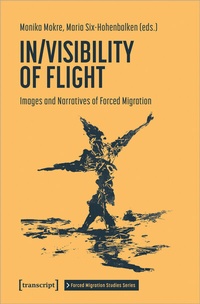
In/Visibility of Flight
Images and Narratives of Forced Migration
1st Edition
Published on 4. March 2024
266 pages
978-3-8394-6903-3 (ISBN)
Description

In/Visibility is unequally distributed in society and closely related to the distribution of power and privilege. Using images and narratives to mobilize is part of political strategies. The relationship of in/visibility and migration is the guiding question for this edited volume.The chapters discuss multidisciplinary perspectives and factors that contribute to the visibility of forced migration beyond a policy-centered discourse. They focus on the voices and agency of refugees in different countries and contexts. By including research, practical experiences and artistic methods, the volume will be of interest to readers from different academic disciplines and the arts as well as to practitioners.
More details
Other editions
Additional editions
Monika Mokre | Maria Six-Hohenbalken
In/Visibility of Flight
Images and Narratives of Forced Migration
Book
03/2024
1st Edition
transcript
€42.00
Shipment within 5-7 days
Persons
Monika Mokre (PD Dr.), born in 1963, is a senior researcher at the Institute of Culture Studies and Theatre Studies of the Austrian Academy of Sciences (ÖAW). The political scientist did her doctorate at Universität Wien and her habilitation at Universität Innsbruck. She teaches at various universities. Her research focuses on asylum and migration, democracy and the political public sphere, cultural politics, and gender studies.
Maria Six-Hohenbalken (Dr.), born in 1965, is a senior researcher at the Institute for Social Anthropology of the Austrian Academy of Sciences (ÖAW). She did her doctorate at Universität Wien. Her research fields are political and historical anthropology, diasporas and transnational communities, memory studies and art-based research. Her regional focus is on Kurdish communities in the Middle East and in Diaspora.
Maria Six-Hohenbalken (Dr.), born in 1965, is a senior researcher at the Institute for Social Anthropology of the Austrian Academy of Sciences (ÖAW). She did her doctorate at Universität Wien. Her research fields are political and historical anthropology, diasporas and transnational communities, memory studies and art-based research. Her regional focus is on Kurdish communities in the Middle East and in Diaspora.
Content
- Cover
- Contents
- Acknowledgements
- Introduction: in/visibility, privilege, and discrimination
- Contributions
- References
- Involuntary journey-a picture theater in unjust scenes
- Visibility and interactions of immigrant Kurdish women in urban public spaces: a comparison of Vienna and Cologne
- Introduction
- The nature of public space
- Women's visibility in public space
- Case-study cities
- Kurdish women's visibility and interactions in urban public space
- Frequenting public spaces
- Sense of safety
- Meaningful social activities
- Barriers of presence and contact
- Conclusion
- References
- Ethical reflexivity in qualitative study and participatory research among Afghan refugee women in Munich, Germany
- Introduction
- Presenting informed consent
- Anonymity, privacy and confidentiality
- The power and position of the researcher and the relationship with participants
- Ethical considerations through participatory and photovoice research
- Photovoice
- Photovoice through social media
- Small but powerful participatory meetings
- Keeping in touch with participants for support in health issues
- Conclusion
- References
- Blurred vision: potential and challenges of co-creation approaches for migrants' visibility
- Introduction
- Co-creation approaches in the easyRights project
- Co-creation between participation, visibility and empowerment
- The easyRights project-enabling (im)migrants to easily know and exercise their rights
- Blurred (in)visibilities in services integration: the challenges of project implementation
- The institutional support networks for service design and integration
- Birmingham
- Larissa
- Palermo
- Malaga
- Conclusions and discussion
- References
- Online sources
- "Traces and masks of refugees"- artistic representations of the visible, the hidden and the ambiguous
- Institutional preconditions and framing of the topic
- Main outlines of the exhibition, artists and works exhibited
- Who is a refugee and who has the power to define that? What does it mean to be a refugee?
- "Refugees" versus "exiles"
- Historical references and their transformation in artwork materiality
- "Traces and Masks" as visual agents
- References
- Modernity's sacrificial tradition: "The endless screams of my mother"
- Homelessness
- Afterlives?
- "Mother, where are you?"
- References
- Roma and the war against Ukraine
- Introduction
- On the situation in Ukraine
- General situation of Roma in Ukraine
- The Roma in the war of aggression against Ukraine
- Internally displaced Roma in Ukraine
- Survivors of the Nazi genocide
- Short review: Situation of the Roma before the war
- Antigypsyism in Ukraine
- Active civil society and successful Roma
- Refugees from Ukraine
- On the situation of Roma refugees
- Brief overview of the situation of Roma refugees in selected countries
- Poland
- Germany
- Czech Republic
- Hungary
- Moldova
- Perspectives of Roma refugees
- References
- The many fears we live with
- Those in darkness drop from sight-the hypervisibility, invisibility, and voicelessness of refugees
- The invisibility of migrants
- The hypervisibility of criminal migrants
- The subaltern cannot speak
- Conclusions (March 2022)
- References
- Marginalized or essential (workers)? The pandemic effects on humanitarian migrants
- Introduction
- Mobility as a privilege
- The effects of COVID-19 on refugees in Austria
- Conclusion
- References
- Below the radar-the invisibility of agency among diaspora and refugee networks during the COVID-19 pandemic
- Introduction
- Empirical study
- Research design
- Community networks
- Information services
- Consultation services
- Legal and educational support
- Socio-psychological care
- Analytical notes
- References
- Contributors
