

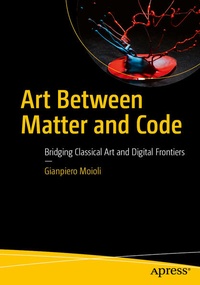
Art Between Matter and Code
Description

Explore the evolving intersection of traditional sculpture, digital modeling, 3D printing, procedural generation, artificial intelligence, and immersive virtual spaces. The book examines how contemporary art moves between Apollonian order and Dionysian metamorphosis, balancing formal structure and organic transformation in the evolving language of sculpture.
It further investigates how concepts of authenticity and uniqueness are challenged in the digital era through technologies like NFTs, blockchain certification, and the emergence of hybrid artworks that simultaneously exist as physical matter, digital code, and metaverse experiences.
The volume is structured into four comprehensive parts. The first part begins with a historical and material perspective and explores the philosophical and material shift from classical forms to digital energy, addressing the interplay between Apollonian clarity and Dionysian fluidity, while introducing issues of uniqueness, dematerialization, and the role of digital code in contemporary aesthetics. The second part delves into the creative processes of virtual modeling, procedural generation, algorithmic form-making, and artificial growth as new logics of artistic creation, where algorithms collaborate with the artist to generate evolving, unpredictable forms, visual landscapes, and possible new or alien worlds. It also explores hybrid creative processes that combine AI-powered expansions, using platforms like Stable Diffusion Midjourney, DALL-E, and text-to-image models, resulting in hybrid artworks that exist simultaneously in physical, digital, and immersive dimensions.
The third part presents the artistic application of these processes through five fundamental creative themes: Energy, Landscapes, Architecture, Memory, and Future Worlds. Each theme gives shape to original artworks that merge traditional techniques, digital modeling, and AI-driven expansions, resulting in installations that explore symbolic, natural, and visionary dimensions. The fourth part investigates how blockchain, NFTs, and metaverse exhibition spaces redefine authenticity, ownership, and the display of art in an increasingly virtualized cultural landscape.
The book offers both theoretical and practical guidance on 3D modeling, procedural generation, AI-powered image synthesis, and 3D printing, while also addressing issues of authenticity, ownership, and virtual exhibition. By following these processes, artists and scholars will gain a comprehensive understanding of how contemporary art navigates the expanding intersection between matter, code, and imagination.
You Will
Explore concepts of uniqueness, aura, authenticity, and the transformation of artwork in the digital and post-digital context
Develop hybrid creative workflows integrating manual drawing, physical painting, and digital interventions
Delve into new scenarios for certification and art presentation through blockchain, NFTs, the metaverse, and new forms of virtual exhibition
Who Is This Book For
This book is intended for artists, researchers, and creative professionals who are interested in exploring the intersection of traditional sculpture and emerging digital technologies. Readers should have a basic understanding of artistic practice but no advanced technical expertise is required.
More details
Other editions
Additional editions
Person
Gianpiero Moioli is a sculptor, architect, and professor of sculpture, virtual architecture, and history of contemporary architecture at the Brera Academy of Fine Arts in Milan. He has been a certified instructor (BFCT) with the Blender Foundation since 2008.
Gianpiero graduated with a degree (MA) in sculpture from the Brera Academy of Fine Arts in Milan and received his degree (MA) in architecture from the Polytechnic University of Milan. In 2008, he and Stefania Albertini created the Brera Academy Virtual Lab, a virtual sculpture and architecture laboratory at the Academy of Fine Arts of Brera. He started using Blender in 2004 and presented his first results with this open source software in three Blender conferences in 2008, 2010, and 2011.
Content
Chapter 1: Introduction - Technologies, Materials, and New Aesthetics.- Chapter 2: Modeling as Creative Gesture.- Chapter 3: Procedurality and Artificial Growth.- Chapter 4: The Concept of Uniqueness Between Material and Digital.- Chapter 5: Techniques and Creative Processes for New Art.- Chapter 6: From Virtuality to Matter: 3D Printing.- Chapter 7: Artificial Intelligence as a Creative Tool.- Chapter 8: Five Journeys Through Nature, Architecture, and Imagination.- Chapter 9: Art, Blockchain, and NFTs.- Chapter 10: The Metaverse as an Exhibition Space.
