

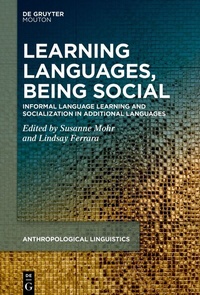
Learning Languages, Being Social
Informal Language Learning and Socialization in Additional Languages
1st Edition
Published on 6. August 2024
VIII, 266 pages
978-3-11-079467-0 (ISBN)
Description

This book addresses increasingly diverse language learning trajectories in a modern, globalized world, specifically outside of formal classroom situations and with respect to second and additional language practices. This includes, but is not restricted to, intersections of formal and informal learning, computer-mediated contexts as well as family contexts and language learning in multilingual contexts. The book provides a current and specifically anthropological view on the second and additional language acquisition in non-school settings through various studies. It is unique in its focus and scope and is relevant to anthropologists and linguists, who are interested in the intersection of language and culture.
More details
Series
Language
English
Place of publication
Berlin/Boston
Germany
Publishing group
de Gruyter Mouton
Target group
Professional and scholarly
US School Grade: College Graduate Student
Illustrations
8 b/w and 16 col. ill., 22 b/w tbl.
File size
47,10 MB
ISBN-13
978-3-11-079467-0 (9783110794670)
Schweitzer Classification
Other editions
Additional editions
Susanne Mohr | Lindsay Ferrara
Learning Languages, Being Social
Informal Language Learning and Socialization in Additional Languages
E-Book
08/2024
1st Edition
De Gruyter Mouton
€129.95
Available for download
Susanne Mohr | Lindsay Ferrara
Learning Languages, Being Social
Informal Language Learning and Socialization in Additional Languages
Book
08/2024
1st Edition
De Gruyter Mouton
€129.95
Shipment within 5-7 days
Persons
Susanne Mohr
and
Lindsay Ferrara
, Norwegian University of Science and Technology, Trondheim, Norway.
Content
- Intro
- Acknowledgements
- Contents
- Setting the scene: Informal language learning and socialization in additional languages
- Part I: Informal language learning in private contexts
- The impact of family and media on L2 development in early childhood in a multilingual society: The case of the Seychelles
- ELF and other languages in the family: Portraying multilingual repertoires at dinner tables across Europe
- Dynamic language repertoires: The case of an Italian-Turkish couple in Istanbul
- A multimodal perspective on communicative competence in multilingual Afro-Surinamese speaker communities
- Part II: Informal language learning in public contexts
- Communicative competence in the virtual breathing space: Minoritized language learning in social media
- Researching the benefits of integrating language and museum education on students' linguistic, cognitive, affective, and intercultural development
- Bringing the outside in: Attitudes towards multilingual competence in Zambia and Tanzania
- Student teachers' attitudes toward translanguaging in formal learning vis-à-vis informal interaction: A survey of a university in Kenya
- About the contributors
- Index of subjects
