

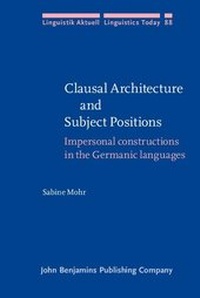
Clausal Architecture and Subject Positions
Impersonal constructions in the Germanic languages
1st Edition
Published on 13. October 2005
VIII, 207 pages
978-90-272-9399-2 (ISBN)
Description

This book offers a comparative study of the Germanic languages. It promotes a new approach to the OV vs. VO classification, according to which all clauses have a universal base where the internal argument is always merged in SpecVP. Word order differences and their correlates result from an interaction of checking conditions, the EPP and different types of verb movement, and from parametric variation concerning the location of the subject of predication in the I- or in the C-system. In the discussion of a range of impersonal constructions in German, Dutch, Afrikaans, Yiddish, Icelandic, the Mainland Scandinavian languages and English, it is shown that crosslinguistic variation as regards, e.g., the distribution of the expletive in impersonal passives and the occurrence of a Definiteness Effect in Transitive Expletive Constructions is mainly due to the choice of different kinds of 'expletive' elements (each associated with different featural make-ups which force them to show up in different positions), namely true expletives, event arguments and quasi-arguments, whereas expletive pro is shown not to exist.
More details
Other editions
Additional editions
Sabine Mohr
Clausal Architecture and Subject Positions
Impersonal constructions in the Germanic languages
Book
10/2005
John Benjamins Publishing Co
€111.30
Shipment within 10-15 days
Person
Content
- Clausal Architecture and Subject Positions
- Editorial page
- Title page
- LCC data
- Contents
- Acknowledgements
- I. Introduction
- 0. Introduction
- II. Clausal architecture and the EPP
- 1. Subject positions and the EPP: the evolution of the two concepts
- 1.1 From principle to feature - the history of the EPP in the works of Chomsky
- 1.2 From deconstruction to cartography - subject positions and their features
- 1.3 Universality reconsidered - the EPP as a parameter
- 2. The EPP and the Extension Condition
- 2.1 The EPP-feature - the general idea
- 2.1.1 Some data
- 2.1.2 Different ways of realising head-positions
- 2.2 Head-movement - is it syntactic or a PF-phenomenon or even an illusion?
- 2.2.1 The Extension Condition and Chomsky's objections
- 2.2.2 Head-movement and the interfaces
- 2.2.3 Does head-movement exist after all?
- 2.3 Head-movement and the Extension Condition - how can these two be reconciled?
- 3. Clause structure
- 3.1 The projections of the C-system
- 3.1.1 Sentence-initial XPs in V2 clauses and their positions
- 3.1.2 Locality and why the finite verb in Fin can only be preceded by one XP
- 3.2 The projections of the I-system
- 3.2.1 Overview
- 3.2.2 TopP, FocP and Scrambling
- 3.2.3 Two subject positions in the Mittelfeld
- 3.2.4 RefP and the EPP
- 3.3 The projections of the V-system
- 4. Checking
- 4.1 Types of features
- 4.2 Matching features
- 4.3 Checking configurations
- 4.3.1 Specifier-head configuration
- 4.3.2 Checking in a head-head configuration and types of V-movement
- 4.3.3 Consequences of the restrictions on checking - Scrambling vs. Object Shift and a note on typology
- 5. The 'universal EPP' on T
- 5.1 Feature checking on T
- 5.1.1 Nominative Case
- 5.1.2 T and the New Extension Condition
- 5.2 The EPP-feature as a subject-of-predication feature?
- 6. Summary
- III. Impersonal constructions and subject positions
- 7. The constructions to be discussed and previous accounts
- 7.1 The data
- 7.1.1 Presentational sentences
- 7.1.2 Impersonal passives
- 7.2 Expletives
- 7.2.1 Expletives everywhere
- 7.2.2 Against non-overt expletives
- 7.3 Locatives in Small Clauses
- 7.4 Positions and movements involved in the derivation of TECs
- 8. The derivation of presentational sentences and impersonal passives
- 8.1 Not all of the alleged expletives can be expletives
- 8.2 Event arguments
- 8.3 Comparing German and Dutch
- 8.3.1 Presentational sentences and impersonal passives as expletive constructions - German
- 8.3.2 Event arguments mistaken for expletives - Dutch
- 8.3.3 Some remarks on German 'da'
- 8.4 Afrikaans
- 8.5 Yiddish
- 8.6 Icelandic
- 8.7 Mainland Scandinavian
- 8.8 English
- 8.8.1 The 'there'-construction as a focus construction
- 8.8.2 The Case of the subject DP
- 8.8.3 Impersonal passives
- 8.8.4 Locative Inversion
- 9. Constructions involving quasi-arguments (or not)
- 9.2 Impersonal psych verbs
- 9.1 Weather verbs
- 9.1.1 German, Dutch, Afrikaans, MSc and English
- 9.1.2 Icelandic
- 9.1.3 Yiddish
- 10. Summary
- IV. Conclusion
- 11. Conclusion
- References
- Index
- The series Linguistik Aktuell/Linguistics Today
