

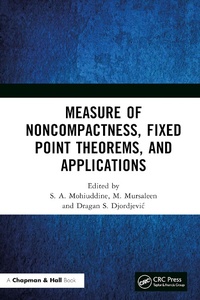
Measure of Noncompactness, Fixed Point Theorems, and Applications
1st Edition
Published on 24. April 2024
204 pages
978-1-040-01332-8 (ISBN)
Description

The theory of the measure of noncompactness has proved its significance in various contexts, particularly in the study of fixed point theory, differential equations, functional equations, integral and integrodifferential equations, optimization, and others. This edited volume presents the recent developments in the theory of the measure of noncompactness and its applications in pure and applied mathematics. It discusses important topics such as measures of noncompactness in the space of regulated functions, application in nonlinear infinite systems of fractional differential equations, and coupled fixed point theorem.
Key Highlights:
Explains numerical solution of functional integral equation through coupled fixed point theorem, measure of noncompactness and iterative algorithm
Showcases applications of the measure of noncompactness and Petryshyn's fixed point theorem functional integral equations in Banach algebra
Explores the existence of solutions of the implicit fractional integral equation via extension of the Darbo's fixed point theorem
Discusses best proximity point results using measure of noncompactness and its applications
Includes solvability of some fractional differential equations in the holder space and their numerical treatment via measures of noncompactness
This reference work is for scholars and academic researchers in pure and applied mathematics.
Key Highlights:
Explains numerical solution of functional integral equation through coupled fixed point theorem, measure of noncompactness and iterative algorithm
Showcases applications of the measure of noncompactness and Petryshyn's fixed point theorem functional integral equations in Banach algebra
Explores the existence of solutions of the implicit fractional integral equation via extension of the Darbo's fixed point theorem
Discusses best proximity point results using measure of noncompactness and its applications
Includes solvability of some fractional differential equations in the holder space and their numerical treatment via measures of noncompactness
This reference work is for scholars and academic researchers in pure and applied mathematics.
More details
Edition
1. Auflage
Language
English
Place of publication
London
United Kingdom
Publishing group
Taylor & Francis Ltd
Target group
College/higher education
Professional and scholarly
Illustrations
2 Tables, black and white
ISBN-13
978-1-040-01332-8 (9781040013328)
Copyright in bibliographic data and cover images is held by Nielsen Book Services Limited or by the publishers or by their respective licensors: all rights reserved.
Schweitzer Classification
Other editions
Additional editions
S. A. Mohiuddine | M. Mursaleen | agan S. Djordjevic
Measure of Noncompactness, Fixed Point Theorems, and Applications
Book
04/2024
1st Edition
Chapman & Hall/CRC
€185.90
Shipment within 10-20 days
Persons
S. A. Mohiuddine is a full Professor of Mathematics at King Abdulaziz University, Jeddah, Saudi Arabia. An active researcher, he has co-authored 5 books: Convergence Methods for Double Sequences and Applications (Springer, 2014), Advances in Summability and Approximation Theory (Springer, 2018), Soft Computing Techniques in Engineering, Health, Mathematical and Social Sciences (CRC Press, Taylor & Francis Group, 2021), Approximation Theory, Sequence Spaces, and Applications (Springer, 2022), Sequence Space Theory with Applications (CRC Press, Taylor & Francis Group, 2023), and a number of chapters in numerous edited books. More than 170 research papers and various leading journals, bear his name.
Mohiuddine is the referee of scientific journals and a member of the editorial boards of those journals, various international scientific bodies and organizing committees. He has visited international universities, including Imperial College London, UK, and served as a guest editor for a number of special journals' issues. His research interests are: sequence spaces, statistical convergence, matrix transformation, measures of non-compactness and approximation theory. His name has appeared in the prestigious list of World's Top 2% Scientists, compiled by Stanford University in California, USA, via Scopus data provided by Elsevier, for four consecutive years from 2020-2023.
M. Mursaleen, since 1982, has served at Aligarh Muslim University from lecturer to full Professor. From 2915 to 2018, he was Chairman of the Department of Mathematics. He has published 9 books, published more than 400 research papers in several highly reputed journals, and besides Masters' students, has guided 21 Ph.D. students.
Mursaleen has been a reviewer for various international scientific journals and is a member of numerous editorial boards for various international scientific journals. He has received a number of awards for his research achievements and was recognized as a 2019 Highly Cited Researcher by the Web of Science.
Dragan Djordjevic received his degrees in mathematics from the University of Nis Serbia: Bachelors in 1992, Masters in 1996, and a PhD in 1998. He has worked at the University of Nis since 1992, and from 2006, as full Professor at the Faculty of Sciences and Mathematics. He has taught courses in various levels of education (Functional Analysis, Operator Theory, Complex Analysis, Measure and integration, Algebras of Operators) and served as the Dean of the Faculty of Sciences and Mathematics, a member of several scientific boards of the University of Nis (Senat, Scientific Council for Sciences and Mathematics), Ministry of Education, Science and Technological Development of Serbia (Scientific Council for Mathematics, Mechanics and Computer Science, Head of the council), as well as in the Republic of Serbia (National council for higher education). He was the head and member of several scientific projects financed by the Ministry of Education, Science and Technological Development of Serbia. He is a member and vice president of the Association Serbian Scientific Mathematical Society. Djordjevic supervised 10 PhD theses (8 in Nis, 1 in Belgrade and 1 in Skopje). He has published 130 scientific papers, including 104 papers in JCR journals. He has collaborated with more than 30 authors, most of them his students, and his results are cited approximately 1400 times, with a Hirsch index of h=22.
Djordjevic has been as an invited speaker for mathematical conferences in Korea, Japan, and Turkey, has organized conferences in mathematical or functional analysis in Nis and Novi Sad, has reviewed papers for mathematical journals, including Mathematical Reviews. His cientific work includes operator theory, with some aspects of functional analysis, linear algebra, general algebra and numerical analysis. His main focus is on operators on Banach and Hilbert spaces, their ordinary and generalized invertibility properties, Fredholm and spectral theory, as well as applications to general ring theory, and operator equations in various structures. He has results related to majorizaion and doubly stochastic operators, theory of spaces with indefinite inner products, and Hilbert C*- modules. Dragan Djordjevic sits on the boards of these mathematical journals: Filomat (one of the editors-in-chief), Functional Analysis, Approximation and Computation (founder, editor-in-chief), Applied Mathematics and Computer Science (founder, one of the editors-in-chief), Advances in the Theory of Nonlinear Analysis and its Application (member of the board), Publications de l'Institute Mathematique (member of the board), and Advances in Operator Theory (member of the board).
Mohiuddine is the referee of scientific journals and a member of the editorial boards of those journals, various international scientific bodies and organizing committees. He has visited international universities, including Imperial College London, UK, and served as a guest editor for a number of special journals' issues. His research interests are: sequence spaces, statistical convergence, matrix transformation, measures of non-compactness and approximation theory. His name has appeared in the prestigious list of World's Top 2% Scientists, compiled by Stanford University in California, USA, via Scopus data provided by Elsevier, for four consecutive years from 2020-2023.
M. Mursaleen, since 1982, has served at Aligarh Muslim University from lecturer to full Professor. From 2915 to 2018, he was Chairman of the Department of Mathematics. He has published 9 books, published more than 400 research papers in several highly reputed journals, and besides Masters' students, has guided 21 Ph.D. students.
Mursaleen has been a reviewer for various international scientific journals and is a member of numerous editorial boards for various international scientific journals. He has received a number of awards for his research achievements and was recognized as a 2019 Highly Cited Researcher by the Web of Science.
Dragan Djordjevic received his degrees in mathematics from the University of Nis Serbia: Bachelors in 1992, Masters in 1996, and a PhD in 1998. He has worked at the University of Nis since 1992, and from 2006, as full Professor at the Faculty of Sciences and Mathematics. He has taught courses in various levels of education (Functional Analysis, Operator Theory, Complex Analysis, Measure and integration, Algebras of Operators) and served as the Dean of the Faculty of Sciences and Mathematics, a member of several scientific boards of the University of Nis (Senat, Scientific Council for Sciences and Mathematics), Ministry of Education, Science and Technological Development of Serbia (Scientific Council for Mathematics, Mechanics and Computer Science, Head of the council), as well as in the Republic of Serbia (National council for higher education). He was the head and member of several scientific projects financed by the Ministry of Education, Science and Technological Development of Serbia. He is a member and vice president of the Association Serbian Scientific Mathematical Society. Djordjevic supervised 10 PhD theses (8 in Nis, 1 in Belgrade and 1 in Skopje). He has published 130 scientific papers, including 104 papers in JCR journals. He has collaborated with more than 30 authors, most of them his students, and his results are cited approximately 1400 times, with a Hirsch index of h=22.
Djordjevic has been as an invited speaker for mathematical conferences in Korea, Japan, and Turkey, has organized conferences in mathematical or functional analysis in Nis and Novi Sad, has reviewed papers for mathematical journals, including Mathematical Reviews. His cientific work includes operator theory, with some aspects of functional analysis, linear algebra, general algebra and numerical analysis. His main focus is on operators on Banach and Hilbert spaces, their ordinary and generalized invertibility properties, Fredholm and spectral theory, as well as applications to general ring theory, and operator equations in various structures. He has results related to majorizaion and doubly stochastic operators, theory of spaces with indefinite inner products, and Hilbert C*- modules. Dragan Djordjevic sits on the boards of these mathematical journals: Filomat (one of the editors-in-chief), Functional Analysis, Approximation and Computation (founder, editor-in-chief), Applied Mathematics and Computer Science (founder, one of the editors-in-chief), Advances in the Theory of Nonlinear Analysis and its Application (member of the board), Publications de l'Institute Mathematique (member of the board), and Advances in Operator Theory (member of the board).
Content
1. The existence and numerical solution of functional integral equation via coupled fixed point theorem, measure of non-compactness and iterative algorithm. 2. Applications of measure of non-compactness and Petryshyn's fixed-point theorem for a class of functional integral equations in a Banach algebra.3. Some Darbo fixed point theorems and solutions of the implicit fractional integral equation. 4. A survey on recent best proximity point results using measure of noncompactness and applications.5. A Petryshyn based approach to the existence of solutions for Volterra functional integral equations with Hadamard-type fractional integrals.6. Coupled fixed point theorem and measure of noncompactness for existence of solution of functional integral equations system and iterative algorithm to solve it. 7. Optimum solution of integral equation via measure of noncompactness. 8. Approximate finite dimensional additive mappings in modular spaces by fixed point method. 9. Ulam stability results of the quadratic functional equation in Banach space and multi-normed space by using direct and fixed point methods.10. Solution of simultaneous nonlinear integral equations by generalized contractive condition. 11. Compactness via Hausdor measure of non-compactness on q-Pascal difference sequence spaces.
