

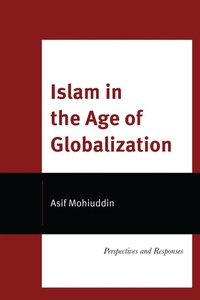
Islam in the Age of Globalization
Perspectives and Responses
1st Edition
Published on 29. November 2024
358 pages
979-8-8818-0134-2 (ISBN)
Description

Globalization has been a central theme in political, economic, cultural, and religious debates since the turn of the century. While some see it as a solution, others consider it the root of our problems. The intensification of cultural and military warfare, and the "West v. the Rest" mentality, fuels a deep-seated ethnocentrism. Religion, meanwhile, faces scrutiny from various fundamentalisms and grand narratives. Many modern Muslim thinkers are skeptical of globalization, perceiving it as a homogenizing force that spreads Western culture and concentrates power among a few nations. They argue that Islam promotes human oneness and provides an intellectual and spiritual framework for a more civilized and universal approach to globalization, opposing the Western-centric hegemonic tendencies.
The goal of this book is to demonstrate that Islam favors globalization in its original, voluntary form, as opposed to the violent imposition of the West on the East. It will examine Muslim responses to globalization and their attempts to find global answers to local problems in their own local, regional, national, and global contexts. Several academic works have explored various aspects of globalization, focusing on tensions and conflicts, such as power politics, religious authority, and legislative issues. However, there is a notable absence of attention given to the Islamic perspective on globalization, including both appreciation and critique. This book addresses this gap by offering not only a Muslim critique of globalization but also a broader framework for understanding Islam's unique perspective on globalization. Does globalization support the inclusivity that Islam advocates? How does Islam fit into the globalization era? What impact and influence may Muslims have on the future of globalization? What unique prospects does globalization provide Muslims and the Islamic faith? Is Islamic revivalism a reaction to globalization? Alternatives to globalization could exist. What kind of structure will the Islamic globalization paradigm have?
In addition to addressing these questions, the book attempts to provide a theoretical framework for Islamic globalization, which incorporates the shuratic practice and the vision of an international community extending beyond the Arabs and non-Arabs. This underscores the importance of historical contexts for contemporary actions and beliefs. In the process the book attempts to extend the debate on Islam and globalization by mapping out the effects of globalization on various aspects of Muslim culture.
The goal of this book is to demonstrate that Islam favors globalization in its original, voluntary form, as opposed to the violent imposition of the West on the East. It will examine Muslim responses to globalization and their attempts to find global answers to local problems in their own local, regional, national, and global contexts. Several academic works have explored various aspects of globalization, focusing on tensions and conflicts, such as power politics, religious authority, and legislative issues. However, there is a notable absence of attention given to the Islamic perspective on globalization, including both appreciation and critique. This book addresses this gap by offering not only a Muslim critique of globalization but also a broader framework for understanding Islam's unique perspective on globalization. Does globalization support the inclusivity that Islam advocates? How does Islam fit into the globalization era? What impact and influence may Muslims have on the future of globalization? What unique prospects does globalization provide Muslims and the Islamic faith? Is Islamic revivalism a reaction to globalization? Alternatives to globalization could exist. What kind of structure will the Islamic globalization paradigm have?
In addition to addressing these questions, the book attempts to provide a theoretical framework for Islamic globalization, which incorporates the shuratic practice and the vision of an international community extending beyond the Arabs and non-Arabs. This underscores the importance of historical contexts for contemporary actions and beliefs. In the process the book attempts to extend the debate on Islam and globalization by mapping out the effects of globalization on various aspects of Muslim culture.
More details
Series
Edition
1. Auflage
Language
English
Place of publication
New York
United States
Target group
Professional and scholarly
Illustrations
2 BW Photos
ISBN-13
979-8-8818-0134-2 (9798881801342)
Copyright in bibliographic data and cover images is held by Nielsen Book Services Limited or by the publishers or by their respective licensors: all rights reserved.
Schweitzer Classification
Other editions
Additional editions
Book
12/2024
Rowman & Littlefield Publishers
€135.10
Shipment within 15-20 days
Persons
Asif Mohiuddin is Senior Lecturer, Department of Moral Studies, Civics and Character Building, Sultan Idris Education University, Malaysia. He is the author of Navigating Religious Authority in Muslim Societies: Islamist Movements and the Challenge of Globalisation, (2023). Previously, he served as a post-doctoral fellow in the Faculty of Theology, Sakarya University, in Turkey from 2021 to 2022. Prior to joining Sakarya University, he worked as a lecturer in the Department of Higher Education, Government of Jammu and Kashmir, India. He received his PhD from the University of Kashmir in 2018. His research interests include globalization and Islam, intersection between politics and religion in the Middle East, human rights law, Islam and the West and Muslim minorities in multicultural societies (Europe and South Asia).
Content
- Cover
- Half Title
- Series Page
- Title Page
- Copyright Page
- Contents
- Foreword
- Acknowledgments
- Introduction
- Globalization, Muslim Identity, and Transnational Networks
- Historical Patterns and Contemporary Global Sphere
- Intersections, Impacts, and Alternatives
- Organization of Chapters
- Notes
- Part I: Globalization and Islam
- Chapter 1: Revisiting Globalization: Definitions, Discourses, and Domains
- Introduction
- Definitions
- Globalization: Conflicting Views and Evolving Paradigms
- Globalists
- Skeptics
- Transformationalists
- Globalization through the Ages: From Ancient Trade Routes to Modern Networks
- Beyond One Globalization: Understanding Plural Perspectives
- Economic Globalization: Impacts, Controversies, and Alternative Movements
- Political Globalization: Redefining Power and Governance in a Changing World
- Cultural Globalization: The Power Dynamics of Global Flows
- Glocal Dynamics: Power, Meaning, and Identity in a Connected World
- The Interplay of Globalization and Social Identity
- The Rising Tide of Anti-Globalization Forces
- Conclusion
- Notes
- Chapter 2: Globalization and Islam: Exploring the Alternative Paradigm
- Introduction
- The Foundations of Islamic Paradigm
- Ummah
- Islamic Perspective on the Institutional Aspect of Globalization
- Application of Shuratic Perspective
- The Islamic Paradigm: Ethics, Innovation, and Economic Development
- The Qur'anic Approach to Creative Methodologies
- Shari'ah Objectives and Utility in Technological Innovation
- Toward Economic Justice and Global Sustainability
- Economic, Environmental, and Social Sustainability in Islamic Finance
- Environmental Crisis and Management
- Fostering Global Diversity, Pluralism, and Interfaith Cooperation for Mutual Understanding
- Conclusion
- Notes
- Chapter 3: From Globalization to Global Islam: Tracing Intersections and Convergence
- Introduction
- Islamic Paradigm and Archaic Globalization
- Muslim Universalism and the Early Stages of Globalization
- Islamic Cooperation and Conflict in the Era of Modern Globalization
- Muslim Universalism in the Postcolonial World
- Islam and Postcolonial Identity Formation
- Global Muslim Diaspora and Transnational Connections
- Religious Associations and Transnational Ties
- Diasporic Identity and the Dynamics of Cultural Reproduction
- Islam and Global Governance
- Conclusion
- Notes
- Chapter 4: Islamic Revivalism in the Era of Globalization: Unraveling the Dynamics of Religion, Culture, and Resistance
- Introduction
- Islamic Revivalism: A Global Perspective
- Islamic Fundamentalism and Revivalism
- Revivalism in the Early Period
- Eighteenth- and Nineteenth-Century Revivalism
- Tajdid: Islamic Renaissance in the Eighteenth and Nineteenth Centuries
- Modern Revivalism
- Technology and Islamic Revivalism
- Critique of Islamic Revivalist Movements in the Arab World
- Islamic Revivalist Movements and the Global Perception of Islam
- Conclusion
- Notes
- Part II: Adaptive Islam
- Chapter 5: Embracing or Resisting Globalization? Ali Mazrui's Exploration of Interdependence and the Muslim World's Dilemma
- Introduction
- Ali Mazrui: Brief Biography and Works
- The Driving Forces of Globalization
- Unveiling the Paradoxes of Globalization: Homogenization vs. Hegemonization
- The Three Abodes: Islam's Influence and the West's Appropriation
- International Law, the United Nations, and Western Hegemony
- Acts of War, Globalization, and American Military Engagements
- Western Culture, Islam, and Censorship
- Intersections of Violence, Globalization, and Islam
- Cultural Globalization: Struggles, Contradictions, and Muslim Responses
- The Intersection of Islam and Western Culture
- Conclusion
- Notes
- Chapter 6: Islam and the Globalization Paradox: Akbar Ahmad's Reflections on Crisis and Resilience
- Introduction
- Brief Biography and Works
- Islam, Migration, and the Forces of Globalization
- Economic and Cultural Dimensions in Global Interconnections
- Cultural Currents and Contested Homogenization
- Clash of Civilizations and the Sense of Siege among Muslims
- Global Media, Culture, and Identity
- Risk Society and a Post-Honor World
- Culture, Territory, and Power: Dynamics of the Muslim Diaspora
- Faith in Flux: Unearthing Layers of American Muslim Identity
- Backlash and Responses
- Promoting Dialogue in the Age of Uncertainty
- Conclusion
- Notes
- Chapter 7: Toward a Moral Dimension in Globalization: Umar Chapra's Exploration of Islam's Response to Economic Challenges
- Introduction
- Umer Chapra: Brief Biography and Works
- Islam's Vision of Equality and Solidarity
- Justice as the Key
- Economic Integration: A Path to Peace and Prosperity
- Justice in Islamic Economics: Implications for Global Integration
- Challenges in Global Economic Integration and the Role of Developing Nations
- Redefining Globalization through Islamic Economic Principles
- The Qur'an's Message of Social Integration
- Building Alliances for Peace: Political Integration and Global Cooperation
- Islam's Moral Foundation for Societal Transformation and Economic Justice
- Islamic Economic Thought and Maqasid al-Shari'ah
- Overcoming Challenges
- Conclusion
- Notes
- Chapter 8: Islamic Thought in the Age of Globalization: Ibrahim Abu Rabi's Perspective on Epistemological, Ethical, and Socioeconomic Changes
- Introduction
- Ibrahim Abu Rabi': Brief Biography and Works
- Contemporary Islamic Thought in the Face of Globalization
- Poverty, Wealth Concentration, and State Repression
- Neocolonialism and Cultural Hegemony
- Arab Intellectual Responses
- Conclusion
- Notes
- Conclusion
- Proposed Recommendations
- Notes
- Bibliography
- Index
- About the Author
