

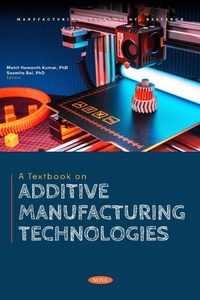
Textbook on Additive Manufacturing Technologies
Published on 17. June 2024
173 pages
979-8-89113-804-9 (ISBN)
Description

Embark on a comprehensive exploration of additive manufacturing technologies with this informative text. Commencing with a thorough foundational overview, the book systematically introduces readers to the intricacies of additive manufacturing processes. Beyond rudimentary concepts, it delves into the meticulous construction of fundamental machines, providing readers with a nuanced comprehension of the machinery underpinning this innovative field. An engaging aspect of the book is its in-depth examination of the role played by Artificial Intelligence (AI) in optimizing additive manufacturing processes. Offering profound insights, the text elucidates how AI applications fundamentally transform the manufacturing landscape, enhance operational efficiency, and extend the boundaries of what is achievable in contemporary manufacturing. The scope of the book extends beyond technical details to encompass the realm of innovative product development. Readers are invited to explore the convergence of design theories, customer-centric approaches, and sustainable practices, discerning these elements' pivotal role in shaping the manufacturing trajectory. A substantial focus is directed towards the strategic integration of reverse engineering and additive manufacturing. This section furnishes strategic insights into sustainable lifecycle management, providing readers with a strategic framework for navigating the future of these technologies. For those interested in advanced manufacturing techniques, the book thoroughly covers modeling, various production methods, and the intricacies of digital data processing. This comprehensive examination equips readers with a profound understanding of the latest advancements, preparing them to navigate the intricate landscape of modern manufacturing. This textbook stands as an invaluable resource for a student embarking on an exploration of additive manufacturing, a researcher seeking to deepen their knowledge base, or a professional in the field. It offers a holistic and detailed perspective on additive manufacturing technologies, providing a robust foundation for theoretical comprehension and practical application. Join the journey through the dynamic additive manufacturing landscape with this insightful and educational book.
More details
Other editions
Additional editions
Mohit Hemanth Kumar
A Textbook on Additive Manufacturing Technologies
Book
06/2024
Nova Science Publishers Inc
€126.26
Shipment within 3-4 weeks
Content
- Intro
- Contents
- Preface
- Chapter 1
- Introduction to Additive Manufacturing Technologies
- Abstract
- Introduction
- Evolution of Additive Manufacturing
- Inception of Additive Manufacturing (1980s-1990s)
- Advancements in Materials and Processes (2000-2010)
- Mainstream Adoption and Industrialization (2010-2015)
- Consumer 3D Printing on the Rise (2010-2015)
- Bioprinting and Electronics Advancements (2015-2020)
- Current Situation and Prospects (2020-Present)
- Additive Manufacturing Process Chain: From Design to Production
- Design and Computer-Aided Design (CAD) Modeling
- File Preparation and Slicing
- Material Selection and Preparation
- Post-Processing
- Process Classification in Additive Manufacturing
- Classification Based on Applications
- Future Considerations and Emerging Trends
- Additive Manufacturing Design Principles and Process Selection
- Applications of Additive Manufacturing Technology: Transforming Industries
- Space Exploration
- Defense and Military
- Architectural Models
- Part Pre- and Post-Processing in Additive Manufacturing Technologies
- Future Directions of Additive Manufacturing Technologies
- Certification and Standards: Industry-Wide Standards
- Conclusion
- References
- Chapter 2
- Construction of Basic Machines in Additive Manufacturing Technologies
- Abstract
- Introduction
- Energy Delivery, Material Delivery, Nozzle, and Heating Systems in Additive Manufacturing Technologies
- Material Delivery Systems
- Nozzle Systems
- Heating Systems
- Optical and Optoelectronic Components in Additive Manufacturing Technologies
- CNC and Process Controller in Additive Manufacturing Technologies
- Environmental Control Systems in Additive Manufacturing Technologies
- Rapid Tooling Equipment in Additive Manufacturing Technologies
- Rapid Tooling Applications
- Conclusion
- References
- Chapter 3
- AI Applications in Optimizing Additive Manufacturing Process
- Abstract
- An Overview of Additive Manufacturing and Artificial Intelligence
- Data Collection and Sensing in AI-based Additive Manufacturing
- Data-Driven Design Approaches in AI
- Design Optimization Applications
- Material Optimization
- Process Parameter Optimization
- Predictive Maintenance
- Conclusion
- References
- Chapter 4
- Innovative Product Development: Bridging Design Theories, Customer-Centric Approaches, and Sustainable Practices
- Abstract
- Introduction
- Modern Product Development and Design Theories
- Process Tools
- Understanding Customer Needs
- Product Function
- Tear Down and Experimentation
- Key Testing Methodologies
- Importance of Calibration and Traceability
- Product Portfolio and Architecture
- Generating Concepts and Selection
- Modelling of Product Metrics
- Robustness and Environmental Design
- Quantifying Additive Manufacturing's Sustainability
- Designing Robust and Resilient Components
- Ensuring Repeatability and Reliability
- Lifecycle Considerations for Closed-Loop Systems
- Conclusion
- References
- Chapter 5
- Integrating Reverse Engineering and Additive Manufacturing: Strategies for Sustainable Lifecycle Management and Future Technologies
- Abstract
- Introduction
- Need for Life Cycle Management
- Life Cycle Phases
- Strategies
- Integration of Environmental Aspects
- Life Cycle Assessment Techniques
- Technology Forecasting
- Conclusion
- References
- Chapter 6
- Advanced Manufacturing Techniques: Modeling, Production Methods, and Digital Data Processing
- Abstract
- Introduction
- Process Modelling
- Machine Learning and Digital Twin
- Direct and Indirect Method of Production
- 3D Data Capture and Processing
- Image Processing Software
- MIMICS Software
- Medicine Modelling
- Planning and Simulation of Complex Surgeries
- Design and Fabrication of Customized Implants and Prosthesis
- Design and Production of Medical Devices
- Criteria for Medical Models When Made Using Additive Manufacturing
- Forensic Science and Anthropology
- Visualization of Biomolecules and Organ Printing
- Automotive Industry
- Conclusion
- References
- Index
- Blank Page
