

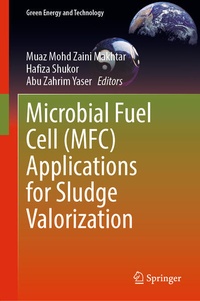
Microbial Fuel Cell (MFC) Applications for Sludge Valorization
Description

This book highlights current efforts and research (in Malaysia) on Microbial Fuel Cell (MFC) approach as a core technique for sludge treatment and energy recovery. It also includes health and socioeconomic perspectives used in this approach. The book begins with an overview of sludge in waste treatment plants and the efficient generation of renewable energy through dewatered sludge bioconversion via MFC. It presents the use of Electrogenic Bacteria (EB) for accelerating the hydrolysis treatment of sludge and the determination of metabolites produced in the process. The book highlights new achievements in the purification of sludge through rubber band technology and further treatment. It discusses the recovery of beneficial biodegradable polymer compounds that are added value for the plastic industry and presents safety issues of sludge on human health. Further, it presents a case study on the MFC project for STEM (Science, Technology, Engineering, and Mathematics) education, and includes the economic perspective of innovation in energy. The book ends with various ways forward toward improving renewable energy production and clean waste treatment.
More details
Other editions
Additional editions
Persons
Dr. Hafiza Shukor is a Senior Lecturer specializing in the areas of fermentation technology (biofuel and biomass treatment) at the Faculty of Chemical Engineering Technology, Universiti Malaysia Perlis (UniMAP). She received her Ph.D. from Facultyof Engineering and Built Environment, Universiti Kebangsaan Malaysia (UKM) under the field of Chemical and Process Engineering, and she obtained her Bachelor Degree and M,Sc. in Chemical Engineering from School of Chemical Engineering, Universiti Sains Malaysia (USM). Her research interests are in the areas of biomass treatment technology, bioconversion of biomass to biofuels (biobutanol, bioethanol, and biohydrogen), and wastewater treatment using biomaterials as biosorbent (biological treatment).
Dr. Abu Zahrim Yaser is an Associate Professor in Waste Processing Technology at the Faculty of Engineering, Universiti Malaysia Sabah. He obtained his Ph.D. from Swansea University. Dr. Zahrim has published 12 books and over 100 other refereed technical papers. His inventions on composting system have been adopted by Tongod, Nabawan and Kundasang communities in Sabah. Dr. Zahrim was a Visiting Scientist at the University of Hull.
