

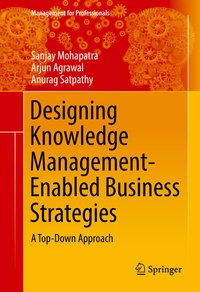
Designing Knowledge Management-Enabled Business Strategies
A Top-Down Approach
Published on 13. July 2016
XVII, 196 pages
978-3-319-33894-1 (ISBN)
Description

This book provides a practical approach to designing and implementing a Knowledge Management (KM) Strategy. The book explains how to design KM strategy so as to align business goals with KM objectives. The book also presents an approach for implementing KM strategy so as to make it sustainable. It covers all basic KM concepts, components of KM and the steps that are required for designing a KM strategy. As a result, the book can be used by beginners as well as practitioners.
Knowledge management is a discipline that promotes an integrated approach to identifying, capturing, evaluating, retrieving, and sharing all of an enterprise's information assets. These assets may include databases, documents, policies, procedures, and previously un-captured expertise and experience in individual workers. Knowledge is considered to be the learning that results from experience and is embedded within individuals. Sometimes the knowledge is gained through critical thinking, watching others, and observing results of others. These observations then form a pattern which is converted in a 'generic form' to knowledge. This implies that knowledge can be formed only after data (which is generated through experience or observation) is grouped into information and then this information pattern is made generic wisdom. However, dissemination and acceptance of this knowledge becomes a key factor in knowledge management. The knowledge pyramid represents the usual concept of knowledge transformations, where data is transformed into information, and information is transformed into knowledge. Many organizations have struggled to manage knowledge and translate it into business benefits. This book is an attempt to show them how it can be done.
Knowledge management is a discipline that promotes an integrated approach to identifying, capturing, evaluating, retrieving, and sharing all of an enterprise's information assets. These assets may include databases, documents, policies, procedures, and previously un-captured expertise and experience in individual workers. Knowledge is considered to be the learning that results from experience and is embedded within individuals. Sometimes the knowledge is gained through critical thinking, watching others, and observing results of others. These observations then form a pattern which is converted in a 'generic form' to knowledge. This implies that knowledge can be formed only after data (which is generated through experience or observation) is grouped into information and then this information pattern is made generic wisdom. However, dissemination and acceptance of this knowledge becomes a key factor in knowledge management. The knowledge pyramid represents the usual concept of knowledge transformations, where data is transformed into information, and information is transformed into knowledge. Many organizations have struggled to manage knowledge and translate it into business benefits. This book is an attempt to show them how it can be done.
More details
Series
Edition
1st ed. 2016
Language
English
Place of publication
Cham
Switzerland
Publishing group
Springer International Publishing
Target group
Professional and scholarly
Product notice
Reflowable
Illustrations
XVII, 196 p. 76 illus., 52 illus. in color.
File size
7,62 MB
ISBN-13
978-3-319-33894-1 (9783319338941)
DOI
10.1007/978-3-319-33894-1
Schweitzer Classification
Other editions
Additional editions
Sanjay Mohapatra | Arjun Agrawal | Anurag Satpathy
Designing Knowledge Management-Enabled Business Strategies
A Top-Down Approach
Book
07/2016
Springer
€53.49
Shipment within 10-15 days
Persons
Dr. Sanjay Mohapatra received his B.E. from NIT Rourkela, MBA from XIMB, M.Tech from IIT Madras, India and PhD from Utkal University. Dr. Mohapatra has more than 29 years of combined industry and academic experience. He has consulted many organizations in different domains such as Utilities, Banking, Insurance and healthcare sectors. His teaching interests are in IT Strategy and Management Information Systems and research interests are in the area of IT enabled processes. He has authored/co-authored twenty one books, more than fifty papers in national and international referred journals besides publications in different conferences.
Arjun Agrawal completed his MBA from Xavier Institute of Management, Bhubaneswar, India. He has varied experience in the field of Product Management, Banking and Information Technology. Prior to this, he completed his Bachelors in Engineering (Comp. Sc.) from Birla Institute of Technology, Mesra, India. He has served as reviewer forseveral conferences around the world and has also published several IEEE papers in India and abroad. His research interests include Marketing Strategy, International Marketing, Product Management, Knowledge Management, Information Systems and other related areas.
Anurag Satpathy is a consultant with one of the leading consulting companies in the industry. He has diverse experience in the field of handling consulting projects, Project Management, Quality Assurance and Technology Development. His research interests include Sustainable Development, Strategy & Operations, Innovation Management and Knowledge Management. Anurag holds a B.Tech in Metallurgical and Materials Engineering from Malaviya National Institute of Technology, Jaipur, India and an MBA from Xavier Institute of Management, Bhubaneswar, India.
Arjun Agrawal completed his MBA from Xavier Institute of Management, Bhubaneswar, India. He has varied experience in the field of Product Management, Banking and Information Technology. Prior to this, he completed his Bachelors in Engineering (Comp. Sc.) from Birla Institute of Technology, Mesra, India. He has served as reviewer forseveral conferences around the world and has also published several IEEE papers in India and abroad. His research interests include Marketing Strategy, International Marketing, Product Management, Knowledge Management, Information Systems and other related areas.
Anurag Satpathy is a consultant with one of the leading consulting companies in the industry. He has diverse experience in the field of handling consulting projects, Project Management, Quality Assurance and Technology Development. His research interests include Sustainable Development, Strategy & Operations, Innovation Management and Knowledge Management. Anurag holds a B.Tech in Metallurgical and Materials Engineering from Malaviya National Institute of Technology, Jaipur, India and an MBA from Xavier Institute of Management, Bhubaneswar, India.
Content
Introduction to Knowledge Management.- Knowledge Management Cycles.- Communities of Practice for Effective Knowledge Management Strategy.- Issues and Challenges in Knowledge Management.- Designing Knowledge Management Strategy.- KM Metrics and KM Audit.- Implementing KM Strategy.- KM and Web 2.0.- KM and Cloud Computing.- KM in Development Sector.- Automation in Knowledge Management.
