

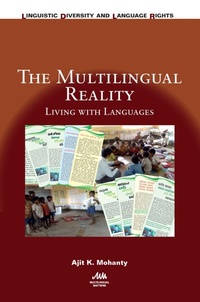
The Multilingual Reality
Living with Languages
Published on 1. November 2018
288 pages
978-1-78892-198-5 (ISBN)
Description

This book is a multidisciplinary analysis of the meaning and dynamics of multilingualism from the perspectives of multilingual societies and language communities in the margins, who are trapped in a vicious circle of disadvantage. It analyses the social, psychological and sociolinguistic processes of linguistic dominance and hierarchical relationships among languages, discrimination, marginalisation and assertive maintenance in multilingualism characterised by a Double Divide, and shows the relationship between educational neglect of languages, capability deprivation and poverty, and loss of linguistic diversity. Its comparative analysis of language-in-education policies and practices and applications of multilingual education (MLE) in diverse contexts shows some promises and challenges in the education of indigenous/tribal/minority children. This book will be of interest to students, researchers, educators and practitioners in sociolinguistics, educational linguistics, psycholinguistics, multilingualism and bilingual/multilingual education.
Reviews / Votes
This remarkable and important volume stands in stark contrast to reductive, partial or tendentious accounts of language in society and education. Mohanty's book is a tour de force. It will stand the test of time due to its ability to comprehend and critique injustice and inequality without losing sight of the cultural richness, intellectual depth and sheer marvel at the ingenuity that languages represent. * Joseph Lo Bianco, The University of Melbourne, Australia * Highly respected and beloved professor Ajit Mohanty has worked tirelessly so that children and teachers in multilingual contexts can learn and teach in their strongest languages. This inspiring book represents a wealth of experience and provides both theoretical and practical guidance on developing appropriate policy and practice in multilingual education. * Carol Benson, Columbia University, USA * Ajit Mohanty's meticulous book demonstrates why all countries can learn from the Indian experience. It reveals how educational language policy can serve the interests of the marginalised, and not merely the privileged. It is the missing link to Amartiya Sen's books on ensuring greater social justice, with English in appropriate perspective. * Robert Phillipson, Professor Emeritus, Copenhagen Business School, Denmark * This book serves as an excellent resource for those interested in learning about multilingualism as a paradigm of study and also those who are interested in learning about cutting edge research in multilingual education. This book opens up a space for dialogue on mother-tongue based multilingual education with educators, researchers and policymakers. * Anuja Sarda and Usree Bhattacharya, University of Georgia, USA, International Journal of Bilingual Education and Bilingualism, August 2019 * This is a well-researched, well-articulated book for academics and practitioners working in the area of education in post-colonial and multilingual societies. It is also relevant for theorists and practitioners working in the West, whose ideas about bi- and multilingual education would be challenged and widened by exposure to the range of issues that Mohanty raises, issues that are backed by decades of detailed research conducted with different ITM populations in India, as well as the author's personal biography as a citizen and scholar in a multilingual society. -- Shailaja Menon, Azim Premji University, India * Psychological Studies, 2020 *More details
Series
Language
English
Place of publication
Bristol
United Kingdom
Target group
College/higher education
Product notice
Reflowable
ISBN-13
978-1-78892-198-5 (9781788921985)
Copyright in bibliographic data and cover images is held by Nielsen Book Services Limited or by the publishers or by their respective licensors: all rights reserved.
Schweitzer Classification
Other editions
Additional editions
Book
11/2018
Multilingual Matters
€56.20
Shipment within 3-4 weeks
Person
Ajit K. Mohanty is Chief Adviser of the National Multilingual Education Resource Consortium (NMRC) and Retired Professor, Jawaharlal Nehru University, New Delhi, India. His research interests include multilingualism, multilingual education, multilingual socialisation and educational language policy.
Content
Chapter 1. Introduction: Languaging without Borders and Binaries
Chapter 2. The Multilingual World: Conceptual Issues
Chapter 3. Multilingualism: A Resource or Burden?
Chapter 4. Language, Power and Hierarchy: The Double Divide
Chapter 5. Negotiation of Identities in Multilingual Societies: Moving From Marginalisation/Assimilation to Assertive Maintenance
Chapter 6. Language Disadvantage, Capability Deprivation and Poverty
Chapter 7. Multilingualism and Language Policy in Education
Chapter 8. Educational Models in Multilingual Societies: Rethinking MLE
Chapter 9. English in Multilingual Societies: The Dynamics of Dominance
References
Chapter 2. The Multilingual World: Conceptual Issues
Chapter 3. Multilingualism: A Resource or Burden?
Chapter 4. Language, Power and Hierarchy: The Double Divide
Chapter 5. Negotiation of Identities in Multilingual Societies: Moving From Marginalisation/Assimilation to Assertive Maintenance
Chapter 6. Language Disadvantage, Capability Deprivation and Poverty
Chapter 7. Multilingualism and Language Policy in Education
Chapter 8. Educational Models in Multilingual Societies: Rethinking MLE
Chapter 9. English in Multilingual Societies: The Dynamics of Dominance
References
