

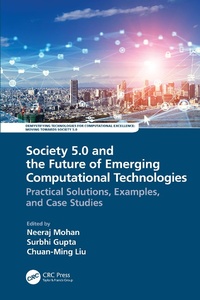
Society 5.0 and the Future of Emerging Computational Technologies
Practical Solutions, Examples, and Case Studies
1st Edition
Published on 7. June 2022
312 pages
978-1-000-53130-5 (ISBN)
Description

This book discusses the technological aspects for the implementation of Society 5.0. The foundation and recent advances of emerging technologies such as artificial intelligence, data science, Internet of Things, and Big Data for the realization of Society 5.0 are covered. Practical solutions to existing problems, examples, and case studies are also offered.
Society 5.0 and the Future of Emerging Computational Technologies: Practical Solutions, Examples, and Case Studies discusses technologies such as machine learning, artificial intelligence, and Internet of Things for the implementation of Society 5.0. It offers a firm foundation and understanding of the recent advancements in various domains such as data analytics, neural networks, computer vision, and robotics, along with practical solutions to existing problems in fields such as healthcare, manufacturing industries, security, and infrastructure management. Applications and implementations are highlighted along with the correlation between technologies. Examples and case studies are presented throughout the book to augment text.
This book can be used by research scholars in the engineering domain who wish to gain knowledge and contribute towards a modern and secure future society. The book will also be useful as a reference at universities for postgraduate students who are interested in technological advancements.
Society 5.0 and the Future of Emerging Computational Technologies: Practical Solutions, Examples, and Case Studies discusses technologies such as machine learning, artificial intelligence, and Internet of Things for the implementation of Society 5.0. It offers a firm foundation and understanding of the recent advancements in various domains such as data analytics, neural networks, computer vision, and robotics, along with practical solutions to existing problems in fields such as healthcare, manufacturing industries, security, and infrastructure management. Applications and implementations are highlighted along with the correlation between technologies. Examples and case studies are presented throughout the book to augment text.
This book can be used by research scholars in the engineering domain who wish to gain knowledge and contribute towards a modern and secure future society. The book will also be useful as a reference at universities for postgraduate students who are interested in technological advancements.
More details
Series
Edition
1. Auflage
Language
English
Place of publication
London
United Kingdom
Publishing group
Taylor & Francis Ltd
Target group
College/higher education
Professional and scholarly
Illustrations
42 Tables, black and white; 75 Line drawings, black and white; 41 Halftones, black and white; 116 Illustrations, black and white
ISBN-13
978-1-000-53130-5 (9781000531305)
Copyright in bibliographic data and cover images is held by Nielsen Book Services Limited or by the publishers or by their respective licensors: all rights reserved.
Schweitzer Classification
Other editions
Additional editions
Neeraj Mohan | Surbhi Gupta | Chuan-Ming Liu
Society 5.0 and the Future of Emerging Computational Technologies
Practical Solutions, Examples, and Case Studies
Book
10/2024
1st Edition
CRC Press
€71.90
Shipment within 10-20 days
Neeraj Mohan | Surbhi Gupta | Chuan-Ming Liu
Society 5.0 and the Future of Emerging Computational Technologies
Practical Solutions, Examples, and Case Studies
Book
06/2022
1st Edition
CRC Press
€206.90
Shipment within 10-20 days
Persons
Neeraj Mohan is working as Assistant Professor in Computer Science & Engineering Department in I.K. Gujral Punjab Technical University, Kapurthala (Punjab) India. He has a rich and quantitative academic experience of 19 years at various positions. He did his Doctoral degree from I.K. Gujral Punjab Technical University, Kapurthala (Punjab) India in the year 2016. He is an active researcher with more than 50 research papers in reputed journals and conferences. His research interest areas are network traffic management and image processing. He has guided one Ph.D. Thesis and 17 M.Tech. Thesis till date.
Surbhi Gupta holds a B. Tech. degree and Ph.D. from I.K. Gujral Punjab Technical University, Punjab, India. She received a merit for her master's degree at Punjab Agricultural University, Punjab, India. She is presently working as an Assistant Professor - Computer Science and Engineering at Punjab Agricultural University, Ludhiana, India. She is involved in research on applications of image analysis using machine learning. She has authored over 40 international journal and conference papers. She has contributed as a reviewer for reputed journals like Journal of Visual Communication and Image Representation (Elsevier), Imaging Science (Taylor & Francis), and Journal of Electronic Imaging (SPIE).
Chuan-Ming Liu is a professor in the Department of Computer Science and Information Engineering (CSIE), National Taipei University of Technology (Taipei Tech), TAIWAN, where he was the Department Chair from 2013-2017. Dr. Liu received his Ph.D. in Computer Science from Purdue University in 2002 and joined the CSIE Department in Taipei Tech in the spring of 2003. In 2010 and 2011, he has held visiting appointments with Auburn University, Auburn, AL, USA, and the Beijing Institute of Technology, Beijing, China. He has services in many journals, conferences and societies as well as published more than 100 papers in many prestigious journals and international conferences. Dr. Liu was the co-recipients of ICUFN 2015 Excellent Paper Award, ICS 2016 Outstanding Paper Award, MC 2017 Best Poster Award, WOCC 2018 Best Paper Award and MC 2019 Best Poster Award. His current research interests include big data management and processing, uncertain data management, data science, spatial data processing, data streams, ad-hoc and sensor networks, location-based services.
Surbhi Gupta holds a B. Tech. degree and Ph.D. from I.K. Gujral Punjab Technical University, Punjab, India. She received a merit for her master's degree at Punjab Agricultural University, Punjab, India. She is presently working as an Assistant Professor - Computer Science and Engineering at Punjab Agricultural University, Ludhiana, India. She is involved in research on applications of image analysis using machine learning. She has authored over 40 international journal and conference papers. She has contributed as a reviewer for reputed journals like Journal of Visual Communication and Image Representation (Elsevier), Imaging Science (Taylor & Francis), and Journal of Electronic Imaging (SPIE).
Chuan-Ming Liu is a professor in the Department of Computer Science and Information Engineering (CSIE), National Taipei University of Technology (Taipei Tech), TAIWAN, where he was the Department Chair from 2013-2017. Dr. Liu received his Ph.D. in Computer Science from Purdue University in 2002 and joined the CSIE Department in Taipei Tech in the spring of 2003. In 2010 and 2011, he has held visiting appointments with Auburn University, Auburn, AL, USA, and the Beijing Institute of Technology, Beijing, China. He has services in many journals, conferences and societies as well as published more than 100 papers in many prestigious journals and international conferences. Dr. Liu was the co-recipients of ICUFN 2015 Excellent Paper Award, ICS 2016 Outstanding Paper Award, MC 2017 Best Poster Award, WOCC 2018 Best Paper Award and MC 2019 Best Poster Award. His current research interests include big data management and processing, uncertain data management, data science, spatial data processing, data streams, ad-hoc and sensor networks, location-based services.
Content
Section 1: Social, Economic, and Industry Applications. 1. Technology as Backbone for Realization of Society 5.0. 2. Blockchain Technology for Cashless Transactions and Cross Border Payments. 3. Role of Embedded Systems for Futuristic Society. 4. Data Science Applications for Organization Decision-Making. 5. IOT Based Recommender Systems. Section 2: Healthcare Systems. 6. Deep Learning and Pattern Recognition Medical Imaging. 7. Artificial Intelligence (AI) Based Application in Healthcare Systems. 8. Disease Diagnosis and Prediction Using Machine Learning. 9. Future of Ensemble Approaches. Section 3: Safe and Sustainable Cities. 10. Applications of IoT to Safety and Security Systems. 11. Energy Efficient Sustainable Cities and their Planning. 12. Use of AI and Data Science Tools for Fraud and Risk Detection. 13. Natural Language Processing for Various Assistant Systems. 14. Futuristic Communication: Networks without Boundaries.
