

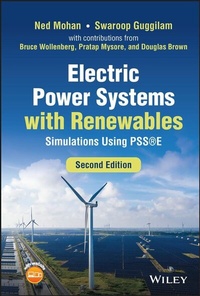
Electric Power Systems with Renewables
Description

Concise, balanced, and fundamentals-based resource providing coverage of power system operation and planning, including simulations using PSS¯®E software
Electric Power Systems with Renewables provides a comprehensive treatment of various topics related to power systems with an emphasis on renewable energy integration into power systems. The updated use cases and methods in the book build upon the climate change science and renewables currently being integrated with the grid and the ability to manage resilience for electrifying transportation and related power systems as societies identify more ways to move towards a carbon-free future.
Simulation examples and software support are provided by integrating the educational version of PSS¯®E. The newly revised edition includes new topics on the intelligent use of PSS¯®E simulation software, presents a short introduction to Python (a widely used software in the power industry), and provides new examples and back-of-the-chapter homework problems to further aid in information retention.
Written by two highly qualified authors with significant experience in the field, Electric Power Systems with Renewables also contains information on:
* Electric energy and the environment, covering hydro power, fossil-fuel based power plants, nuclear power, renewable energy, and distributed generation (DG)
* Power flow in power system networks covers basic power flow equations, the Newton-Raphson procedure, sensitivity analysis, and a new remote bus voltage control concept
* Transformers and generators in power systems, covering basic principles of operation, a simplified model, and per-unit representation
* High voltage DC (HVDC) transmission systems-current-link, and voltage-link systems
Associated with this textbook, there is a website from which the simulation files can be downloaded for use in PSS¯®E and Python. It also contains short videos to simplify the use of these software. This website will be regularly updated.
Electric Power Systems with Renewables serves as a highly useful textbook for both undergraduate and graduate students in Electrical and Computer Engineering (ECE). It is also an appropriate resource for students outside of ECE who have the prerequisites, such as in mechanical, civil, and chemical engineering. Practicing engineers will greatly benefit with its industry-relevant approach to meet the present-day needs.
More details
Other editions
Additional editions
Persons
Ned Mohan, PhD, joined the University of Minnesota in 1975, where he is currently a Regents Professor and Oscar A. Schott Professor of Power Electronic Systems. He is a Fellow of the IEEE and a member of the National Academy of Engineering.
Swaroop Guggilam, PhD, is an Engineer Scientist III, Electric Power Research Institute, Inc. His research areas include frequency control, transmission operations and planning, voltage control and stability, and optimization of distributed energy resources. In addition, the following three contributors bring the industry relevance to this textbook: Bruce F. Wollenberg, Prof. Emeritus at the University of Minnesota, Douglas Brown at Siemens, Inc., and Pratap Mysore with years of experience in relaying and protection at Xcel Energy.
Content
Preface xiii
Table of Simulations Using Pss®e, Python, and Matlab/simulink® xv
About the Companion Website xvii
Chapter 1 Introduction to Power Systems: a Changing Landscape 1
1.1 Nature of Power Systems 2
1.2 Changing Landscape of Power Systems Due to Utility Deregulation 4
1.3 Integration of Renewables Into the Grid 5
1.4 Topics in Power Systems 6
References 9
Problems 9
Chapter 2 Review of Basic Electric Circuits and Electromagnetic Concepts 11
2.1 Introduction 11
2.2 Phasor Representation in a Sinusoidal Steady State 12
2.3 Power, Reactive Power, and Power Factor 16
2.4 Three-Phase Circuits 22
2.5 Real and Reactive Power Transfer between AC Systems 30
2.6 Equipment Ratings, Base Values, and Per-Unit Quantities 32
2.7 Energy Efficiencies of Power System Equipment 33
2.8 Electromagnetic Concepts 34
Reference 44
Problems 44
Appendix 2A 47
Chapter 3 Electric Energy and the Environment 51
3.1 Introduction 51
3.2 Choices and Consequences 51
3.3 Hydropower 53
3.4 Fossil-Fuel-Based Power Plants 53
3.5 Nuclear Power 55
3.6 Renewable Energy 58
3.7 Distributed Generation (DG) 66
3.8 Environmental Consequences and Remedial Actions 66
References 68
Problems 68
Chapter 4 Ac Transmission Lines and Underground Cables 71
4.1 Need for Transmission Lines and Cables 71
4.2 Overhead AC Transmission Lines 72
4.3 Transposition of Transmission-Line Phases 73
4.4 Transmission-Line Parameters 74
4.5 Distributed-Parameter Representation of Transmission Lines in a Sinusoidal Steady State 82
4.6 Surge Impedance Z c and Surge Impedance Loading (SIL) 84
4.7 Lumped Transmission-Line Models in a Steady State 86
4.8 Cables 88
References 89
Problems 90
Appendix 4A Long Transmission Lines 92
Chapter 5 Power Flow in Power System Networks 95
5.1 Introduction 95
5.2 Description of the Power System 96
5.3 Example Power System 97
5.4 Building the Admittance Matrix 98
5.5 Basic Power-Flow Equations 100
5.6 Newton-Raphson Procedure 101
5.7 Solution of Power-Flow Equations Using the Newton-Raphson Method 104
5.8 Fast Decoupled Newton-Raphson Method for Power Flow 109
5.9 Sensitivity Analysis 110
5.10 Reaching the Bus VAR Limit 110
5.11 Synchronized Phasor Measurements, Phasor Measurement Units (PMUS), and Wide-Area Measurement Systems 111
5.12 dc Power Flow 111
References 112
Problems 112
Appendix 5A Gauss-Seidel Procedure for Power-Flow Calculations 113
Appendix 5B Remote Bus Voltage Control by Generators 114
Chapter 6 Transformers in Power Systems 119
6.1 Introduction 119
6.2 Basic Principles of Transformer Operation 119
6.3 Simplified Transformer Model 125
6.4 Per-Unit Representation 127
6.5 Transformer Efficiencies and Leakage Reactances 131
6.6 Regulation in Transformers 131
6.7 Autotransformers 132
6.8 Phase Shift Introduced by Transformers 134
6.9 Three-Winding Transformers 135
6.10 Three-Phase Transformers 136
6.11 Representing Transformers with Off-Nominal Turns Ratios, Taps, and Phase Shifts 137
6.12 Transformer Model in PSS®E 140
References 141
Problems 141
Chapter 7 Grid Integration of Inverter-based Resources (ibrs) and Hvdc Systems 145
7.1 Climate Crisis 146
7.2 Interface Between Renewables/Batteries and The Utility Grid 146
7.3 High-Voltage DC (HVDC) Transmission Systems 152
7.4 IEEE P2800 Standard for Interconnection and Interoperability of Inverter-Based Resources Interconnecting with Associated Transmission Electric Power Systems 156
References 157
Problems 157
Appendix 7A Operation of Voltage Source Converters (vscs) [7a1] 157
Appendix 7B Operation of Thyristor-Based Line- Commutated Converters (LCCS) 161
Chapter 8 Distribution System, Loads, and Power Quality 173
8.1 Introduction 173
8.2 Distribution Systems 173
8.3 Power System Loads 174
8.4 Power Quality Considerations 180
8.5 Load Management 191
References 192
Problems 192
Chapter 9 Synchronous Generators 195
9.1 Introduction 195
9.2 Structure 196
9.3 Induced EMF in the Stator Windings 200
9.4 Power Output, Stability, and The Loss of Synchronism 204
9.5 Field Excitation Control to Adjust Reactive Power 206
9.6 Field Exciters for Automatic Voltage Regulation (AVR) 208
9.7 Synchronous, Transient, and Subtransient Reactances 208
9.8 Generator Modeling in PSS®E 211
References 213
Problems 213
Chapter 10 Voltage Regulation and Stability in Power Systems 215
10.1 Introduction 215
10.2 Radial System as an Example 215
10.3 Voltage Collapse 218
10.4 Preventing Voltage Instability 220
References 227
Problems 228
Chapter 11 Transient and Dynamic Stability Of Power Systems 229
11.1 Introduction 229
11.2 Principle of Transient Stability 229
11.3 Transient Stability Evaluation in Large Systems 238
11.4 Dynamic Stability 239
References 240
Problems 241
Appendix 11A Inertia, Torque, and Acceleration in Rotating Systems 241
Chapter 12 Control of Interconnected Power Systems and Economic Dispatch 245
12.1 Control Objectives 245
12.2 Voltage Control by Controlling Excitation and Reactive Power 246
12.3 Automatic Generation Control (AGC) 247
12.4 Economic Dispatch and Optimum Power Flow 257
References 262
Problems 262
Chapter 13 Transmission Line Faults, Relaying, And Circuit Breakers 265
13.1 Causes of Transmission Line Faults 265
13.2 Symmetrical Components for Fault Analysis 266
13.3 Types of Faults 269
13.4 System Impedances for Fault Calculations 273
13.5 Calculating Fault Currents in Large Networks 276
13.6 Protection Against Short-Circuit Faults 277
References 286
Problems 287
Chapter 14 Transient Overvoltages, Surge Protection, and Insulation Coordination 289
14.1 Introduction 289
14.2 Causes of Overvoltages 289
14.3 Transmission-Line Characteristics and Representation 292
14.4 Insulation to Withstand Overvoltages 294
14.5 Surge Arresters and Insulation Coordination 296
References 296
Problems 297
Index 299
1
INTRODUCTION TO POWER SYSTEMS:A CHANGING LANDSCAPE
Electric power systems are technical wonders; and according to the National Academy of Engineering [1], electricity and its accessibility are the greatest engineering achievements of the twentieth century, ahead of computers and airplanes. In many respects, electricity is a basic human right. It is a highly refined "commodity," without which it is difficult to imagine how a modern society could function. It has saved countless millions from the daily drudgery of backbreaking menial tasks.
Unfortunately, a billion people in the world have either no access or no reliable access to electricity [2]. Added to this challenge is the fact that burning fossil fuels such as coal and natural gas to produce electricity results in carbon dioxide and other greenhouse gases. These greenhouse gases are causing global warming and climate change, the gravest threat facing human civilization.
Therefore, we as electric power engineers are faced with twin challenges. How we generate electricity using renewables such as wind and solar, how we transmit and deliver it, and how we use it are key factors to meet these challenges.
1.1 NATURE OF POWER SYSTEMS
Power systems encompass the generation of electricity to its ultimate consumption in operating everything from computers to hairdryers. In the most simplistic form, a power system is shown in Figure 1.1, where power from a single generating station is being supplied to consumers.
FIGURE 1.1 A single generating station supplying consumers (in color on the accompanying website). Source: [3] / U.S Department of Energy / Public Domain.
The system shown in Figure 1.1 is for illustration purposes only and shows the various components of a power system if such a system were to be constructed. It consists of a generating station, possibly producing voltages at a 20 kV level, a transformer that steps up this voltage to much higher transmission voltages for long-distance transmission of power, and then another transformer to step down the voltage to supply consumers at various voltages. In this book, we will look at all these components.
However, as mentioned, the system in Figure 1.1 is for illustration only. In practice, for example, the North American grid in the United States and Canada consists of thousands of generators, all operating in synchronism. These generators are interconnected by over 200,000 miles of transmission lines at 230 kV voltage levels and above, as shown in Figure 1.2. Such an interconnected system results in the continuity and reliability of service if there is an outage in one part of the system and provides electricity at the lowest cost by utilizing the lowest-cost generation as much as possible at a given time.
FIGURE 1.2 Interconnected North American power grid (in color on the accompanying website). Source: [4].
This power system has evolved over several decades, and a good history of it can be read in [5].
As mentioned earlier, even though the actual power system may consist of tens of thousands of generators and hundreds of thousands of miles of transmission lines, it is possible to zoom in on a subset of such an extremely large system. This is illustrated in Figure 1.3, as an example, which consists of only 10 generators. Although power transmission systems are always three-phase (except in high-voltage DC [HVDC] transmission systems), we represent them with one line in the figure, in a so-called one-line diagram.
FIGURE 1.3 A one-line diagram of the IEEE 39 bus system, known as the 10-machine New England Power System (in color on the accompanying website). It has 10 generators and 46 lines. Source: [6].
1.2 CHANGING LANDSCAPE OF POWER SYSTEMS DUE TO UTILITY DEREGULATION
Power systems today are undergoing major changes in how they are evolving in their structure and meeting load demand. In the past (and still true to some extent), electric utilities were highly centralized, owning large central power plants as well as the transmission and distribution systems, all the way down to the consumer loads. These utilities were monopolies: consumers had no choice but to buy power from their local utilities. For oversight purposes, utilities were highly regulated by Public Service Commissions that acted as consumer watchdogs, preventing utilities from price gouging, and as custodians of the environment by not allowing avoidable polluting practices.
The structure and operation of power systems are beginning to change, and the utilities have been divided into separate generation and transmission/distribution companies. There is distributed generation (DG) by independent power producers (IPPs), and there are distributed energy resources (DERs) to generate electricity by whatever means (wind, for example); they must be allowed access to the transmission grid to sell power to consumers. The impetus for the breakup of the utility structure was provided by the enormous benefits of deregulation in the telecommunication and airline industries, which fostered a large degree of competition, resulting in much lower rates and much better service to consumers. Despite the inherent differences between these two industries and the utility industry, it was perceived that utility deregulation would similarly profit consumers with lower electricity rates.
This deregulation is in transition, with some states and countries pursuing it more aggressively and others more cautiously. To promote open competition, utilities are forced to restructure by unbundling their generation units from their transmission and distribution units. The objective is that the independent transmission system operators (TSOs) wheel power for a charge from anywhere and from anyone to the customer site. This fosters competition, allowing open transmission access to everyone: for example, IPPs. Many such small IPPs have gone into business, producing power using gas turbines, windmills, and PV plants.
Operation in a reliable manner is ensured by independent system operators (ISOs), and financial transactions are governed by real-time bidding to buy and sell power. Energy traders have gotten into the act for profit: buying energy at lower prices and selling it at higher prices in the spot market. Utilities are signing long-term contracts for energy, such as gas. This is all based on the rules of the financial world: forecasting, risks, options, reliability, etc.
As mentioned earlier, the outcome of this deregulation, still in transition, is far from certain. However, there is every reason to believe that the deregulation now in progress will continue, with little possibility that the clock will be turned back. Some fixes are needed. The transmission grid has become a bottleneck, with little financial incentive for TSOs to increase capacity. If the transmission system is congested, TSOs can charge higher prices. The number of transactions and the complexity of these transactions have increased dramatically. These factors point to anticipated legislative actions needed to maintain electric system reliability.
1.3 INTEGRATION OF RENEWABLES INTO THE GRID
In addition to the deregulation mentioned, there is a great deal of emphasis on generating power using renewables such as wind and solar rather than fossil fuels such as coal and natural gas that emit greenhouse gases. The cost of power from these renewables has been declining and, in many cases, is lower than the cost of conventional sources. In making this comparison, we must realize that renewables are intermittent, and thus their value goes down as their penetration into the grid increases.
At present, the amount of electricity produced by renewables is small, as shown in Figure 1.4 for the United States.
FIGURE 1.4 Generation of electricity by various sources in the United States (in color on the accompanying website). Source: [7].
However, due to climate concerns, the portion of electricity from renewable sources will undoubtedly grow, and our study of power systems must include how we can accommodate them in the grid.
1.4 TOPICS IN POWER SYSTEMS
The purpose of this textbook is to provide a complete overview of power systems meeting present and future energy needs. As we can appreciate, the interconnected power system with thousands of generators and hundreds of thousands of transmission lines between them is vast and complex. Therefore, the question in front of us is how we can impart the fundamental concepts and learn the workings of various components while pointing to the real tools used in industry to study such systems in their entirety.
It should be recognized that there can be planning studies that may have over 90,000 buses-e.g. the entire Eastern Interconnection System in the United States. However, the authors have taken the three-bus example shown in Figure 1.5 to explore various fundamental concepts. To extend these concepts to the study of the real system, the authors have decided to use PSS®E [8] from Siemens, which is one of the most widely used software packages in the utility industry in over 140 countries. The analysis of this three-bus simple system is shown in Figure 1.6 using PSS®E.
FIGURE 1.5 A three-bus example system.
